Entendendo a ressonância da lâmina





ressonância da lâmina é um ressonância condition in which individual blades or vanes in a fan, compressor, turbine or pump vibrate at one of their frequências naturais in response to excitation from aerodynamic forces, mechanical vibration, or electromagnetic effects. When the excitation frequency lands on a blade’s natural frequency, the blade’s oscillation is dramatically amplified, generating high alternating stresses that drive high-cycle fadiga cracking and, ultimately, blade failure. It is an especially treacherous phenomenon because a single resonating blade may be all but invisible to the bearing-housing vibration measurements used in routine monitoring, even while that blade endures destructive stress. Blade resonance is therefore a first-order design consideration in turbomachinery, and one that can surface in an industrial fan whenever its operating conditions drift from the original design intent.
1. Blade Natural Frequencies
Modos Fundamentais
Each blade is itself a flexible structure with several distinct vibration modes:
Primeiro Modo de Flexão
- Simple cantilever bending, with the blade tip deflecting.
- The lowest natural frequency of the blade.
- The most easily excited, and therefore the most often troublesome.
- Typically 100–2000 Hz, depending on blade size and stiffness.
Segundo Modo de Flexão
- An S-shaped bending pattern with a node along the blade.
- Higher in frequency — typically 3–5× the first mode.
- Less commonly excited, but entirely possible.
Modo de torção
- Twisting of the blade about its own axis.
- Its frequency depends on blade geometry and how the blade is mounted.
- Readily excited by unsteady aerodynamic forces, which couple strongly into twist.
Fatores que afetam a frequência natural da lâmina
- Blade length: longer blades have lower natural frequencies.
- Grossura: thicker blades are stiffer and resonate higher.
- Material: the stiffness-to-density ratio sets the frequency for a given shape.
- Montagem: the attachment stiffness fixes the boundary conditions, shifting every mode.
- Reforço centrífugo: at speed, centrifugal tension on the blade raises its apparent stiffness and lifts its natural frequencies — which is why a blade’s frequencies must be evaluated at running speed, not at rest.
That last effect, centrifugal stiffening, is the reason blade resonance cannot be assessed from a static bench test alone; the same centrifugal field that stiffens the blade also stresses its root, a load that a fan-blade centrifugal-force calculator can quantify.
2. Excitation Sources
Excitação aerodinâmica
Perturbações a montante
- Support struts or guide vanes upstream of the rotor shed wakes that the blades chop through.
- The number of disturbances multiplied by rotor speed sets the excitation frequency.
- If that product coincides with a blade natural frequency, resonance follows.
Turbulência de fluxo
- Unsteady flow provides broadband, random excitation through turbulência do fluxo.
- It can excite a blade mode whenever it carries energy at the right frequency.
- It is common in off-design operation, where the flow no longer follows the blades cleanly.
Ressonância Acústica
- Standing acoustic waves can form in the ductwork.
- Their pressure pulsations can excite the blades directly.
- The danger peaks when an acoustic mode couples with a structural blade mode at the same frequency.
Excitação mecânica
- Rotor desequilíbrio creating a 1× vibration that is transmitted into the blades.
- Desalinhamento contributing a 2× excitation.
- Bearing defects injecting high-frequency vibration into the rotor.
- Foundation or casing vibration coupling through the structure into the blades.
Excitação eletromagnética (ventiladores acionados por motor)
- A 2× line-frequency component from the motor.
- O pole-passing frequency.
- If either falls near a blade natural frequency, resonance becomes possible — so the motor’s frequência elétrica belongs in any blade-resonance assessment of a directly driven fan.
3. Symptoms and Detection
Características de vibração
- High-frequency component at the blade natural frequency, often in the 200–2000 Hz range.
- Dependência de velocidade: it appears only at specific operating speeds where the coincidence occurs.
- Possibly mild at the bearings: because blade vibration is localised, it may register only weakly in bearing-housing measurements.
- Direcional: it may be stronger in particular measurement directions.
Indicadores acústicos
- A high-pitched whine or whistle at the resonant frequency.
- A tonal noise clearly distinct from normal running sound.
- Presente apenas em velocidades ou condições de fluxo específicas.
- Often strikingly loud even when the measured vibration is only moderate.
Evidência física
- Visible blade motion: individual blade flutter or vibration that can sometimes be seen with a strobe.
- Fatigue cracks at blade roots or other stress concentrations.
- Preocupação: wear marks at the blade attachment that betray relative motion.
- Broken blades: the ultimate result if the resonance is not corrected.
4. Detection Challenges
Why Blade Resonance Is Hard to Detect
- Blade motion does not couple strongly into the bearing housing.
- Standard accelerometers mounted on the bearings can miss it entirely.
- The vibration is localised to individual blades, not shared across the rotor.
- Reliable detection may require specialised measurement techniques aimed at the blades themselves.
Métodos avançados de detecção
- sincronização da ponta da lâmina: non-contact sensors time each blade’s passage to infer its deflection, blade by blade.
- Strain gauges: bonded to the blades to measure stress directly, requiring rotor telemetria to get the signal off the spinning rotor.
- Vibrometria a laser: non-contact optical measurement of blade motion.
- Acoustic monitoring: microphones or casing-mounted accelerometers placed close to the blades.
5. Consequences of Blade Resonance
Fadiga de alto ciclo
- The resonance imposes a large alternating stress at the blade root.
- At hundreds of hertz, millions of stress cycles accumulate in mere hours or days.
- Fatigue cracks initiate and then propagate under that cyclic load.
- Failure can arrive suddenly, with little prior warning at the bearings.
Because the damage is fundamentally a fatigue process, the alternating stress amplitude and cycle count govern how long a blade survives — the relationship captured by an S-N curve and made tractable by a calculadora de vida útil por fadiga.
Libertação da Lâmina
- A complete blade separates from the rotor through fatigue failure.
- The lost mass produces severe, instantaneous unbalance.
- The liberated fragment becomes a high-energy projectile.
- Extensive secondary damage to the casing and downstream components follows.
- It poses a genuine safety risk to nearby personnel.
6. Prevenção e mitigação
Fase de projeto
- Campbell diagram analysis: um Diagrama de Campbell predicts where blade natural frequencies intersect the excitation lines across the speed range — the same information an diagrama de interferência presents for bladed assemblies.
- Adequate separation: ensure blade natural frequencies do not coincide with any excitation source within the operating range.
- Blade tuning: adjust blade stiffness to shift its natural frequencies clear of the excitations.
- Designed-in damping: incorporate friction dampers, shrouds or damping coatings.
For turbine blading, this analysis is routine; a turbine-blade natural-frequency and Campbell-diagram tool supports the placement of blade modes relative to the engine orders they must avoid.
Soluções Operacionais
- Mudança de velocidade: operate at a speed that avoids the resonance.
- Flow control: adjust the operating point to reduce the exciting force.
- Forbidden-speed bands: establish and enforce speed ranges to be avoided once a resonance is identified.
Soluções de Modificação
- Blade stiffening: add material, ribs, or ties between blades to raise the frequency.
- Change the blade count: this alters both the blade frequency and the excitation pattern, since the count sets the blade-passing frequency; a blade-pass frequency calculator helps check that a new count does not simply relocate the problem.
- Damping treatments: apply constrained-layer damping to the blades.
- Remove the excitation source: modify the upstream flow disturbances that drive the resonance.
7. Industry Examples
Induced-Draft Fans (Power Plants)
- Large fans, 10–20 ft in diameter, carrying long blades.
- Blade natural frequencies in the 50–200 Hz range.
- These can coincide with blade-passing or motor electromagnetic frequencies.
- The combination has caused catastrophic blade failures historically, which is why such fans feature prominently among documented fan defects.
Turbinas a gás
- High-speed compressor and turbine blades.
- Blade frequencies spanning roughly 500–5000 Hz.
- Demanding sophisticated analysis during design.
- Often equipped with blade-tip-timing monitoring in critical service.
Ventiladores de HVAC
- Usually less critical, thanks to lower speeds and stresses.
- Here resonance more often manifests as a noise nuisance than a structural threat.
- Typically resolved by a speed change or modest blade stiffening.
8. The Role of Balancing and Field Measurement
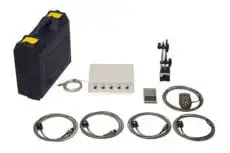
While blade resonance is principally a structural and aerodynamic problem, the mechanical excitation that can trigger it is largely controllable in the field. Rotor unbalance feeds a 1× force into the blades at every revolution, so keeping the rotor well balanced removes one of the more avoidable excitation paths — and lowers the synchronous load on the blade roots. A portable two-channel analyser such as the Conjunto de equilíbrio-1a lets a technician balance a fan or impeller in its own bearings at operating speed and record the casing vibration spectrum, where a sharp tone near a known blade frequency can flag a developing resonance for closer, specialised investigation. Reducing unbalance and desalinhamento will not, on its own, cure a true blade resonance — that needs a frequency shift or added damping — but it eliminates the mechanical forcing that so often tips a marginal design over the edge.
Blade resonance is a specialised vibration phenomenon that sits at the intersection of structural dynamics and fluid–structure interaction. Though potentially catastrophic, it can be prevented through proper design analysis, avoided through operating restrictions, or mitigated through structural modification — securing the safe, reliable operation of bladed machinery from HVAC fans to gas turbines.

