Compreendendo a velocidade de corrida (1X)



Velocidade de corrida é a frequência fundamental em análise de vibração that corresponds to the rotational speed of a machine’s shaft — the frequency at which the shaft completes one full revolution. In vibration terminology it is almost always written as 1X. It is the anchor point of nearly every diagnosis: once you know where 1X sits in the espectro, most other frequencies of interest can be read off as multiples (harmônicos) or fractions (sub-harmonics) of it.
1. Definição: O que é velocidade de corrida?
If a fan runs at 1800 revolutions per minute (RPM), its 1X running-speed frequency is 1800 CPM (cycles per minute), equivalent to 30 Hz (1800 ÷ 60). The conversion is simply Hz = RPM ÷ 60, and it is worth carrying both units in your head because spectra are sometimes scaled in CPM and sometimes in Hz.
The 1X frequency serves as the primary reference point in almost all diagnostic work. A measurement is rarely meaningful in isolation; it gains meaning once it is expressed relative to shaft speed. That is why locating 1X is the first thing an analyst does with any new spectrum.
2. Por que o 1X é tão importante?
The 1X frequency matters because many of the most common and most significant machine faults generate vibration at exactly this frequency. A high level at 1X is, on its own, a strong indicator that something is wrong — and the pattern of what surrounds it usually tells you what.
Falhas comuns que se manifestam no 1X incluem:
- Desequilíbrio: The most common cause of high 1X vibration. An uneven mass distribution creates a força centrífuga that rotates at shaft speed, producing a clean sinusoidal vibration at 1X. Pure unbalance shows little or no harmonic content.
- Desalinhamento: Often dominated by a strong 2X component, but angular and parallel misalignment can also raise 1X significantly.
- Eixo Curvo: Behaves mechanically like a form of unbalance, producing a high 1X peak (frequently with a strong axial component that helps distinguish it).
- Excentricidade: An eccentric pulley, gear or rotor core creates a 1X peak as its rotating high spot pushes against the system once per turn.
- Ressonância: If a structure’s frequência natural sits close to running speed, even a small forcing input — minor unbalance, say — is greatly amplified, producing extremely high vibration at 1X. This is why the relationship between 1X and any nearby velocidade crítica is so important.
Because so many causes overlap at 1X, the amplitude alone is not a diagnosis. The decisive step is to measure 1X fase as well, which separates unbalance from a bent shaft, soft foot, or resonance.
3. Harmônicos e subharmônicos da velocidade de corrida
Once 1X is identified, the rest of the spectrum can be interpreted in relation to it:
- Harmonics (2X, 3X, 4X, …): Integer multiples of running speed. They typically point to desalinhamento (a strong 2X), frouxidão mecânica (a long series of harmonics), and other non-linear effects. The forma of the harmonic family is often more diagnostic than 1X by itself.
- Sub-Harmonics (0.5X, 1/3X, …): Fractions of running speed, commonly associated with oil-film instability in mancais de deslizamento — classic redemoinho de óleo appears near 0.4–0.48X — or with looseness in a bearing housing. These fall into the broader category of sub-synchronous vibration.
Describing frequencies as multiples of a fundamental speed is the basis of Análise de pedidos. On variable-speed machines, tracking vibration by “orders” rather than fixed Hz is essential, because every speed-related peak moves with the shaft while structural resonances stay put — and that difference is exactly how you tell them apart. The Calculadora de frequência harmônica converts an RPM into its 1×–10× order frequencies for quick reference.
4. Como a velocidade de corrida é medida?
Running speed is determined in one of two ways:
- From the vibration spectrum: In most cases a clear peak corresponds to shaft rotation, and it is usually the first significant peak an analyst identifies. This works well when the machine runs at a steady, known speed.
- Usando um tacômetro: A tachometer gives a direct, unambiguous speed measurement by generating one pulse per revolution, which is fed into the analisador de vibração. This not only confirms the 1X frequency but also unlocks advanced techniques such as phase analysis and order analysis.
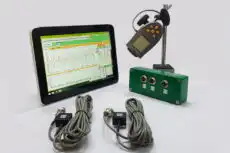
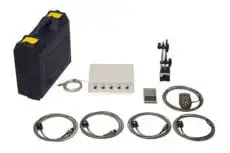
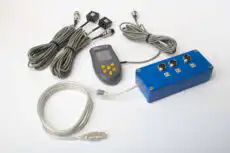
The tachometer route is what makes 1X actionable rather than merely observable. A portable two-channel instrument such as the Conjunto de equilíbrio-1a takes its speed pulse from an optical tachometer triggering on a strip of fita refletora, locks the vibration data to shaft angle, and reports the synchronous 1× amplitude and phase. That phase reference is precisely what turns a 1X unbalance peak into a defined heavy-spot angle — and therefore into a peso de correção of known size and location during balanceamento de campo.

