Diagnóstico de defeitos em engrenagens com análise de vibração


Gear defects are wear and damage modes — tooth wear, cracks, eccentricity, misalignment — that develop in the gearsets used for power transmission throughout industrial machinery. The meshing of gear teeth is an inherently noisy and vibrant process, so healthy gears produce a very clear and stable vibration signature; any deviation from that signature is a strong indicator of trouble. Because análise de vibração can detect these deviations at a very early stage, it catches gear faults long before they escalate into the catastrophic failure of a gearbox.
1. A assinatura vibratória das engrenagens
Every gearset has a characteristic fingerprint in the frequency domain, dominated by the rate at which teeth engage and surrounded by activity tied to each shaft’s rotation. A baseline measurement of a healthy gearbox is therefore one of the most valuable references a reliability programme can hold: faults are diagnosed not by an absolute number but by how today’s spectrum and forma de onda temporal differ from that known-good signature. The discipline of gear diagnosis is largely the discipline of reading that difference correctly, which is why gears feature so prominently in routine monitoramento de condição.
2. Frequência de malha de engrenagens (GMF)
A frequência mais importante na análise da caixa de engrenagens é a Frequência de malha de engrenagens (GMF) — the rate at which the teeth of two meshing gears engage with one another.
GMF = Número de dentes em uma engrenagem × Velocidade de rotação dessa engrenagem
In a healthy gearbox the Espectro FFT shows a clear peak at the GMF, usually with a few small harmônicos (2×GMF, 3×GMF). The amplitude of the GMF peak reflects the load on the gears, so a tall GMF peak on its own is not necessarily a fault — it may simply mean the gearbox is working hard. The real diagnostic information lives in the frequencies around the GMF peak, not in the peak itself. Because the GMF depends on both tooth count and speed, it is easy to mis-identify by hand; a Calculadora da frequência de engrenagem resolves the GMF and its sidebands for a given gearset in seconds.
3. Using Sidebands to Diagnose Faults
Bandas laterais are the single most powerful tool for diagnosing specific gear problems. They are small peaks that appear on either side of the GMF and its harmonics, produced when a fault modulates the meshing process. The crucial clue is their spacing: the gap between a sideband and the GMF peak equals the rotational speed of the shaft carrying the faulty gear, which immediately tells you que shaft to inspect.
- Worn or eccentric gear: a worn, eccentric or flawed gear modulates the GMF at its own rotational speed, creating sidebands spaced at the velocidade de corrida (1×) of that gear’s shaft. If the sidebands match the input-shaft speed, the fault is on the input gear.
- General tooth wear: desgaste da engrenagem typically raises the amplitude of the GMF and its harmonics, accompanied by 1× sidebands from the corresponding gear.
- Cracked or broken tooth: a single cracked or broken tooth generates a strong peak at the 1× running speed of that gear, often with many harmonics, plus sidebands around the GMF spaced at that gear’s speed. The time waveform is especially valuable here — it shows a distinct, periodic impact each time the damaged tooth tries to mesh.
- Desalinhamento das engrenagens: desalinhamento of the gears often produces a high 2×GMF harmonic, sometimes taller than the primary GMF peak, again accompanied by running-speed sidebands.
A related effect worth knowing is the hunting-tooth frequency, the very low rate at which a specific pair of teeth re-engages; faults that involve one bad tooth on each gear can excite it.
4. Specialised Analysis Techniques
Because gear vibration is so rich, standard spectrum analysis is frequently reinforced with techniques that isolate the gear signal:
- Time-waveform analysis: essential for confirming broken or cracked teeth, which appear as sharp, repeating impacts synchronised to the gear’s rotation rather than to the mesh.
- Análise de Cepstrum: a transform that condenses whole families of evenly spaced sidebands into single, easily read components, making sideband patterns visible when they are buried in a crowded FFT.
- Análise de envelope: demodulates the high-frequency carrier to expose the low-frequency impact rate of a localised tooth defect, complementing the sideband picture.
5. Estágios de falha de engrenagem
Vibration analysis can track the progression of a gear fault through four recognisable stages, giving maintenance teams the lead time to plan an intervention:
- Stage 1 (early): small sidebands appear around the GMF. The overall vibration level may not change at all.
- Stage 2 (moderate): the sideband amplitudes grow, and harmonics of the GMF begin to appear with sidebands of their own.
- Stage 3 (serious): the GMF and its harmonics carry many large sidebands, the 1× frequency of the problem gear starts to rise, and the noise floor of the spectrum lifts.
- Stage 4 (catastrophic): the GMF may vanish, replaced by a noisy, random vibration signature as the teeth are severely damaged or destroyed.
6. Putting It Into Practice in the Field
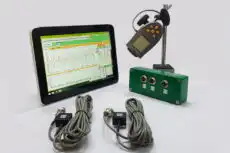
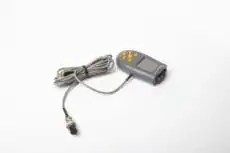
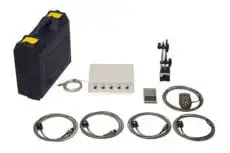
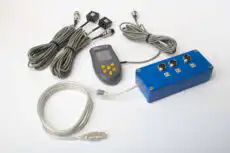
Diagnosing gears starts with a clean field measurement at operating speed and load. A portable two-channel instrument such as the Conjunto de equilíbrio-1a captures the FFT spectrum and the raw time waveform at each bearing, letting an engineer locate the GMF, read off the sideband spacing to pin the fault to a specific shaft, and watch the waveform for the tell-tale periodic impact of a broken tooth — all without opening the gearbox. Where a gearbox also drives or supports a rotor, the same instrument verifies that residual consequência and unbalance-related vibration stays within the limits of standards such as ISO 20816, so a confirmed gear fault is not masked by unrelated sources. Caught at Stage 1 or 2, a gear defect becomes a scheduled repair rather than an unplanned breakdown.

