Vacuum pumps balancing stand
High-Speed Rotor Balancing Stand para sa Vacuum Pump
Introduction
Balancing of high-speed rotors in vacuum pumps requires specialized equipment capable of maintaining accuracy under extreme operational conditions. To meet these requirements, dedicated balancing stands were developed in 2002 and 2009. These systems are designed for dynamic balancing of assembled turbine rotors at actual operational speeds ranging from 42,000 to 60,000 rpm, directly in their own bearing supports. The design objective was to achieve residual imbalance values in accordance with Class 1 accuracy as per GOST 22061-76, the Soviet balance quality standard (its modern international counterpart is ISO 21940-11, formerly ISO 1940-1).
Disenyo at Pagsasaayos ng Istraktura
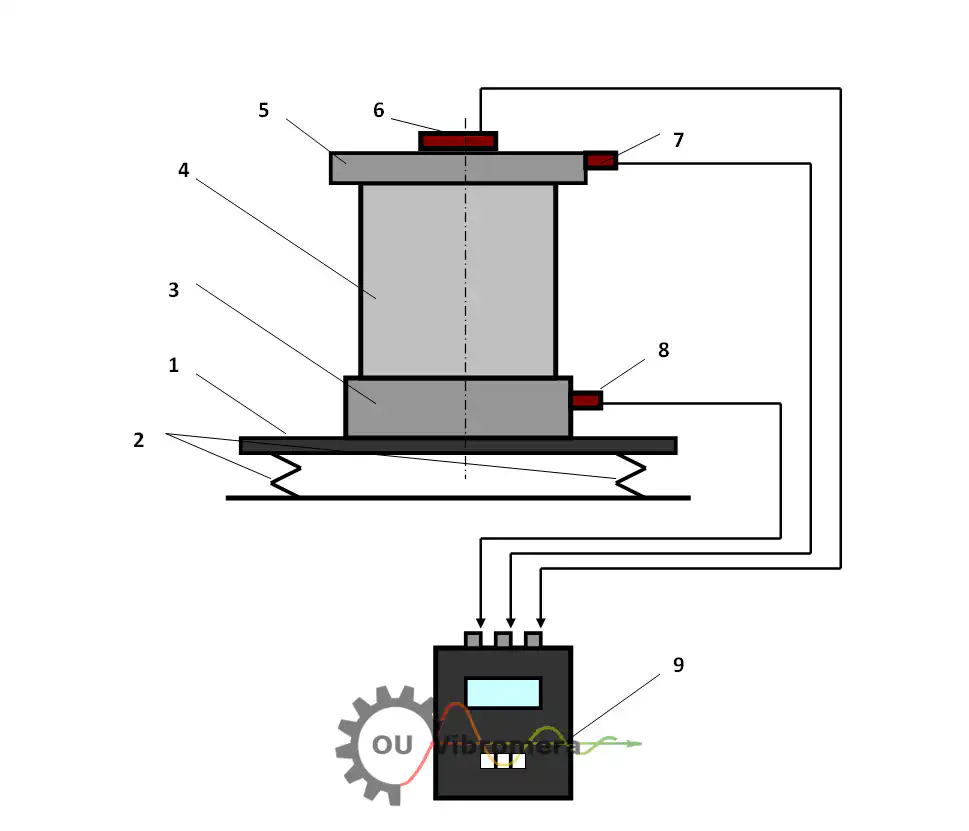
Ang Figure 1 ay nagpapakita ng schematic layout ng high-speed balancing stand na ginagamit para sa vacuum pump rotor.
Figure 1 – Structural layout ng high-speed vacuum pump balancing stand:
1 – Rigid platform
2 – Cylindrical vibration-isolating springs
3 – Cylindrical mounting base
4 – Balanced vacuum pump
5 – Protective cover
6 – Phase angle sensor
7 – Vibration sensor sa cover
8 – Vibration sensor sa base
9 – Measuring at computing unit
Ang stand ay itinayo sa rectangular platform (1), sinusuportahan ng apat na cylindrical spring (2), na nagbibigay ng vibration isolation. Ang platform ay pinalakas ng longitudinal at transverse stiffener, na nakakamit ng mataas na stiffness habang binabawasan ang timbang. Ang structural solution na ito ay nagsisiguro ng mataas na sensitivity sa imbalance force at pumipigil sa resonant oscillation sa buong speed range ng pump sa panahon ng balancing.
Ang mounting base (3) ay mahigpit na nakakabit sa platform at nagsisilbi upang posisyunan ang pump (4) nang tumpak. Ang pump ay nabalot ng dedicated cover (5), na tumatanggap din ng phase angle sensor (6). Dalawang vibration sensor (7 at 8) ay nakalunsad sa cover at base, ayon sa pagkakabanggit. Ang lahat ng sensor ay konektado sa measuring at computing unit (9), na nagsasagawa ng real-time analysis at kinakalkula ang corrective weight.
Proseso ng Pagpapantay
Ang balancing ay isinasagawa sa dalawang sequential stage upang masiguro ang precision sa ilalim ng parehong rigid at flexible rotor condition.
Stage 1 – Rigid Rotor Balancing
In the initial stage, the pump rotor is balanced at rotational speeds up to 8,000 rpm, where it behaves as a rigid body. The objective here is to compensate for both static and couple imbalances. In tests on this vibration-isolated stand, the system achieves residual vibration levels below 0.01 mm/s RMS in the 3,500–8,000 rpm frequency range. This ultra-low reading is a stand-test result obtained under controlled conditions, not a typical field-measurement figure.
Stage 2 – Mataas na Bilis na Flexible Rotor Balancing
Sa pangalawang yugto, ang pagbabalanse ay isinasagawa sa operational speed ng rotor—alinman sa 42,000 o 60,000 rpm, depende sa modelo ng pump. Sa bilis na ito, ang rotor ay pumasok sa isang flexible state at sumasailalim sa deformation, na nagreresulta sa karagdagang dynamic imbalance. Ang final correction ay kinakalkula at inilalapat upang mabawasan ang mga epektong ito. Ang residual vibration level pagkatapos ng high-speed balancing ay hindi lumalampas sa 0.3 mm/s RMS, na nagsisiguro ng long-term stable operation ng pump.
Performance Characteristics
-
Natitirang vibration (rigid stage): ≤ 0.01 mm/s (3,500–8,000 rpm, stand-test result)
-
Natitirang vibration (flexible stage): ≤ 0.3 mm/s (42,000–60,000 rpm)
-
Kabuuang cycle time para sa balancing: Typically under 30 minutes
Conclusion
Ang high-speed balancing stand para sa vacuum pump rotors ay pinagsasama ang structural rigidity, precision measurement, at advanced computation. Ito ay nagbibigay-daan sa accurate balancing sa ilalim ng real operational conditions, na kumukompensaiso para sa parehong static at dynamic imbalances. Ang solusyon ay sumusunod sa stringent vibration standards at malaking pinapahusay ang reliability at service life ng high-speed vacuum pump systems.

