Understanding Sensor Sensitivity

Sensitivity is the ratio of a sensor’s output signal to the input physical quantity it measures — in effect, its gain or conversion factor. For vibration sensors, sensitivity defines how much electrical output (a voltage or a charge) is produced per unit of vibration, whether that vibration is expressed as acceleration, velocity அல்லது displacement. A higher sensitivity gives a larger output for a given vibration level, which improves resolution and signal-to-noise ratio — but it also limits the maximum vibration that can be measured before the sensor output saturates. Sensitivity is the fundamental specification you must know to convert raw sensor voltage into meaningful engineering units. It is fixed during manufacturing calibration, recorded on the அளிப்பீட்டு சான்றிதழ், and used in every vibration calculation downstream.
One clarification at the outset: this article is about sensor sensitivity, the transducer’s output-per-input. It should not be confused with சமநிலை உணர்திறன், which describes how much a balancing machine’s reading changes per unit of rotor unbalance — a related idea but a different measurement.
1. Sensitivity Units by Sensor Type
Accelerometers
The accelerometer is the workhorse of vibration measurement, and its sensitivity is quoted differently depending on the signal-conditioning type.
- IEPE / voltage mode: expressed in mV/g (millivolts per g of acceleration); typical values 10–1000 mV/g, with 100 mV/g the most common general-purpose figure. High-sensitivity units of 500–1000 mV/g suit low-vibration work, while low-sensitivity units of 10–50 mV/g suit high-vibration and shock.
- Charge mode: expressed in pC/g (picocoulombs per g); typical values 1–1000 pC/g, with 10–50 pC/g common for general purpose.
Velocity sensors and displacement probes
- வேகத்தை அளவிடும் சென்சார்கள்: mV per in/s or mV per mm/s — typically 100 mV/in/s, equivalent to roughly 3.94 mV/mm/s; sometimes quoted as V per m/s (100 mV/in/s ≈ 3.94 V/(m/s)).
- Displacement probes: mV/mil or V/mm — typically 200 mV/mil or 7.87 V/mm for eddy-current probes, and always calibrated for a specific target material and gap range.
2. Sensitivity Trade-offs
The central tension in sensor selection is that sensitivity and measurement range pull in opposite directions.
High sensitivity (100–1000 mV/g)
- Advantages: a large output for low vibration, better resolution to detect small changes, a better signal-to-noise ratio, and ideal performance on low-vibration machinery.
- Disadvantages: a limited dynamic range that saturates at lower vibration (typical range ±5g to ±50g), making it unsuitable for high-vibration or shock work.
Low sensitivity (10–50 mV/g)
- Advantages: a wide dynamic range able to measure high vibration (±100g to ±10,000g), suitability for shock and impact, and no saturation in violent conditions.
- Disadvantages: a smaller output for low vibration, a poorer signal-to-noise ratio, reduced resolution, and the risk of missing small changes.
3. Selecting Sensitivity by Application
The practical rule is to match the sensor to the vibration level you expect, so that the signal comfortably fills the instrument’s input range without clipping.
- Low vibration (< 5 mm/s): high sensitivity (100–500 mV/g) for precision and low-speed machinery, where good resolution of small changes matters.
- Moderate vibration (5–20 mm/s): standard sensitivity (50–100 mV/g) for general industrial machinery — the most common range.
- High vibration (> 20 mm/s): low sensitivity (10–50 mV/g) to prevent saturation on crushers, mills and high-unbalance equipment.
- Shock and impact: very low sensitivity (1–10 mV/g) to reach ±1000g or more for impact and crash testing.
4. Effect on Measurements
Signal level, dynamic range and noise
- Signal level: higher sensitivity gives a larger signal voltage that better fills the instrument input range and improves resolution — but caps the maximum measurable vibration.
- Dynamic range: the span from the noise floor to saturation; high sensitivity gives a narrow range (good for small signals), low sensitivity a wide range (good for variable signals) — a direct trade-off between resolution and range.
- Noise performance: every sensor has an inherent electrical noise floor; higher sensitivity gives a better signal-to-noise ratio for low vibration, whereas that noise becomes proportionally more significant as sensitivity drops.
A worked check: a 100 mV/g sensor exposed to 50g of vibration produces 5 V of output. If the instrument’s input is ±5 V, that sensor is matched right up to its 50g ceiling — anything beyond clips.
5. Calibration and Verification
Sensitivity is only useful if it is accurate and current, which is why it is verified at three points in a sensor’s life.
- Factory calibration: new sensors are calibrated at the factory, with the sensitivity marked on the body or certificate to a tolerance of typically ±5–10%; verify it before any critical use.
- Periodic recalibration: sensitivity can drift over time, so recalibrate annually or to schedule, take the updated value from the new certificate, and enter it in the instrument or apply a correction.
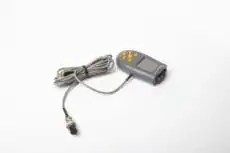
- Field verification: a handheld calibrator applies a known reference vibration so you can confirm the output matches the expected value (sensitivity × input) — a quick sanity check before important measurements.
This is distinct from permanent calibration in rotor balancing, where the term refers to a balancing machine’s stored, reusable calibration rather than a transducer’s gain.
6. Related Specifications
- Measurement range: the maximum vibration the sensor can capture, inversely related to sensitivity — a 100 mV/g sensor with a ±5 V output gives a ±50g range.
- Resolution: the smallest detectable change, limited by noise and digitisation; higher sensitivity generally means better resolution.
- Linearity: how constant the sensitivity stays across the measurement range — good sensors hold to < 1% deviation from linear, specified as a percentage of full-scale error.
7. Practical Considerations
Instrument input matching and mixed fleets
- Input matching: the instrument input range must accommodate the sensor output — a 100 mV/g sensor at 50g produces 5 V, which must fit a ±5 V input; adjustable input gains let one instrument handle different sensitivities.
- Multiple sensors: running sensors of different sensitivities in one programme means configuring the instrument for each one, and entering the wrong sensitivity is a common source of error — standardising on a single sensitivity simplifies operations considerably.
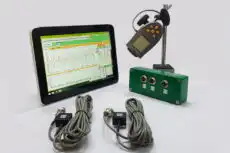
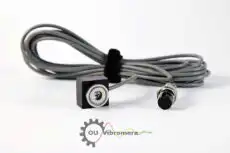
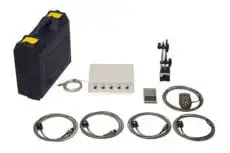
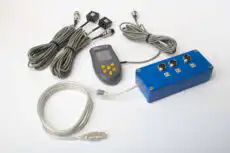
In a portable instrument the sensitivity figure is exactly what the software needs to turn the transducer’s millivolts into the amplitude-and-phase readings used for diagnostics and balancing. A field analyser such as the Balanset-1A is configured with the sensitivity of each supplied accelerometer so that its measurements read in true engineering units; entering the correct value is what guarantees a 1× reading in mm/s is trustworthy enough to compute a balancing correction. If the sensitivity entered does not match the sensor fitted, every subsequent number is wrong by the same ratio. You can sanity-check the expected output for a given sensor and vibration with our அதிர்வெண் உணரி உணர்வுத்தன்மை கணக்கீடு.
Sensor sensitivity is the fundamental specification that defines the conversion between physical vibration and electrical signal. Understanding the units, choosing a value to match the expected vibration level, and entering it correctly in the measuring instrument are essential for accurate measurements, sound sensor selection, and avoiding the errors that come from sensitivity mismatches or saturation.

