رولنگ عنصر بیرنگ میں سپلنگ کو سمجھنا






چھلکنا — also called spall, flaking, or pitting when small — is the localised flaking, chipping, or fracture of material from the surface of a bearing’s raceways or rolling elements caused by rolling contact fatigue. A spall appears as a crater or pit where a flake of hardened steel has broken away, leaving a rough, sharp-edged depression. Each time a ball or roller rolls over that crater it delivers a tiny mechanical impact, and those repeated impacts radiate کمپن at predictable بیئرنگ فالٹ فریکوئنسی — the signature that lets an analyst catch the fault long before the bearing seizes.
Spalling is the most common and, in a sense, the most normal bearing failure mode: it represents the natural end of a bearing’s fatigue life. It is distinct from پہننا (gradual, distributed material loss) and from corrosion-induced گڑھا. Crucially, spalling is detectable through کمپن تجزیہ months before the bearing fails outright, which makes it a cornerstone target of every پیشن گوئی کی دیکھ بھال پروگرام.
1. The Physical Mechanism of Spalling
Rolling contact fatigue
Spalling is not a sudden event but the visible climax of a long fatigue process:
- دورانیاتی بوجھ: every pass of a rolling element imposes a Hertzian contact stress on the raceway, typically 1000–3000 MPa, concentrated in a contact patch smaller than a grain of rice.
- Subsurface shear stress: the maximum alternating shear stress occurs not at the surface but slightly below it, usually 0.2–0.5 mm deep.
- Crack initiation: after millions — often billions — of stress cycles, a microscopic crack nucleates at a subsurface stress concentration, frequently at a non-metallic inclusion in the steel.
- Crack propagation: the crack grows parallel to the surface, then branches both toward the surface and deeper into the material.
- Material separation: the crack network eventually isolates a chunk of steel.
- Spall formation: that isolated material breaks free, leaving the characteristic crater.
Because the damage begins below the surface, a bearing can be within days of producing a visible spall while its raceways still look mirror-bright to the naked eye — which is precisely why subsurface fatigue is invisible to inspection but audible to a vibration sensor.
Typical spall characteristics
- سائز: initially 1–5 mm in diameter, growing to 10–20 mm or more.
- گہرائی: 0.2–2 mm into the hardened case.
- شکل: an irregular crater with a rough bottom and ragged edges.
- مقام: most often on the outer race within the load zone.
- ظاہری شکل: bright, sharp-edged and metallic at first, darkening as operation continues.
2. Causes and Contributing Factors
Normal fatigue life
- Every bearing has a finite fatigue life — the L10 life, the point by which 90% of a population is expected to survive.
- Spalling is the expected end-of-life mode; reaching it at or beyond the calculated L10 life is not a defect but a design success.
- Sound bearing selection ensures the L10 life comfortably exceeds the required service life. You can size that life against load and speed with our بیئرنگ L10 لائف کیلکولیٹر (ISO 281).
Premature spalling
When spalls appear well short of the L10 life, an external cause is almost always at work:
- اوورلوڈنگ: life falls with the cube of load (Life ∝ 1/Load³), so even modest overload slashes service life.
- Poor lubrication: an inadequate film lets asperities touch, raising surface stress.
- آلودگی: hard particles dent the raceway and create stress risers that seed cracks.
- غلط ترتیب: edge loading concentrates stress at one end of the contact.
- Incorrect installation: mounting damage initiates early failures.
- سنکنرن: surface pits act as ready-made crack initiation sites.
- Material defects: inclusions in the bearing steel.
A frequently overlooked accelerant is dynamic load from poor rotor balance: residual عدم توازن adds a rotating force to the static bearing load, and through that cubic relationship even a small increase in dynamic load can dramatically shorten fatigue life. Keeping rotors well balanced is therefore a genuine bearing-preservation measure, not merely a vibration-comfort one.
3. Vibration Detection by Severity Stage
The great value of spalling, diagnostically, is that it announces itself early and escalates in a recognisable sequence. Detection relies heavily on لفافے کا تجزیہ, which demodulates the high-frequency impact rings to reveal the underlying defect rate.
Early stage (micro-spall)
- Spall under 1–2 mm diameter.
- Small peaks at the bearing fault frequencies in the لفافہ سپیکٹرم.
- Often invisible in the standard ایف ایف ٹی سپیکٹرم.
- Envelope amplitude: roughly 0.5–2 g.
- Remaining life: typically 6–18 months.
Moderate stage
- Spall 2–10 mm diameter.
- Clear fault-frequency peaks in both the FFT and envelope spectra.
- Two to three ہارمونکس of the defect frequency visible.
- Onset of سائڈ بینڈ formation around the peaks.
- Amplitude: roughly 2–10 g.
- Remaining life: 2–6 months.
Advanced stage
- Spall larger than 10 mm, possibly several spalls.
- Very high-amplitude fault-frequency peaks.
- Numerous harmonics, four to eight or more.
- A complex sideband structure.
- An elevated noise floor.
- Amplitude: above 10 g.
- Remaining life: days to weeks.
Severe / critical stage
- Extensive spalling with multiple defects.
- Broadband noise begins to dominate the spectrum.
- Individual fault frequencies become obscured by that noise.
- Very high overall vibration, audible bearing noise and rising temperature.
- Failure is imminent — immediate replacement is required.
To turn this into action you must know the exact frequencies to look for. They depend on the bearing’s geometry and shaft speed, so compute them up front with the بیئرنگ ڈیفیکٹ فریکوئنسی کیلکولیٹر — the resulting بی پی ایف او, بی پی ایف آئی, بی ایس ایف and ایف ٹی ایف values tell you precisely where on the spectrum a spall on each component will show up.
4. Progression and Secondary Damage
Spall growth
Once a spall has formed it grows progressively, and the growth tends to be exponential rather than linear:
- Impact loading at the spall edges creates locally high stress.
- The adjacent material fatigues more rapidly than virgin raceway.
- The spall expands outward and deeper with every revolution.
- A small spall can become a large one within weeks once the process is self-feeding.
Secondary damage
Spalling also generates debris that triggers cascading damage:
- Debris generation: metal flakes from the spall circulate in the lubricant.
- Three-body abrasion: that debris acts like a lapping compound, scoring otherwise sound surfaces.
- Secondary spalls: embedded particles dent fresh raceway and nucleate new spalls elsewhere.
- Rapid deterioration: once several spalls coexist, failure accelerates sharply.
- Complete failure: the bearing ultimately loses all load-carrying capacity.
5. Response and Corrective Actions
Upon detection
- Confirm the diagnosis: verify the measured fault frequency matches the bearing’s geometry — not a coincidence or a ہارمونک of something else.
- Assess severity: place the fault on the stage scale above using amplitude and harmonic count.
- Increase monitoring: tighten the interval from monthly to weekly or daily as severity rises.
- Schedule replacement: plan the change-out for an appropriate shutdown window.
- Procure the bearing: order the correct model and verify its specifications before the outage.
Emergency indicators
Immediate shutdown is warranted if any of the following appear:
- Vibration amplitude doubling in less than a week.
- Bearing temperature rising rapidly — more than about 5 °C in a single shift.
- قابل سماعت پیسنا، چیخنا، یا بیئرنگ سے کھردرا پن
- Multiple bearing frequencies present at once, indicating multiple defects.
- Loss of lubricant or visible contamination.
6. Prevention Through Design and Maintenance
Design phase
- Select bearings with an adequate life rating (L10 comfortably greater than the required service life).
- Provide a proper lubrication system and effective sealing.
- Ensure adequate cooling for the operating conditions.
Installation phase
- Use clean installation practices and the correct mounting tools to avoid mounting damage.
- Verify the correct بیئرنگ کلیئرنس.
- Achieve precise سیدھ to avoid edge loading.
Operation phase
- Run a vibration monitoring programme that includes envelope analysis.
- Maintain a disciplined lubrication programme — correct intervals, quantities and grade.
- Monitor temperature.
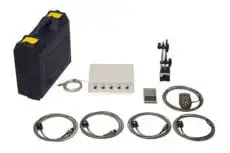
- Keep rotors well balanced to minimise the dynamic loads that shorten fatigue life. A portable two-channel analyser such as the بیلنسیٹ -1 اے lets a technician both trend a suspect bearing’s envelope spectrum and, when the root cause is rotor unbalance, correct it on-site in the machine’s own bearings — removing the very dynamic load that was driving the bearing toward early spalling.
Spalling is the inevitable end point of bearing fatigue, but it need not be a surprise. Through sound bearing selection, clean installation, disciplined lubrication and حالت کی نگرانی, service life is maximised and the failure is caught early enough to prevent secondary damage and convert an unplanned breakdown into a planned, low-cost replacement.

