पोल पास फ्रिक्वेन्सी समजून घेणे



पोल पास फ्रिक्वेन्सी (PPF) is the low-frequency vibration component generated in an AC induction motor as the rotating magnetic field slips past the rotor. It is calculated as the number of poles multiplied by the स्लिप वारंवारता: PPF = number of poles × (synchronous speed − actual speed) / 60. Because slip is small, PPF is a very low frequency — typically only a few hertz — and it usually shows up not as a stand-alone peak but as sidebands spaced at PPF around the running-speed and line-frequency components. That slip-related modulation is greatly amplified when the motor has air-gap eccentricity, broken rotor bars, or a rotor-to-stator alignment problem. Because of this, PPF is one of the most useful tools for separating विद्युत दोषांचा यांना पूर्णपणे यांत्रिक समस्यांपासून वेगळे ओळखण्यासाठी सर्वात उपयुक्त साधनांपैकी एक आहे.
PPF matters diagnostically because elevated sidebands spaced at this frequency point squarely at an electromagnetic problem — an eccentric rotor, broken rotor bars, a non-uniform air gap, or dynamic rotor–stator interaction — rather than at unbalance or misalignment. योग्य प्रकारे वाचल्यास, विश्लेषकाने मोटर उघडावी की ड्राइव्ह-ट्रेनमध्ये इतरत्र तपासावे हे ते सांगते.
1. Pole Pass Frequency ची गणना
मूलभूत सूत्र
- PPF = P × (Nसमकालिक − N) / 60
- जिथे P = ध्रुवांची संख्या,
- Nसमकालिक = synchronous speed in RPM (Nसमकालिक = 120 × line frequency / P),
- N = RPM मधील प्रत्यक्ष रोटर वेग,
- and the result is in Hz. The term (Nसमकालिक − N) / 60 is the slip frequency expressed in Hz.
Note that PPF is built on the difference between synchronous and actual speed — the स्लिप. At no load an induction motor runs almost at synchronous speed, so PPF approaches zero; as load grows, slip and therefore PPF grow with it, typically ending up in the range of roughly 0.5–3.5 Hz at rated load. Do not confuse PPF with the purely mechanical order P × running speed (for a 4-pole motor at 1750 RPM that is about 116.7 Hz) — that is a harmonic of shaft rotation, not pole pass frequency. When you need to convert running speed into a family of orders quickly, our हार्मोनिक वारंवारता कॅल्क्युलेटर 1×–10× orders मध्ये RPM चे Hz मध्ये रूपांतर करते, आणि मोटर विद्युत दोष वारंवारता कॅल्क्युलेटर विद्युतचुंबकीय वारंवारिता बाजूबाजूने मांडते.
कार्य केलेली उदाहरणे
1750 RPM (60 Hz supply) वरील 4-pole मोटर:
- Synchronous speed Nसमकालिक = 120 × 60 / 4 = 1800 RPM.
- Slip frequency = (1800 − 1750) / 60 = 0.83 Hz.
- PPF = 4 × (1800 − 1750) / 60 = 3.33 Hz
- In the vibration spectrum it appears as sidebands spaced ±3.33 Hz around the 1× running-speed peak (29.2 Hz) and around 2× line frequency (120 Hz) — a pattern diagnostic for eccentricity and broken rotor bars.
970 RPM (50 Hz supply) वरील 6-pole मोटर:
- Synchronous speed Nसमकालिक = 120 × 50 / 6 = 1000 RPM.
- Slip frequency = (1000 − 970) / 60 = 0.5 Hz.
- PPF = 6 × (1000 − 970) / 60 = 3.0 Hz
- Sidebands spaced only ±3.0 Hz around the 1× peak (16.2 Hz) or around 2× line frequency (100 Hz) are easy to miss.
- Resolving them demands careful, high-resolution वर्णक्रम विश्लेषण.
2. भौतिक यंत्रणा
विद्युतचुंबकीय बल कसे निर्माण होते
PPF निर्माण करणाऱ्या घटनांची साखळी सरळ आहे:
- स्टेटर वाइंडिंग्ज एक चुंबकीय क्षेत्र निर्माण करतात जे सिंक्रोनस गतीने फिरते.
- ते field N–S–N–S नमुन्यात चुंबकीय ध्रुवांमध्ये मांडलेले असते.
- The rotor runs slightly slower because of slip, so the field poles continuously drift past the rotor rather than staying locked to it.
- Each time a field pole slips past a given spot on the rotor (a high-resistance bar, an eccentric side of the air gap), the magnetic force acting on that spot is modulated.
- जर P poles, that spot is passed P times per slip cycle.
- The frequency of the resulting modulation is therefore P × slip frequency = PPF — a slow “beating” superimposed on the running-speed and line-frequency vibration.
समान air gap — एक निरोगी मोटर
- रोटर स्टेटरच्या bore मध्ये मध्यभागी असतो.
- air gap संपूर्ण परिघाभोवती एकसमान असतो.
- चुंबकीय बलं संतुलित असतात आणि एकमेकांना रद्द करतात.
- PPF-related modulation is consequently very low in amplitude.
विकेंद्रित air gap — दोषपूर्ण मोटर
- रोटर बेअरिंग घिसावट, एक वाकलेला शाफ्टमुळे किंवा उत्पादनातील त्रुटीमुळे मध्यापासून हटून बसतो.
- एका बाजूला air gap कमी आणि विरुद्ध बाजूला जास्त असतो.
- चुंबकीय बलं असंतुलित होतात — gap जिथे कमी असतो तिथे ती जास्त असतात.
- A net radial force appears — असंतुलित चुंबकीय खेच — and it is modulated at PPF as the field poles slip past the narrow side of the gap.
- Sidebands spaced at PPF develop around the main spectral peaks and grow with severity.
3. Sidebands आणि निदान नमुने
स्थिर विकेंद्रितपणा
येथे रोटरचे केंद्र सरकलेले असते पण स्टेटरच्या संदर्भात स्थिर असते:
- नमुना: an elevated 2× line frequency component (100/120 Hz); pole-pass sidebands are weak or absent because the offset does not rotate with the shaft.
- कारण: bearing wear, frame or end-bell distortion, or a machining error in the stator bore.
- आयाम: the 2× line frequency amplitude indicates the severity of the eccentricity.
गतिमान विकेंद्रितपणा
येथे रोटरचे केंद्र स्टेटरच्या केंद्राभोवती परिभ्रमण करते किंवा whirl होते:
- नमुना: 1× running speed and 2× line frequency peaks with sidebands spaced at PPF (e.g. ±3.33 Hz in the 4-pole example above).
- कारणे: a bent shaft, rotor विकेंद्रता, rotor-to-stator rub किंवा bearing सैलपणा.
- अधिक गंभीर: it signals an active dynamic interaction rather than a fixed offset. The same pole-pass sideband family around 1× and its harmonics is the classic signature of broken rotor bars.
मिश्र विकेंद्रितपणा
- स्थिर आणि गतिमान परिणामांचा संयोग.
- प्रत्यक्ष मोटरमध्ये हीच सर्वात सामान्य अवस्था आढळते.
- यामुळे गुंतागुंतीचे sideband नमुने तयार होतात.
- याचा योग्य अर्थ लावण्यासाठी काळजीपूर्वक विश्लेषण आवश्यक असते.
4. निदानात्मक अर्थ लावणे
Because PPF is only a few hertz, it is judged through the strength of its sidebands around the 1× running-speed and 2× line-frequency peaks, read as a continuum:
Low — pole-pass sidebands barely visible above the noise floor
- सामान्य स्थिती.
- एकसमान air gap आणि चांगली rotor–stator concentricity.
- दुरुस्तीची गरज नाही.
Moderate — sidebands clearly visible but far below the carrier peak
- Slight air-gap non-uniformity or early rotor-circuit degradation.
- trend पाहत राहा आणि bearing ची स्थिती तपासा.
- रोटरची स्थिती सहज तपासता येत असल्यास ती पडताळा.
- तातडीने गंभीर नाही, पण याकडे लक्ष देणे आवश्यक आहे.
High — sidebands approaching the carrier peak in amplitude
- Significant eccentricity, broken rotor bars, or an air-gap problem.
- A pronounced low-frequency “beat” may be felt or heard at PPF.
- rotor-to-stator contact चा धोका.
- वाढती विद्युतचुंबकीय बलं जी नुकसान वेगाने वाढवतात.
- दुरुस्ती किंवा बदलाची योजना करा.
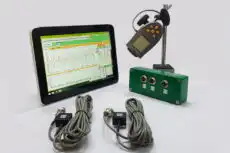
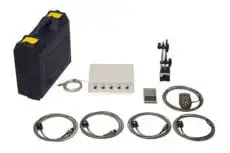
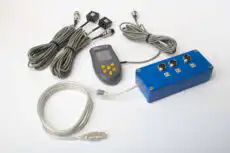
प्रत्यक्षात विश्लेषक क्वचितच PPF ला एकट्याने तपासतो. bearing housing वर वापरला जाणारा Balanset-1A, used at the bearing housings, captures the spectrum and resolves the pole-pass sidebands around the 1× and line-frequency peaks — and, just as importantly, confirms whether the dominant component is electromagnetic or the simple 1× peak of a mechanical fault. That distinction decides everything that follows: an electromagnetic signature sends you inside the motor, while a clean 1× peak that disappears the instant power is cut points to unbalance ज्याला तुम्ही क्षेत्र संतुलन रोटर जागेवरच संतुलित करून दुरुस्त करू शकता.
5. इतर मोटर वारंवारितांशी संबंध
PPF हा गर्दीच्या motor spectrum मधील एक tone आहे, आणि तो शेजारच्या घटकांच्या तुलनेत कुठे बसतो हे ओळखणे म्हणजे निम्मी लढाई जिंकणे. 60 Hz supply वरील 4-pole, 1750 RPM मोटरसाठी एक सर्वसाधारण श्रेणी अशी आहे:
- Slip frequency: (1800 − 1750) / 60 ≈ 0.83 Hz.
- PPF: P × slip frequency — about 3.3 Hz here, the lowest tone in the family.
- चालू वेग (1×): about 29.2 Hz.
- Line frequency: 60 Hz (or 50 Hz in Europe).
- Rotor mechanical order P × running speed: about 117 Hz — often mistaken for PPF, but it is a shaft-speed harmonic.
- 2× लाईन वारंवारता: 120 Hz (or 100 Hz) — the key electromagnetic component for eccentricity.
- Rotor bar pass frequency: number of rotor bars × running speed, up in the kilohertz range.
The close spacing of 2× line frequency (120 Hz) and the nearby harmonics of running speed (the 4th order sits at about 117 Hz here) is exactly why electromagnetic faults are so easily confused with mechanical ones — and why the fine pole-pass sideband structure, not amplitude alone, is the deciding clue. Where the picture remains ambiguous, switching off the supply is the definitive test: an electromagnetic component vanishes instantly with the field, whereas a mechanical one decays only as the rotor coasts down.
6. दुरुस्तीच्या पद्धती
यांत्रिक विकेंद्रितपणासाठी
- योग्य rotor centring पुनर्स्थापित करण्यासाठी झिजलेले bearings बदला.
- वाकलेला shaft दुरुस्त करा किंवा rotor बदला.
- दोष स्थापनेतील चूक असल्यास rotor पुन्हा बसवा.
- end-bell alignment आणि bolt tightness पडताळा.
निर्मितीतील eccentricity साठी
- गंभीर परिस्थितीत rotor किंवा stator चे reboring करावे लागू शकते.
- आर्थिकदृष्ट्या योग्य असल्यास मोटर बदला.
- कंपन स्वीकार्य मर्यादेत राहिल्यास ही स्थिती मान्य करा.
- भविष्यातील तुलनेसाठी याची baseline म्हणून नोंद करा.
air-gap समस्यांसाठी
- bearing ची स्थिती तपासा आणि झीज असल्यास बदला.
- rotor ची axial position तपासा.
- frame distortion किंवा end-bell समस्यांची तपासणी करा.
- जिथे शक्य आहे तिथे प्रत्यक्ष air gap मोजा.
Pole pass frequency is, in summary, a slip-related, motor-specific low-frequency component that opens a window onto rotor–stator electromagnetic interaction and air-gap uniformity. Mastering its calculation, recognising its sideband signatures, and reading their amplitude trends lets an engineer diagnose electromagnetic faults with confidence — and direct maintenance effort to the right place instead of chasing a mechanical cause that was never there.

