Kuelewa Pole Pass Frequency





Pole pass frequency (PPF) is the low-frequency vibration component generated in an AC induction motor as the rotating magnetic field slips past the rotor. It is calculated as the number of poles multiplied by the slip frequency: PPF = number of poles × (synchronous speed − actual speed) / 60. Because slip is small, PPF is a very low frequency — typically only a few hertz — and it usually shows up not as a stand-alone peak but as sidebands spaced at PPF around the running-speed and line-frequency components. That slip-related modulation is greatly amplified when the motor has air-gap eccentricity, broken rotor bars, or a rotor-to-stator alignment problem. Because of this, PPF is one of the most useful tools for separating hitilafu za umeme kutoka kwa zile halisi za mitambo.
PPF matters diagnostically because elevated sidebands spaced at this frequency point squarely at an electromagnetic problem — an eccentric rotor, broken rotor bars, a non-uniform air gap, or dynamic rotor–stator interaction — rather than at unbalance or misalignment. Ikiwa kusoma kwa kaida, inagambia mchambuzi ikiwa anafungua motor au anatazama mahali pengine kwenye treni.
1. Kuhesabu Pole Pass Frequency
Fomula ya msingi
- PPF = P × (Nsync − N) / 60
- where P = idadi ya poles,
- Nsync = synchronous speed in RPM (Nsync = 120 × line frequency / P),
- N = kasi halisi ya rotor katika RPM,
- and the result is in Hz. The term (Nsync − N) / 60 is the slip frequency expressed in Hz.
Note that PPF is built on the difference between synchronous and actual speed — the slip. At no load an induction motor runs almost at synchronous speed, so PPF approaches zero; as load grows, slip and therefore PPF grow with it, typically ending up in the range of roughly 0.5–3.5 Hz at rated load. Do not confuse PPF with the purely mechanical order P × running speed (for a 4-pole motor at 1750 RPM that is about 116.7 Hz) — that is a harmonic of shaft rotation, not pole pass frequency. When you need to convert running speed into a family of orders quickly, our Kihesabu cha Mzunguko wa Harmoniki turns RPM into Hz across the 1×–10× orders, and the Motor Electrical Defect Frequency Calculator inaonyesha frequencies za umeme karibu.
Mifano iliyotumika
Motoo ya 4-pole katika 1750 RPM (usambazaji wa 60 Hz):
- Synchronous speed Nsync = 120 × 60 / 4 = 1800 RPM.
- Slip frequency = (1800 − 1750) / 60 = 0.83 Hz.
- PPF = 4 × (1800 − 1750) / 60 = 3.33 Hz
- In the vibration spectrum it appears as sidebands spaced ±3.33 Hz around the 1× running-speed peak (29.2 Hz) and around 2× line frequency (120 Hz) — a pattern diagnostic for eccentricity and broken rotor bars.
Motri ya pole 6 kwa 970 RPM (usambazaji wa 50 Hz):
- Synchronous speed Nsync = 120 × 50 / 6 = 1000 RPM.
- Slip frequency = (1000 − 970) / 60 = 0.5 Hz.
- PPF = 6 × (1000 − 970) / 60 = 3.0 Hz
- Sidebands spaced only ±3.0 Hz around the 1× peak (16.2 Hz) or around 2× line frequency (100 Hz) are easy to miss.
- Resolving them demands careful, high-resolution uchambuzi wa mawimbi.
2. Utendaji wa Kimwili
Jinsi nguvu ya umeme inavyozaliwa
Mlolongo wa matukio ambayo huzalisha PPF ni rahisi:
- Windings za stator huzalisha uwanja wa magnetic unao zunguka kwa kasi ya synchronous.
- Uwanja huo unakuwa sehemu katika poles ya magnetic katika muundo wa N–S–N–S.
- The rotor runs slightly slower because of slip, so the field poles continuously drift past the rotor rather than staying locked to it.
- Each time a field pole slips past a given spot on the rotor (a high-resistance bar, an eccentric side of the air gap), the magnetic force acting on that spot is modulated.
- With P poles, that spot is passed P times per slip cycle.
- The frequency of the resulting modulation is therefore P × slip frequency = PPF — a slow “beating” superimposed on the running-speed and line-frequency vibration.
Pengo la hewa la kwa kutosha — motri ya kawaida
- Rotor iko katikati ya bure la stator.
- Pengo la hewa ni sawa kuzunguka kwa mzunguko kamili.
- Nguvu za magnetic zimebadilishwa na kurudia kila mmoja.
- PPF-related modulation is consequently very low in amplitude.
Pengo la hewa lisilo sawa — motri yenye kasoro
- Rotor inakaa mbali na katikati kutoka bearing wear, a bent shaft, au kosa la uzalishaji.
- Pengo la hewa ni ndogo upande mmoja na kubwa upande wa kinyume.
- Nguvu za sumaku zinakuwa na usawa — nguvu kubwa pale pengo linavyokuwa ndogo.
- A net radial force appears — mvutano wa sumaku usio na usawa — and it is modulated at PPF as the field poles slip past the narrow side of the gap.
- Sidebands spaced at PPF develop around the main spectral peaks and grow with severity.
3. Sidebands na Mifumo ya Tanisisi
Usawa wa tuli
Hapa kituo cha rotor kipo kwa mbali lakini tuli jamaa na stator:
- Pattern: an elevated 2× line frequency component (100/120 Hz); pole-pass sidebands are weak or absent because the offset does not rotate with the shaft.
- Cause: bearing wear, frame or end-bell distortion, or a machining error in the stator bore.
- Amplitude: the 2× line frequency amplitude indicates the severity of the eccentricity.
Usawa wa kinamic
Hapa kituo cha rotor kinazunguka, au kugeuka, kuzunguka kituo cha stator:
- Pattern: 1× running speed and 2× line frequency peaks with sidebands spaced at PPF (e.g. ±3.33 Hz in the 4-pole example above).
- Causes: a bent shaft, rotor eccentricity, rotor-to-stator rub or bearing looseness.
- More severe: it signals an active dynamic interaction rather than a fixed offset. The same pole-pass sideband family around 1× and its harmonics is the classic signature of broken rotor bars.
Usawa wa mchanganyiko
- Mchanganyiko wa athari za tuli na kinamic.
- Hii ndio hali ya kawaida inayopatikana katika motors halisi.
- Inatoa mifumo changamano ya sideband.
- Uchambuzi makini unahitajika ili kuiinterpretia kwa usahihi.
4. Tafsiri ya Uchunguzi
Because PPF is only a few hertz, it is judged through the strength of its sidebands around the 1× running-speed and 2× line-frequency peaks, read as a continuum:
Low — pole-pass sidebands barely visible above the noise floor
- Hali ya kawaida.
- Pengo la hewa sare na concentricity nzuri ya rotor–stator.
- Hakuna hatua ya kurekebisha inayohitajika.
Moderate — sidebands clearly visible but far below the carrier peak
- Slight air-gap non-uniformity or early rotor-circuit degradation.
- Fanya mwendo wa kufuatilia na angalia hali ya kuzaa.
- Thibitisha nafasi ya rotor ikiwa inaweza kufikiwa.
- Sio muhimu mara moja, lakini inahitaji tahadhari.
High — sidebands approaching the carrier peak in amplitude
- Significant eccentricity, broken rotor bars, or an air-gap problem.
- A pronounced low-frequency “beat” may be felt or heard at PPF.
- Hatari ya kuwasiliana kwa rotor-to-stator.
- Nguvu za umeme zinazokua zinazoacheleza uharibifu.
- Panga ukamataji au kubadilisha.
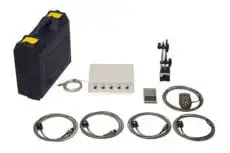
Katika mazoezi, mchambuzi anakamatia PPF mara chache peke yake. Analyser ya kubebwa ya chaneli mbili kama vile Balancet-1A, used at the bearing housings, captures the spectrum and resolves the pole-pass sidebands around the 1× and line-frequency peaks — and, just as importantly, confirms whether the dominant component is electromagnetic or the simple 1× peak of a mechanical fault. That distinction decides everything that follows: an electromagnetic signature sends you inside the motor, while a clean 1× peak that disappears the instant power is cut points to unbalance unaweza kusahihisha kwa field balancing rotor inayofanya kazi vizuri.
5. Uhusiano na Masafa Mengine ya Kinyumba
PPF ni saba moja katika sauti nyingi za kinyumba, na kutambua mahali inapokaa kwa heshima na jirani zake ni nusu ya mapigania. Muundo wa kawaida kwa kinyumba cha polisi 4, 1750 RPM kwenye usambazaji wa 60 Hz ni:
- Msaba wa kuteleza: (1800 − 1750) / 60 ≈ 0.83 Hz.
- PPF: P × slip frequency — about 3.3 Hz here, the lowest tone in the family.
- Running speed (1×): about 29.2 Hz.
- Line frequency: 60 Hz (or 50 Hz in Europe).
- Rotor mechanical order P × running speed: about 117 Hz — often mistaken for PPF, but it is a shaft-speed harmonic.
- 2× msaba wa mstari: 120 Hz (or 100 Hz) — the key electromagnetic component for eccentricity.
- Msaba wa upakaji wa rotor: number of rotor bars × running speed, up in the kilohertz range.
The close spacing of 2× line frequency (120 Hz) and the nearby harmonics of running speed (the 4th order sits at about 117 Hz here) is exactly why electromagnetic faults are so easily confused with mechanical ones — and why the fine pole-pass sideband structure, not amplitude alone, is the deciding clue. Where the picture remains ambiguous, switching off the supply is the definitive test: an electromagnetic component vanishes instantly with the field, whereas a mechanical one decays only as the rotor coasts down.
6. Njia za Marekebisho
Kwa kubadilika kwa mitambo
- Badilisha njia mlipukaji iliyochakaa ili kurudisha kuzunguka kwa rotor vizuri.
- Sahihisha shimoni iliyonyanyuka au badilisha rotor.
- Tengeza upya rotor ikiwa hitilafu ni kosa la kuakisi.
- Thibitisha umiliki wa ncha-kengele na upigaji wa bolt.
Kwa kubadilika kwa utengenezaji
- Vitendo vilivyosumbuwa mara nyingi vinaweza kuhitaji kurudisha kuborea rotor au stator.
- Badilisha kinyumba ambapo hiyo ina heshima ya kiuchumi.
- Kukubali hali hiyo ikiwa mitambo inabaki ndani ya mipango inakamatia.
- Dokeza kama kiwango cha kulinganisha katika siku zijazo.
Kwa ajili ya matatizo ya pengo la hewa
- Angalia hali ya chombo na ubadilishe ikiwa kimezaa.
- Hakiki msomeko wa rotor katika mwelekeo wa axial.
- Chagua sura ya pembetatu au matatizo ya kengele ya mwisho.
- Pima pengo la hewa halisi mahali ambapo linaweza kufikia.
Pole pass frequency is, in summary, a slip-related, motor-specific low-frequency component that opens a window onto rotor–stator electromagnetic interaction and air-gap uniformity. Mastering its calculation, recognising its sideband signatures, and reading their amplitude trends lets an engineer diagnose electromagnetic faults with confidence — and direct maintenance effort to the right place instead of chasing a mechanical cause that was never there.

