Полюс өту жиілігін түсіну





Полюс өтпелі жиілігі (PPF) is the low-frequency vibration component generated in an AC induction motor as the rotating magnetic field slips past the rotor. It is calculated as the number of poles multiplied by the slip frequency: PPF = number of poles × (synchronous speed − actual speed) / 60. Because slip is small, PPF is a very low frequency — typically only a few hertz — and it usually shows up not as a stand-alone peak but as sidebands spaced at PPF around the running-speed and line-frequency components. That slip-related modulation is greatly amplified when the motor has air-gap eccentricity, broken rotor bars, or a rotor-to-stator alignment problem. Because of this, PPF is one of the most useful tools for separating электрлік ақаулықтарын таза механикалық ақаулықтарынан ажыратудың ең пайдалы құралдарының бірі.
PPF matters diagnostically because elevated sidebands spaced at this frequency point squarely at an electromagnetic problem — an eccentric rotor, broken rotor bars, a non-uniform air gap, or dynamic rotor–stator interaction — rather than at unbalance or misalignment. Дәл оқылса, ол аналитикке мотордың құрылымын ашу керек пе, немесе пойыздың басқа бөлігін қарау керек пе екенін айтады.
1. Полюс Өту Жиілігін Есептеу
Негіздеме формула
- PPF = P × (Nsync − N) / 60
- where P = полюстердің саны,
- Nsync = synchronous speed in RPM (Nsync = 120 × line frequency / P),
- N = роторының нақты айналу жылдамдығы RPM-де,
- and the result is in Hz. The term (Nsync − N) / 60 is the slip frequency expressed in Hz.
Note that PPF is built on the difference between synchronous and actual speed — the slip. At no load an induction motor runs almost at synchronous speed, so PPF approaches zero; as load grows, slip and therefore PPF grow with it, typically ending up in the range of roughly 0.5–3.5 Hz at rated load. Do not confuse PPF with the purely mechanical order P × running speed (for a 4-pole motor at 1750 RPM that is about 116.7 Hz) — that is a harmonic of shaft rotation, not pole pass frequency. When you need to convert running speed into a family of orders quickly, our Гармоникалық Жиілік Калькулятор turns RPM into Hz across the 1×–10× orders, and the Motor Electrical Defect Frequency Calculator электромагниттік жиілік компоненттерін қатар орналастырады.
Орындалған мысалдар
4 полюстік мотор 1750 RPM-де (60 Hz қоректену):
- Synchronous speed Nsync = 120 × 60 / 4 = 1800 RPM.
- Slip frequency = (1800 − 1750) / 60 = 0.83 Hz.
- PPF = 4 × (1800 − 1750) / 60 = 3.33 Hz
- In the vibration spectrum it appears as sidebands spaced ±3.33 Hz around the 1× running-speed peak (29.2 Hz) and around 2× line frequency (120 Hz) — a pattern diagnostic for eccentricity and broken rotor bars.
6 полюстік мотор 970 RPM-де (50 Hz қоректену):
- Synchronous speed Nsync = 120 × 50 / 6 = 1000 RPM.
- Slip frequency = (1000 − 970) / 60 = 0.5 Hz.
- PPF = 6 × (1000 − 970) / 60 = 3.0 Hz
- Sidebands spaced only ±3.0 Hz around the 1× peak (16.2 Hz) or around 2× line frequency (100 Hz) are easy to miss.
- Resolving them demands careful, high-resolution спектрлік талдау.
2. Физикалық Механизм
Электромагниттік күш қалай өндіріледі
PPF құратын оқиғалар тізбегі тура:
- Статор орамы синхронды жылдамдықта айналатын магниттік өрісті құрайды.
- Бұл өрісі N–S–N–S ығысында магниттік полюстерге ұйымдастырылған.
- The rotor runs slightly slower because of slip, so the field poles continuously drift past the rotor rather than staying locked to it.
- Each time a field pole slips past a given spot on the rotor (a high-resistance bar, an eccentric side of the air gap), the magnetic force acting on that spot is modulated.
- With P poles, that spot is passed P times per slip cycle.
- The frequency of the resulting modulation is therefore P × slip frequency = PPF — a slow “beating” superimposed on the running-speed and line-frequency vibration.
Біркелкі ауа сорығы — сау қозғалтқыш
- Ротор статор сорағының ортасында орталасқан.
- Ауа сорығы барлық айналасында біркелкі.
- Магниттік күштер теңестірілген және бір-біріне қарсы әрекет етеді.
- PPF-related modulation is consequently very low in amplitude.
Эксцентрік ауа сорығы — ақаулы қозғалтқыш
- Ротор орталасудан ауытқып отыр bearing wear, a bent shaftнемесе өндіріс қатесі.
- Ауа сорығы бір жағында кіші, ауласында ұлғаю.
- Магниттік күштер теңеспелі болады — сорығы кіші жерде күшті.
- A net radial force appears — дисбалансты магниттік төзу — and it is modulated at PPF as the field poles slip past the narrow side of the gap.
- Sidebands spaced at PPF develop around the main spectral peaks and grow with severity.
3. Қабырғалар және диагностика бөлгілері
Статик эксцентриситеті
Мұнда ротордың орталығы ығысқан, бірақ статорға қатысты бағытталған:
- Pattern: an elevated 2× line frequency component (100/120 Hz); pole-pass sidebands are weak or absent because the offset does not rotate with the shaft.
- Cause: bearing wear, frame or end-bell distortion, or a machining error in the stator bore.
- Amplitude: the 2× line frequency amplitude indicates the severity of the eccentricity.
Динамикалық эксцентрисоліктік
Мұнда ротордың орталығы статор орталығының айналасында айналады немесе айналып өтеді:
- Pattern: 1× running speed and 2× line frequency peaks with sidebands spaced at PPF (e.g. ±3.33 Hz in the 4-pole example above).
- Causes: a bent shaft, rotor eccentricity, rotor-to-stator rub or bearing looseness.
- More severe: it signals an active dynamic interaction rather than a fixed offset. The same pole-pass sideband family around 1× and its harmonics is the classic signature of broken rotor bars.
Аралас эксцентрисоліктік
- Статикалық және динамикалық әсерлердің комбинациясы.
- Бұл нақты моторларда кеңінен табылатын ең қалыпты күй.
- Ол сайб полосасының күрделі ызындарын өндіреді.
- Оны дұрыс түсіндіру үшін мүмкін талдау қажет.
4. Диагностикалық түсіндіру
Because PPF is only a few hertz, it is judged through the strength of its sidebands around the 1× running-speed and 2× line-frequency peaks, read as a continuum:
Low — pole-pass sidebands barely visible above the noise floor
- Қалыпты күй.
- Біркелкі ауа майысты және жақсы ротор–статор концентрлігі.
- Түзету іс-әрекеті қажет емес.
Moderate — sidebands clearly visible but far below the carrier peak
- Slight air-gap non-uniformity or early rotor-circuit degradation.
- Тенденцияны мониторингтеу және подшипник жағдайын тексеріңіз.
- Ротордың орны қол жетімді болса, оны тексеріңіз.
- Бірден сын-қатер емес, бірақ назар аударған жөн.
High — sidebands approaching the carrier peak in amplitude
- Significant eccentricity, broken rotor bars, or an air-gap problem.
- A pronounced low-frequency “beat” may be felt or heard at PPF.
- Ротордың статорға тиген тәуекелі.
- Құрылымдық бұзылуын тезейтетін электромагниттік күштерінің өсуі.
- Ремонт немесе алмастыруды жоспарлаңыз.
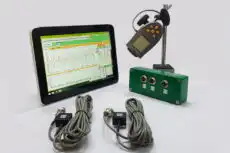
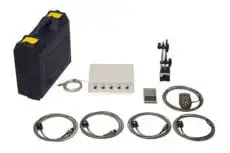
Тәжірибе жүзінде аналитик PPF-ті жеке бөлек де ұқсамайды. Ішінде екі арнайы портативтік анализатор сияқты Балансет-1А, used at the bearing housings, captures the spectrum and resolves the pole-pass sidebands around the 1× and line-frequency peaks — and, just as importantly, confirms whether the dominant component is electromagnetic or the simple 1× peak of a mechanical fault. That distinction decides everything that follows: an electromagnetic signature sends you inside the motor, while a clean 1× peak that disappears the instant power is cut points to unbalance сіз түзе аласыз field balancing ротор өндігінде.
5. Басқа Мотор Жиілік ережесіне Қатынасы
PPF – сөндік мотор спектрінің бір тоны ұзын, және оның қайда тұрғанын тарап көлемі рәс-тай – соңы істі. 60 Гц электр қуатында 4-полюсті, 1750 RPM мотордың типтік құрылымы:
- Ығысу жиілігі: (1800 − 1750) / 60 ≈ 0.83 Hz.
- PPF: P × slip frequency — about 3.3 Hz here, the lowest tone in the family.
- Running speed (1×): about 29.2 Hz.
- Line frequency: 60 Hz (or 50 Hz in Europe).
- Rotor mechanical order P × running speed: about 117 Hz — often mistaken for PPF, but it is a shaft-speed harmonic.
- 2× сызық жиілігі: 120 Hz (or 100 Hz) — the key electromagnetic component for eccentricity.
- Ротор штангасының өту жиілігі: number of rotor bars × running speed, up in the kilohertz range.
The close spacing of 2× line frequency (120 Hz) and the nearby harmonics of running speed (the 4th order sits at about 117 Hz here) is exactly why electromagnetic faults are so easily confused with mechanical ones — and why the fine pole-pass sideband structure, not amplitude alone, is the deciding clue. Where the picture remains ambiguous, switching off the supply is the definitive test: an electromagnetic component vanishes instantly with the field, whereas a mechanical one decays only as the rotor coasts down.
6. Түзету әдістері
Механикалық эксцентриситет үшін
- Өлінген құрамдасты ауыстырып, роторының дұрыс орталасуын қалпына келтіріңіз.
- Иілген валды түзетіңіз немесе роторды ауыстырыңыз.
- Орнату қатесі болса, роторды қайта орнатыңыз.
- Соңы қоршауының реттеуін және болттарының бекіліліктесін тексеріңіз.
Өндіру эксцентриситеті үшін
- Ауырлай жатқан жағдайлар роторды немесе статордың қайта өңделуін қажет етуі мүмкін.
- Экономикалық тұрғыдан ынамдалса, электр қозғалтқышты ауыстырыңыз.
- Вибрация қабылданған шегінде қалса, осындай жағдайды қабылдаңыз.
- Келешектегі салыстыру үшін іске асыруды ресімдеңіз.
Аэрозалы мәселелер үшін
- Подшипник қалыптасуын тексеріңіз және өлінген болса ауыстырыңыз.
- Роторының осьті орны әділеу бар екенін тексеріңіз.
- Каркастың бұзылуы немесе соңы қоршауының мәселелерін шолыңыз.
- Іс жүргіседі аймақында нақты аэрозалды өлшеңіз.
Pole pass frequency is, in summary, a slip-related, motor-specific low-frequency component that opens a window onto rotor–stator electromagnetic interaction and air-gap uniformity. Mastering its calculation, recognising its sideband signatures, and reading their amplitude trends lets an engineer diagnose electromagnetic faults with confidence — and direct maintenance effort to the right place instead of chasing a mechanical cause that was never there.

