ISO 14694 — Balance Quality & Vibration for Industrial Fans
The dedicated standard for industrial fan impeller balancing (BV categories) and operational vibration acceptance limits (vibration limits) — tailoring ISO 1940 and ISO 10816 specifically to centrifugal, axial, and mixed-flow fans.



Fan Impeller Balance Tolerance (BV)
Calculate permissible residual unbalance per ISO 14694 BV category
Results — ISO 14694
Impeller balance tolerance and per-plane values
to see balancing tolerance
BV Categories — Impeller Balance Quality
ISO 14694 maps fan applications to ISO 1940 G-grades through five BV (Balance Vibration) categories
| BV category | Balance grade | दिशा | Practical meaning |
|---|---|---|---|
| BV-1 | G 16 | Least demanding | Loosest balance tolerance |
| BV-2 | G 16 | Basic/general | Same balance grade as BV-1; selected by application context |
| BV-3 | G 6.3 | Standard industrial | Common contractual default for industrial fans |
| BV-4 | G 2.5 | High quality | Stricter balance tolerance |
| BV-5 | G 1.0 | Most stringent | Precision fan applications; tightest balance tolerance |
| Topic | Correct interpretation | Use on site |
|---|---|---|
| Category direction | BV-1 is least demanding; BV-5 is most stringent | Do not describe BV-1 as precision or BV-5 as non-critical |
| Balance calculation | Use the G value from the BV mapping above | Calculate at maximum service speed, not balancing-machine speed |
| Vibration acceptance | ISO 14694 limits depend on BV category, rigid/flexible support and factory vs in-situ test | State the BV category and acceptance condition in the purchase specification |
What is ISO 14694?
ISO 14694 (Industrial fans — Specifications for balance quality and vibration levels) is the standard that tailors ISO 1940 G-grades and ISO 10816 vibration zones specifically for industrial fans. It defines BV fan-application categories (BV-1 to BV-5). These categories are used for both balance-grade selection and vibration-limit selection. The standard default is BV-3 (G 6.3) for balance and specified limit (≤ 4.5 mm/s RMS) for vibration acceptance.
Fans are the most common rotating machine in industry, yet they have unique characteristics — large-diameter impellers, significant aerodynamic forces, often cantilevered rotor arrangements, and highly variable operating environments — that justify a dedicated standard. ISO 14694 removes the ambiguity of interpreting general-purpose standards for fans by providing application-specific BV categories and vibration-limit tables that are directly usable in purchase specifications and acceptance testing.
The standard covers all types: centrifugal (radial), axial, mixed-flow, and cross-flow fans of all sizes for stationary, terrestrial use. It excludes aircraft, air-cushion vehicles, and similar specialized applications.
Two-Part Structure
ISO 14694 is logically divided into two complementary parts that mirror its two category systems:
- Part 1 — BV (Balance Quality): Specifies the permissible residual unbalance for the fan impeller alone, before assembly. Verified on a संतुलन यंत्र.
- Part 2 — vibration acceptance (Vibration Limits): Specifies the maximum operational vibration for the complete assembled fan. Verified by measurement on bearing housings during operation per ISO 10816 methodology.
Balance Quality Requirements (BV Categories)
BV categories specify the maximum permissible residual unbalance for the fan impeller as a standalone component. Each BV category maps directly to an ISO 1940-1 G-grade. This mapping is the key contribution of ISO 14694: it eliminates the guesswork of selecting the correct G-grade by providing fan-specific guidance.
Selecting the Right BV Category
- BV-1 (G 16): Least demanding ISO 14694 category. Do not use it as shorthand for precision fans.
- BV-2 (G 16): General/basic category with the same balance quality grade as BV-1, but a different application/vibration context.
- BV-3 (G 6.3): The standard for the vast majority of industrial fans — centrifugal and axial, HVAC supply/return, process ventilation. This is the assumed default if no BV category is specified contractually.
- BV-4 (G 2.5): Higher-quality/critical fan category with stricter balance tolerance than BV-3.
- BV-5 (G 1.0): Most stringent category for precision applications. This is the tightest balance tolerance in ISO 14694.
The tolerance must be calculated at the maximum operating speed. Many impellers are balanced on low-speed machines at 300–600 RPM, but the tolerance calculation must use the actual operating speed (e.g., 1 480 RPM). Using balancing-machine speed produces a tolerance that is dangerously loose.
Single-Plane vs. Two-Plane Balancing
ISO 14694 follows ISO 21940-12 guidance: narrow impellers (width/diameter L/D < 0.5, typical for most centrifugal fans) need एक-समतलीय balancing — full Uनुसार applies to one plane. Wide impellers or long axial fan rotors (L/D ≥ 0.5) need दोन-प्लेन डायनामिक बॅलन्सिंग — Uनुसार is divided between planes (equally for symmetric rotors, proportionally for asymmetric ones).
Operational Vibration Limits
vibration limits define the maximum allowable broadband RMS कंपन वेग (mm/s) measured on bearing housings of the complete fan at design speed and load, in the 10–1 000 Hz range per ISO 10816-1 methodology.
Rigid vs. Flexible Foundation
Like ISO 10816, ISO 14694 recognizes that the support structure critically affects measured vibration:
- Rigid: Fan on massive concrete or heavy steel. First नैसर्गिक वारंवारता of the fan-foundation system above 1× RPM. Lower vibration readings.
- Flexible: Fan on spring isolators, rubber pads, or light steel platform. First natural frequency below 1× RPM. Higher vibration readings — but lower force transmission to the building.
Some specifications allow one BV vibration category higher for flexibly mounted fans (e.g., specified limit rigid → specified limit flexible for the same application).
A perfectly balanced impeller (meeting BV-3) does not guarantee the assembled fan meets specified limit. Operational vibration depends on many factors beyond impeller balance: shaft misalignment, बेअरिंग स्थिती, foundation resonance, aerodynamic forces (inlet distortion, damper position), belt tension, and coupling condition. BV is necessary but not sufficient for vibration acceptance.
Aerodynamic Sources of Fan Vibration
Unlike most rotating machines, fans interact dynamically with the airstream, creating vibration sources unique to fans:
- Blade pass frequency (BPF): Every fan produces vibration at BPF = blades × RPM ÷ 60. Excessive BPF amplitude indicates clearance issues, inlet distortion, or guide-vane interaction.
- Inlet distortion: Elbows, dampers, or obstructions close to the inlet create non-uniform flow → periodic blade loading → harmonics of shaft speed.
- Stall and surge: Operating far from the design point causes aerodynamic instability — blade stall or system surge, producing broadband vibration and noise.
- सामग्री साचणे: In dust collectors and cement plants, uneven deposits on blades create progressive unbalance. A fan that met BV-3 at commissioning may exceed specified vibration limits within weeks.
Acceptance Testing — Two-Stage Verification
Stage 1: Impeller Balance Verification (BV)
The impeller is balanced on a calibrated balancing machine before assembly. The procedure:
- Mount impeller on balancing machine mandrel or in its own bearings
- Perform single-plane or two-plane balancing (depending on L/D ratio)
- Reduce residual unbalance below Uनुसार for the specified BV category
- Document: initial unbalance, correction masses placed, final residual unbalance
- Pass criterion: final residual ≤ Uनुसार for specified BV
Stage 2: Operational Vibration Test (vibration acceptance)
After assembly and installation, the fan is tested under operational conditions:
- Install vibration sensors on bearing housings — three orthogonal directions (V, H, A) at each bearing
- Run fan at design speed and operating point; allow thermal stabilisation (15–30 min)
- Record broadband RMS velocity (mm/s) in 10–1 000 Hz range
- Pass criterion: the highest single reading from any bearing in any direction ≤ BV vibration category limit
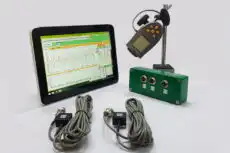
While acceptance is based on overall RMS, always record the FFT स्पेक्ट्रम during commissioning. If the fan later develops problems, comparison with the baseline spectrum is invaluable for diagnosis. The Balanset-1A records both overall RMS and full frequency spectrum automatically.
Field Balancing of Fan Impellers
Many industrial fans must be balanced in-situ — either because the impeller is too large to remove, or because balance was lost during operation due to material buildup, erosion, or blade damage. ISO 14694 implicitly supports field balancing as the practical way to maintain BV and vibration acceptance compliance throughout the fan's operating life.
When Field Balancing Is Needed
- Fan vibration exceeds specified vibration limit and FFT spectrum shows dominant 1× (unbalance) component
- Material buildup has changed impeller balance since commissioning
- Blade repair, blade replacement, or erosion shield replacement performed
- Impeller cannot be removed without major disassembly (centrifugal fans in scroll housings)
- Production schedule cannot accommodate a long shutdown for shop balancing
Procedure with Balanset-1A
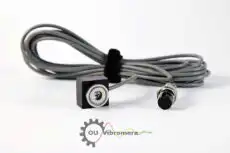
- सेटअप: Mount vibration sensor on bearing housing (radial direction), laser tachometer aimed at shaft. Select single-plane (F2) or two-plane (F3) mode.
- प्रारंभिक रन: Record baseline vibration — amplitude and phase at 1× shaft speed. Example: 8.2 mm/s at 135°.
- ट्रायल वेट: Mount known mass (e.g., 20 g) on accessible blade or hub. Run again, record new vector. Example: 5.5 mm/s at 210°.
- दुरुस्ती: Software calculates required mass and angle. Example: "Add 35 g at 285°." Weight splitting available for blade mounting.
- पडताळा: Final run confirms residual vibration below specified vibration limit. Typical result: 1.0–2.0 mm/s after one correction cycle.
Most centrifugal fan impellers are narrow enough for एक-समतलीय balancing (Balanset F2 mode). Wide impellers, multi-stage fans, and long axial fans need two-plane (Balanset F3 with two sensors). Quick test: measure both bearings — if there is a significant amplitude or phase difference, use two-plane.
Case Studies — ISO 14694 in Practice
Fan: Centrifugal HVAC supply, 22 kW, 1 460 RPM, impeller mass 38 kg, direct-drive on rigid concrete base.
Spec: BV-3 (G 6.3), specified limit (≤ 4.5 mm/s).
BV tolerance: Uनुसार = 9 549 × 6.3 × 38 / 1 460 = 1 566 g·mm total → 783 g·mm per plane.
Balance check: Factory certificate: 420 g·mm residual — well within 1 566 g·mm limit. ✅
vibration acceptance test: Highest reading: 3.8 mm/s (horizontal, drive-end bearing). Within specified limit limit of 4.5 mm/s. ✅
Baseline spectrum: Clean 1× at 24.3 Hz, small BPF at 170 Hz (7 blades). Healthy fan.
Fan: Radial-blade dust collector, 30 kW, 1 750 RPM, impeller 40 kg, rigid base.
समस्या: Vibration grew from 3.5 mm/s at commissioning to 9.8 mm/s after 6 months. specified BV-3 vibration limit → EXCEEDS.
निदान: Balanset-1A FFT: dominant 1× peak at 29.2 Hz = shaft speed. Minimal 2× or other harmonics. Root cause: non-uniform dust buildup on blades.
कृती: Blades cleaned, field balanced with Balanset-1A. Trial weight 15 g, calculated correction 28 g at 195°. Post-balance: 1.3 mm/s. ✅
शिफारस: Schedule quarterly cleaning + rebalancing for material-handling fans.
Fan: Centrifugal roof exhaust, 15 kW, 2 940 RPM, impeller 8 kg, spring isolators (flexible).
समस्या: Overall vibration 12.5 mm/s. Field balancing reduced 1× from 7.0 to 1.5 mm/s, but overall only dropped to 10.8 mm/s.
निदान: FFT shows strong 7× peak at 343 Hz = 8.5 mm/s (BPF, 7 blades × 49 Hz). Fan housing नैसर्गिक वारंवारता at ~340 Hz — resonance.
Root cause: 90° elbow immediately before inlet → non-uniform inlet velocity → BPF excitation → housing resonance amplification.
उपाय: Inlet guide vanes installed + elbow relocated further upstream. BPF dropped to 2.1 mm/s. Overall: 3.2 mm/s. ✅
This case illustrates why BV compliance alone does not guarantee vibration acceptance compliance — aerodynamic factors produce vibration independently of balance quality.
इतर मानकांचा संबंध
ISO 14694 does not exist in isolation — it references and builds upon several international standards:
- ISO 1940-1 / ISO 21940-11: The G-grade system that BV categories reference. ISO 14694 selects appropriate G-grades for each fan type.
- ISO 10816-1 / ISO 20816-1: General vibration measurement methodology. vibration limits are derived from and compatible with ISO 10816 zones.
- ISO 10816-3: Industrial machines 15–300 kW. Fans in this range could use either standard, but ISO 14694 provides more specific fan guidance.
- ISO 5801: Fan performance testing. vibration acceptance tests reference operating conditions from this standard.
- ISO 13347: Fan acoustics (noise). Related but separate — reducing vibration often reduces noise transmission.
- AMCA 204: North American fan vibration standard. Similar scope; fans meeting one generally meet the other.
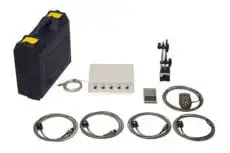
The Balanset-1A portable balancer provides: two-channel vibration measurement (both bearings simultaneously), built-in ISO 1940 / ISO 14694 tolerance calculator, single-plane and two-plane balancing modes, correction weight splitting for blade-mounted weights, FFT spectrum analysis for fault diagnostics, and vibrometer mode for vibration acceptance measurement. The Balanset-4 extends this to four channels for complex multi-bearing fan assemblies.
अधिकृत मानक: ISO 14694 on ISO Store →
Frequently Asked Questions — ISO 14694
Common questions about fan balance quality (BV) and vibration acceptance (vibration acceptance)
संबंधित शब्दकोश लेख
Balance Fans to ISO 14694 — In the Field
Vibromera portable balancing devices calculate BV tolerances automatically and guide correction weight placement — single-plane or two-plane, no impeller removal required.
Browse Fan Balancing Equipment →
