Qutb O'tish Chastotasini Tushunish


Qutb o'tish chastotasi (PPF) is the low-frequency vibration component generated in an AC induction motor as the rotating magnetic field slips past the rotor. It is calculated as the number of poles multiplied by the slip frequency: PPF = number of poles × (synchronous speed − actual speed) / 60. Because slip is small, PPF is a very low frequency — typically only a few hertz — and it usually shows up not as a stand-alone peak but as sidebands spaced at PPF around the running-speed and line-frequency components. That slip-related modulation is greatly amplified when the motor has air-gap eccentricity, broken rotor bars, or a rotor-to-stator alignment problem. Because of this, PPF is one of the most useful tools for separating elektr nosozliklari sof mexanik nosozliklardan ajratishning eng foydali vositalaridan biridir.
PPF matters diagnostically because elevated sidebands spaced at this frequency point squarely at an electromagnetic problem — an eccentric rotor, broken rotor bars, a non-uniform air gap, or dynamic rotor–stator interaction — rather than at unbalance or misalignmentTo'g'ri o'qilsa, u analizatorga dvigatalni ochish kerakmi yoki agregat zanjirining boshqa qismlarini tekshirish kerakmi degan savolga javob beradi.
1. Qutb O'tish Chastotasini Hisoblash
Asosiy formula
- PPF = P × (Nsync − N) / 60
- where P = qutblar soni,
- Nsync = synchronous speed in RPM (Nsync = 120 × line frequency / P),
- N = rotorning haqiqiy aylanish tezligi (RPM),
- and the result is in Hz. The term (Nsync − N) / 60 is the slip frequency expressed in Hz.
Note that PPF is built on the difference between synchronous and actual speed — the slip. At no load an induction motor runs almost at synchronous speed, so PPF approaches zero; as load grows, slip and therefore PPF grow with it, typically ending up in the range of roughly 0.5–3.5 Hz at rated load. Do not confuse PPF with the purely mechanical order P × running speed (for a 4-pole motor at 1750 RPM that is about 116.7 Hz) — that is a harmonic of shaft rotation, not pole pass frequency. When you need to convert running speed into a family of orders quickly, our Garmonik chastota kalkulyatori turns RPM into Hz across the 1×–10× orders, and the Motor Elektr Nosozliklari Chastotasi Kalkulyatori elektromagnit chastotalarini yonma-yon joylashtiradi.
Hisoblash misollari
1750 RPM da ishlaydigan 4 qutbli motor (60 Hz ta'minot):
- Synchronous speed Nsync = 120 × 60 / 4 = 1800 RPM.
- Slip frequency = (1800 − 1750) / 60 = 0.83 Hz.
- PPF = 4 × (1800 − 1750) / 60 = 3.33 Hz
- In the vibration spectrum it appears as sidebands spaced ±3.33 Hz around the 1× running-speed peak (29.2 Hz) and around 2× line frequency (120 Hz) — a pattern diagnostic for eccentricity and broken rotor bars.
970 RPM da ishlaydigan 6 qutbli motor (50 Hz ta'minot):
- Synchronous speed Nsync = 120 × 50 / 6 = 1000 RPM.
- Slip frequency = (1000 − 970) / 60 = 0.5 Hz.
- PPF = 6 × (1000 − 970) / 60 = 3.0 Hz
- Sidebands spaced only ±3.0 Hz around the 1× peak (16.2 Hz) or around 2× line frequency (100 Hz) are easy to miss.
- Resolving them demands careful, high-resolution spektral tahlil.
2. Fizik mexanizm
Elektromagnit kuchining hosil bo'lish mexanizmi
PPF ni yuzaga keltiruvchi voqealar zanjiri oddiy:
- Stator chulg'amlari sinxron tezlikda aylanadigan magnit maydon hosil qiladi.
- Ushbu maydon N–S–N–S naqshidagi magnit qutblarga tashkil etilgan.
- The rotor runs slightly slower because of slip, so the field poles continuously drift past the rotor rather than staying locked to it.
- Each time a field pole slips past a given spot on the rotor (a high-resistance bar, an eccentric side of the air gap), the magnetic force acting on that spot is modulated.
- With P poles, that spot is passed P times per slip cycle.
- The frequency of the resulting modulation is therefore P × slip frequency = PPF — a slow “beating” superimposed on the running-speed and line-frequency vibration.
Bir xil havo oralig'i — sog'lom motor
- Rotor stator teshigining markazida joylashgan.
- Havo oralig'i butun aylana bo'ylab bir xil.
- Magnit kuchlar muvozanatda bo'lib, bir-birini bekor qiladi.
- PPF-related modulation is consequently very low in amplitude.
Ekssentrik havo bo'shlig'i — nosoz motor
- Rotor statorga nisbatan markazdan siljigan holda joylashgan bearing wear, a bent shaft, yoki ishlab chiqarishdagi nuqson.
- Havo bo'shlig'i bir tomonda kichikroq, qarama-qarshi tomonda esa kattaroq bo'ladi.
- Magnit kuchlar muvozanatsizlikka uchraydi — bo'shliq kichikroq bo'lgan joyda kuchliroq bo'ladi.
- A net radial force appears — muvozanatsiz magnit tortish kuchi — and it is modulated at PPF as the field poles slip past the narrow side of the gap.
- Sidebands spaced at PPF develop around the main spectral peaks and grow with severity.
3. Yon polosalar va diagnostik naqshlar
Statik ekssentrisitet
Bu yerda rotor markazi siljigan, lekin statorga nisbatan qo'zg'almaydigan holatda turadi:
- Pattern: an elevated 2× line frequency component (100/120 Hz); pole-pass sidebands are weak or absent because the offset does not rotate with the shaft.
- Cause: bearing wear, frame or end-bell distortion, or a machining error in the stator bore.
- Amplitude: the 2× line frequency amplitude indicates the severity of the eccentricity.
Dinamik ekssentrisitet
Bu yerda rotor markazi stator markazi atrofida orbitada aylanadi yoki siljib yuradi:
- Pattern: 1× running speed and 2× line frequency peaks with sidebands spaced at PPF (e.g. ±3.33 Hz in the 4-pole example above).
- Causes: a bent shaft, rotor eccentricity, rotor-to-stator rub or bearing looseness.
- More severe: it signals an active dynamic interaction rather than a fixed offset. The same pole-pass sideband family around 1× and its harmonics is the classic signature of broken rotor bars.
Aralash ekssentrisitet
- Statik va dinamik ta'sirlarning kombinatsiyasi.
- Bu real motorlarda eng ko'p uchraydigan holat.
- Bu murakkab yon polosa naqshlarini hosil qiladi.
- Uni to'g'ri talqin qilish uchun ehtiyotkorlik bilan tahlil talab etiladi.
4. Diagnostik talqin
Because PPF is only a few hertz, it is judged through the strength of its sidebands around the 1× running-speed and 2× line-frequency peaks, read as a continuum:
Low — pole-pass sidebands barely visible above the noise floor
- Oddiy holat.
- Bir xil havo oralig'i va rotor–stator konsentrisligining yaxshi holati.
- Tuzatuvchi chora ko'rish talab etilmaydi.
Moderate — sidebands clearly visible but far below the carrier peak
- Slight air-gap non-uniformity or early rotor-circuit degradation.
- Tendentsiyani kuzatib boring va podshipnik holatini tekshiring.
- Rotor holatini imkon bo'lsa tekshirib ko'ring.
- Tezkor xavf yo'q, ammo e'tibor talab etiladi.
High — sidebands approaching the carrier peak in amplitude
- Significant eccentricity, broken rotor bars, or an air-gap problem.
- A pronounced low-frequency “beat” may be felt or heard at PPF.
- Rotor va stator o'rtasida tutashib ketish xavfi.
- Shikastlanishni tezlashtiradigan o'sib boruvchi elektromagnit kuchlar.
- Ta'mirlash yoki almashtirish rejasini tuzing.
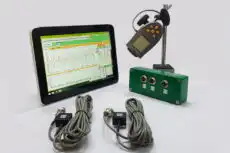
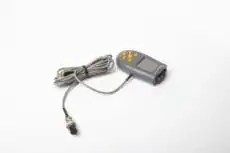
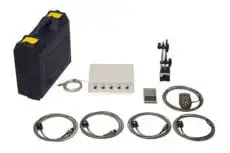
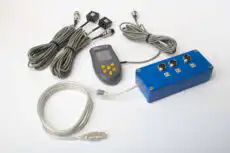
Amaliyotda tahlilchi PPF ni alohida baholamaydi. Masalan, Balanset-1A, used at the bearing housings, captures the spectrum and resolves the pole-pass sidebands around the 1× and line-frequency peaks — and, just as importantly, confirms whether the dominant component is electromagnetic or the simple 1× peak of a mechanical fault. That distinction decides everything that follows: an electromagnetic signature sends you inside the motor, while a clean 1× peak that disappears the instant power is cut points to unbalance siz quyidagi yo'l bilan tuzatishingiz mumkin field balancing rotorni o'z joyida.
5. Boshqa motor chastotalariga munosabat
PPF — to'liq motor spektridagi ko'p tonlardan biri bo'lib, uning qo'shni chastotalarga nisbatan qayerda joylashganini aniqlash vazifaning yarmini hal qiladi. 60 Hz tarmoqda ishlaydigan 4 qutbli, 1750 RPM li motor uchun odatiy ierarxiya quyidagicha:
- Sirpanish chastotasi: (1800 − 1750) / 60 ≈ 0.83 Hz.
- PPF: P × slip frequency — about 3.3 Hz here, the lowest tone in the family.
- Running speed (1×): about 29.2 Hz.
- Line frequency: 60 Hz (or 50 Hz in Europe).
- Rotor mechanical order P × running speed: about 117 Hz — often mistaken for PPF, but it is a shaft-speed harmonic.
- Tarmoq chastotasining 2 baravar ko'paytmasi: 120 Hz (or 100 Hz) — the key electromagnetic component for eccentricity.
- Rotor sterjenlarining o'tish chastotasi: number of rotor bars × running speed, up in the kilohertz range.
The close spacing of 2× line frequency (120 Hz) and the nearby harmonics of running speed (the 4th order sits at about 117 Hz here) is exactly why electromagnetic faults are so easily confused with mechanical ones — and why the fine pole-pass sideband structure, not amplitude alone, is the deciding clue. Where the picture remains ambiguous, switching off the supply is the definitive test: an electromagnetic component vanishes instantly with the field, whereas a mechanical one decays only as the rotor coasts down.
6. Tuzatish usullari
Mexanik ekssentrisitet uchun
- Rotorning to'g'ri markazlanishini tiklash uchun eskirgan podshipniklarni almashtiring.
- Egilgan valni to'g'rilang yoki rotorni almashtiring.
- Nosozlik o'rnatish xatosidan kelib chiqqan bo'lsa, rotorni qayta o'rnating.
- Uchlik qopqoqlarning tekislanishini va bolt mahkamligini tekshiring.
Ishlab chiqarishdagi ekssentrisitet uchun
- Og'ir holatlarda rotorni yoki statorni qayta raskadrovka (qayta teshish) qilish talab etilishi mumkin.
- Iqtisodiy jihatdan asoslangan bo'lsa, motori almashtiring.
- Agar tebranish maqbul chegaralar doirasida qolsa, holatni qabul qiling.
- Kelajakdagi taqqoslash uchun uni bazaviy qiymat sifatida hujjatlashtiring.
Havo oralig'i muammolari uchun
- Podshipnik holatini tekshiring va eskirgan bo'lsa almashtiring.
- Rotorning o'qiy (aksial) joylashuvini tekshiring.
- Ramka deformatsiyasi yoki oxirgi qopqoq muammolarini tekshiring.
- Imkon qadar havo oralig'ini haqiqiy o'lchang.
Pole pass frequency is, in summary, a slip-related, motor-specific low-frequency component that opens a window onto rotor–stator electromagnetic interaction and air-gap uniformity. Mastering its calculation, recognising its sideband signatures, and reading their amplitude trends lets an engineer diagnose electromagnetic faults with confidence — and direct maintenance effort to the right place instead of chasing a mechanical cause that was never there.

