Understanding Structural Resonance






Structural resonance is the condition in which a forcing frequency from rotating machinery — 1× running speed, 2× from misalignment, or a blade/vane passing frequency — matches a natural frequency of the non-rotating support structure. That structure can be the machine frame, the baseplate, the pedestals, the foundation, or even nearby pipework and platforms. When the frequencies coincide, resonance amplifies the structural vibration to levels far beyond anything the rotating parts themselves experience.
Structural resonance is dangerous precisely because it disguises itself. It can make a well-balanced, properly aligned machine look as though it has a severe defect. The large vibration lives in the structure and does not necessarily mean the rotor is in trouble — yet the structural motion can feed back into the rotor and cause genuine mechanical damage over time. Distinguishing the amplifier from the source is the whole diagnostic challenge.
1. How Structural Resonance Occurs
The resonance mechanism
- Excitation source: the machine generates periodic forces — from unbalance, misalignment, and so on.
- Force transmission: those forces pass through the bearings into the support structure.
- Frequency match: the excitation frequency lands on a structural natural frequency.
- Energy accumulation: the structure absorbs energy over many cycles instead of dissipating it.
- Amplification: amplitude builds, limited only by the structural damping.
- Observed effect: the structure can vibrate 5–50× more strongly than the input force alone would produce.
The size of that amplification is set almost entirely by damping. With little damping, a sharp resonance can multiply motion dozens of times; with heavy damping, the same coincidence of frequencies barely registers. This is why damping treatments are such an effective tool, and why a damping ratio calculator is useful for estimating how peaky a given structure will be.
Typical frequency ranges
- Foundation modes: usually 5–30 Hz for typical industrial foundations.
- Baseplate modes: 20–100 Hz depending on size and construction.
- Pedestal modes: 30–200 Hz for typical bearing supports.
- Frame and cover modes: 50–500 Hz for sheet-metal panels and covers.
When the resonant member is the machine’s own body rather than its supports, the same physics is described as frame resonance; when it is the sensor’s mounting that rings, it becomes mounting resonance. All three are facets of the same amplification phenomenon at different points in the structure.
2. Common Resonance Scenarios
1× running-speed resonance
- Example: a machine running at 1800 RPM (30 Hz) with a foundation natural frequency of 28–32 Hz.
- Symptom: very high vibration despite good balance.
- Effect: even a small residual unbalance produces large structural motion.
- Solution: change the foundation stiffness, add damping, or change the operating speed.
2× resonance (misalignment frequency)
- Misalignment generates a 2× excitation.
- If 2× matches a structural mode, amplification occurs.
- The high vibration is easily misdiagnosed as severe misalignment.
- Improving alignment helps but does not eliminate the resonance itself.
Blade/vane passing frequency resonance
- Fans, pumps, and turbines generate a blade passing frequency (N × RPM, where N is the number of blades) — for pumps, the equivalent vane passing frequency.
- Often in the 50–500 Hz range.
- Can excite structural modes in that band.
- Produces high-frequency rattling or buzzing.
3. Diagnostic Identification
Symptoms of structural resonance
- Disproportionate vibration: structural vibration far higher than bearing vibration.
- Narrow speed range: high vibration only at a specific speed (±5–10%).
- Directional dependence: severe in one direction, minimal at right angles — matching the mode shape.
- Location dependence: vibration varies greatly across the structure (antinodes versus nodes).
- Minimal bearing effect: the bearings and rotor may be perfectly acceptable while the structure is severe.
Impact testing (bump test)
The most definitive test. Strike the structure with a hammer and measure the response to reveal every structural natural frequency, then compare them with the machine’s operating frequencies. See bump test and impact testing for technique.
Measurement location comparison
- Measure at the bearing housing (closest to the source).
- Measure again at the pedestal base, baseplate, and foundation.
- If structural vibration far exceeds bearing vibration, resonance is indicated.
- A transmissibility above 2–3 suggests resonant amplification — a vibration transmissibility calculator quantifies the ratio.
Operating deflection shape (ODS)
- Measure vibration at many points on the structure simultaneously.
- Animate the structural motion to see which mode is active.
- Identify nodes and antinodes — see ODS analysis and, for the underlying modes, modal analysis.
4. Separating Source from Structure in the Field
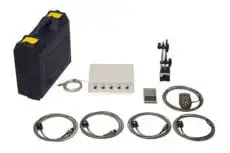
The practical key to diagnosing resonance is to measure the rotor’s behaviour independently of the structure that surrounds it — and a portable two-channel analyser makes that possible without instrumentation labs or downtime. With the Balanset-1A, an analyst captures 1× amplitude and phase and the full spectrum at the bearing, then roves the accelerometer over the baseplate, pedestal, and frame, comparing levels point by point. A modest rotor vibration paired with a huge, sharply tuned structural reading is the unmistakable signature of resonance. Running a coast-down with the same instrument lets the resonant peak reveal itself as the speed sweeps through it, and a trial balance settles whether residual unbalance is really the forcing function or merely an innocent bystander being amplified.
5. Solutions and Mitigation
Frequency separation
Change operating speed. On variable-speed equipment, simply run away from the resonance — change the motor sheave sizes, or use a VFD to select a non-resonant speed. This is not always practical when the speed is fixed by the process.
Modify the structural natural frequency.
- Add mass: lowers the natural frequency (f ∝ 1/√m).
- Add stiffness: raises the natural frequency (f ∝ √k).
- Remove material: in some cases shedding mass shifts the resonance usefully.
- Structural modification: add bracing, gussets, or reinforcement.
Either way, a foundation natural-frequency calculator helps predict where the modified structure will sit relative to the forcing frequency, so a fix does not simply move the problem into a new band.
Damping addition
- Constrained-layer damping: viscoelastic material bonded to the structure, very effective for sheet-metal panels and frames, reducing the resonance peak.
- Tuned mass dampers: a secondary mass-spring system tuned to the problem frequency, absorbing energy and reducing the main structure’s motion — effective but requiring careful design.
- Structural damping materials: rubber pads or isolators at strategic points, damping compounds on surfaces, and friction dampers at joints. On high-speed rotor systems a squeeze film damper performs the analogous job at the bearing.
Isolation
- Install vibration isolators between the machine and the foundation to decouple the two.
- Effective when the isolator natural frequency is below about 0.5× the excitation frequency.
- Requires careful design to avoid creating a new low-frequency resonance — a machine vibration isolation calculator and a vibration mount selection calculator help size the mounts correctly.
Reduce excitation
- Improve balance quality to cut the 1× excitation.
- Use precision alignment to cut the 2× excitation.
- Fix mechanical problems that raise the forcing amplitude.
- This reduces the symptom but does not remove the underlying resonance potential.
6. Prevention in Design
Foundation design criteria
- Aim for a foundation natural frequency above 2× the maximum operating frequency (resonance avoided from above).
- Or below 0.5× the minimum operating frequency (an isolated foundation).
- Avoid the 0.5–2.0× band where resonance is likely.
- Include dynamic analysis in the design phase, just as a rotor’s critical speeds are checked against its operating range.
Structural design
- Design for adequate stiffness relative to the forcing frequencies.
- Avoid lightly loaded structures that are prone to resonance.
- Use ribbing and gussets to raise the frequency.
- Build in inherent damping — composite materials, or joints designed to dissipate energy through friction.
Structural resonance turns minor vibration sources into major problems through sheer amplification. Identifying the resonances through impact testing and operational measurements, then applying the right mitigation — frequency separation, damping, isolation, or reduced excitation — is essential for achieving acceptable vibration in any installation where structural dynamics significantly shape the machine’s overall behaviour.

