Understanding Zoom FFT


Zoom FFT — also called high-resolution FFT or frequency zoom — is an advanced application of the Fast Fourier Transform that concentrates very fine frequency resolution inside a chosen narrow band instead of spreading it thinly across the whole spectrum. Rather than analysing 0–1000 Hz with 1 Hz resolution (1000 lines), a zoom FFT might analyse 95–105 Hz with 0.01 Hz resolution — the same 1000 lines, but all of them packed into a 10 Hz window. That hundred-fold sharpening lets an analyst pull apart closely-spaced components such as sidebands, pin down an exact peak frequency, and study one spectral neighbourhood in forensic detail.
1. Definition: Resolution Where It Counts
Zoom FFT is the tool of choice whenever the diagnostic information lives in peaks too close together for a normal spectrum to separate. The headline cases are motor broken rotor bars (resolving the tiny pole-pass sidebands — spaced at the number of poles × the slip frequency — around 1× running speed), gear problems (reading the modulation pattern around the mesh frequency), and any situation where two important peaks would otherwise merge into one blurred lump.
2. Why Zoom FFT Is Needed
The resolution limit of a standard FFT
Every ordinary FFT obeys one inescapable relationship:
Resolution = Fmax ÷ Number of Lines.
For example, a 0–1000 Hz range with 800 lines gives 1.25 Hz resolution — and two peaks closer than 1.25 Hz simply cannot be told apart. That is a real problem for electrical faults, where the pole-pass sidebands of interest are often only a few hertz — sometimes barely 1–2 Hz — away from the central peak.
The trade-offs of brute force
- Reduce Fmax: dropping to 0–100 Hz improves resolution to 0.125 Hz, but throws away all higher-frequency content.
- Increase the line count: 8000 lines also reaches 0.125 Hz, but is heavy on processing time and memory.
- Zoom FFT: delivers the fine resolution exactly where it is wanted while keeping the computation reasonable — the best of both.
You can preview these trade-offs before measuring with the free FFT Resolution Calculator, which relates span, line count, and resolution directly.
3. How Zoom FFT Works
The technique is a digital “magnifying glass” built from three signal-processing steps:
- Select the band: choose a centre frequency and bandwidth, for example 100 Hz ± 10 Hz.
- Frequency shift: digitally translate that band down toward DC (baseband), so the region of interest sits where the FFT’s resolution is naturally densest.
- Decimation: reduce the sample rate in proportion to the narrowed bandwidth.
- FFT computation: run the transform on the reduced-rate signal.
- Result: a high-resolution spectrum covering only the selected narrow band.
The pay-off scales directly with how far you zoom: zooming to one-tenth of the full span yields ten times finer resolution, so the resolution gain is simply (Full Span ÷ Zoom Span). Going from 0–1000 Hz at 1 Hz to a 95–105 Hz window at 0.01 Hz is a hundred-fold gain.
4. Applications
Motor rotor-bar defect detection
The classic zoom FFT job. Pole-pass sidebands (number of poles × slip frequency) spaced only a few hertz from the 1× peak are too close to resolve in a standard spectrum, so a zoom around 1× running speed at 0.1 Hz or better cleanly separates them and exposes broken rotor bars. The sideband amplitude relative to the 1× peak indicates how many bars are broken.
Gear diagnostics
Zoom around the gear mesh frequency to resolve the sidebands spaced at shaft speed, identify hunting-tooth-frequency patterns, and distinguish pinion sidebands from gear sidebands. The free Gear Mesh Frequency calculator tells you where to centre the zoom in the first place.
Bearing analysis
Zoom around the bearing fault frequencies to resolve their sideband structure, confirm the exact fault frequency against the calculated value, and read the modulation pattern that envelope analysis would otherwise carry.
Electrical frequency analysis
Zoom around line frequency or 2× line frequency to resolve the sidebands spaced at the pole-pass frequency in the current-related vibration and measure that spacing precisely.
Critical-speed studies
Zoom around a suspected natural frequency to fix the resonance precisely and to measure the width of the resonance peak, from which the damping can be estimated.
5. Operational Procedure
Setup
- Run a standard FFT first to find the region of interest — zoom is never a blind first step.
- Select the centre frequency for the zoom.
- Select the span — narrower means higher resolution.
- Set the line count (typically the same as the standard FFT).
- Acquire and let the instrument compute the zoom.
Typical settings
- Motor sidebands: centre at 1× (30 Hz), span ±10 Hz, 800 lines → 0.025 Hz resolution.
- Gear mesh: centre at the GMF (600 Hz), span ±50 Hz, 1600 lines → 0.0625 Hz resolution.
- Bearing fault: centre at BPFO (150 Hz), span ±25 Hz, 800 lines → 0.0625 Hz resolution.
6. Advantages
- High resolution: 10–100× finer than a standard FFT, separating peaks that are otherwise impossible to distinguish and revealing diagnostic detail.
- Computational efficiency: far cheaper than raising the line count across the whole spectrum — faster, with a smaller memory footprint.
- Precision frequency measurement: pins the exact peak frequency so it can be checked against a theoretical calculation, confirming or refuting a suspected diagnosis.
7. Limitations
- Narrow band only: it shows just the selected region and is blind to everything outside it, so you must already know roughly where to look — hence the standard-FFT overview first.
- User knowledge required: choosing a sensible centre and span demands understanding of what you are hunting for, which makes zoom FFT unsuitable for general screening and more demanding than a plain FFT.
- Time investment: it is an extra measurement on top of the standard one, with setup and parameter-selection effort that is justified for critical machines or already-confirmed problems rather than routine surveys.
8. Zoom FFT in the Field
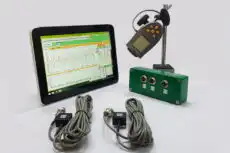
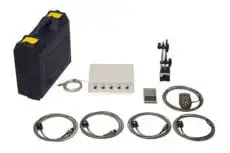
Although the deepest zoom work is often reserved for permanently instrumented critical machines, the same principle is invaluable on portable diagnostics. After a routine field-balancing survey, a two-channel analyser such as the Balanset-1A lets an engineer expand a suspect region of the spectrum — around 1× running speed, say — to confirm whether a raised peak is pure unbalance or a cluster of electrical sidebands hiding beneath it. That distinction decides whether the cure is a balance correction or a motor repair, which is why being able to resolve closely-spaced peaks on site is so useful.
In short, zoom FFT is a powerful spectral tool that supplies the resolution needed to separate the tightly-packed components behind motor electrical faults, gear defects, and bearing problems. Knowing when to reach for it, how to choose the centre and span, and how to read the resulting high-resolution spectrum is a hallmark of advanced vibration analysis and detailed fault diagnosis in complex machinery.

