The Vibration Spectrum: A Diagnostic Roadmap



A vibration spectrum (or frequency spectrum) is a graph that displays the individual frequencies that make up a complex vibration signal. It is the single most powerful tool for diagnosing machinery faults, because it turns a tangled measurement into an ordered map of cause and effect. The spectrum is created by taking a raw time waveform and processing it with a Fast Fourier Transform (FFT) algorithm. The resulting plot shows vibration amplitude on the vertical (Y) axis and frequency on the horizontal (X) axis.
1. Definition: What is a Spectrum?
A machine never vibrates at a single frequency. Its motion is a superposition of many periodic events happening at once — the shaft turning, gear teeth meshing, bearing elements rolling, blades passing, electromagnetic forces pulsing. In the time domain these all add together into one apparently chaotic wiggle. The spectrum is simply the same information re-expressed in the frequency domain: instead of asking “how is the signal moving from moment to moment?”, it asks “how much energy exists at each frequency?”.
This is the core idea of spectral analysis. Where the time waveform shows the sum, the spectrum shows the parts. That decomposition is what makes diagnosis possible, because each mechanical and electrical fault advertises itself at its own predictable frequency.
2. Why the Spectrum is the Key to Diagnostics
A machine’s vibration is a mixture of many different signals occurring simultaneously. The time waveform shows this jumbled signal, but the spectrum acts like a prism, separating it into its distinct components. This is critical because different mechanical and electrical faults generate vibration at specific, predictable frequencies. By looking at the peaks in the spectrum, a trained analyst can identify the root cause of a problem with high confidence — often distinguishing between an unbalance that needs balancing and a misalignment that needs an alignment job, two problems that can feel identical from the outside but call for completely different corrections.
3. How to Read a Vibration Spectrum
A spectrum plot contains a wealth of information. The three elements to examine are the frequency axis, the amplitude axis, and the peaks themselves.
The Frequency (X-Axis)
This axis shows what is vibrating. It can be displayed in various units — Hertz (Hz), Cycles Per Minute (CPM, which lines up neatly with RPM), or orders (multiples of running speed). Displaying the axis in orders, through order analysis, is especially useful on variable-speed machines because a fault peak then stays put even as the shaft speed changes. The location of a peak on this axis is the primary clue to its source.
The Amplitude (Y-Axis)
This axis shows how much vibration is occurring at a given frequency, and therefore the severity of the event. It can be measured in units of displacement, velocity, or acceleration, and displayed on a linear or logarithmic scale. A logarithmic (dB) scale compresses the range so that small, early-stage fault peaks become visible alongside the dominant ones — a linear scale, by contrast, makes the largest peak easy to judge but can bury a budding bearing defect in the baseline.
The Peaks
Each peak in the spectrum represents a specific, periodic event occurring in the machine. Interpreting a spectrum is the process of matching these peaks to known fault frequencies, and noting how they relate to one another — whether they are harmonics, sidebands, or stand-alone non-synchronous tones.
4. Common Patterns and What They Mean
Analysts look for characteristic patterns to diagnose faults. The following signatures cover the large majority of everyday cases:
- A single high peak at 1× RPM: the classic signature of rotor unbalance — vibration locked to the running speed.
- A dominant peak at 2× RPM: often accompanied by high axial vibration, this is a strong indicator of shaft misalignment.
- A series of running-speed harmonics (1×, 2×, 3×, 4×…): a long row of harmonics is the primary indicator of mechanical looseness.
- High-frequency, non-integer peaks: these often correspond to the calculated bearing fault frequencies of rolling-element bearings, and frequently appear with sidebands as the defect grows.
- A high-frequency peak with sidebands: a peak at the gear mesh frequency surrounded by smaller peaks spaced at the gear’s running speed is a definitive sign of a gear fault.
- A raised “noise floor”: a broadband increase in the baseline energy of the spectrum can indicate friction, rubs, or cavitation in pumps.
Reading these patterns is part science, part disciplined comparison — which is why the next section matters so much.
5. Where the Spectrum is Measured in the Field
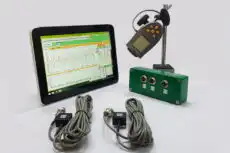
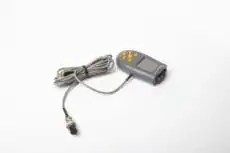
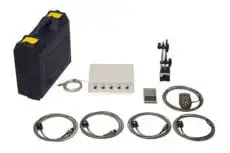
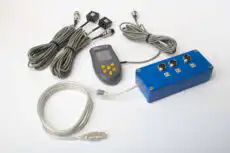
A spectrum is only as good as the signal feeding it. In the field the waveform is captured by an accelerometer bolted to the bearing housing and digitised by a portable analyser. A two-channel instrument such as the Balanset-1A records the time waveform, computes the FFT spectrum, and — because it also reads a once-per-revolution pulse from a tachometer — can tie each peak to shaft phase. That phase reference is what lets the same instrument move beyond diagnosis into correction, computing the mass and angle of a balance weight when the dominant peak turns out to be 1× unbalance.
6. The Importance of Baseline and Trending
A single spectrum provides a snapshot of a machine’s health at one moment in time. The true power of the technique comes from comparing the current spectrum to a baseline spectrum taken when the machine was known to be in good condition. By trending the amplitudes of specific peaks over time, analysts can track the progression of a fault from its earliest stages, set sensible alarm and trip levels, and schedule planned, proactive maintenance long before a failure occurs. In short, one spectrum tells you the machine’s state today; a trend of spectra tells you where it is heading.

