Understanding the Tachometer Signal
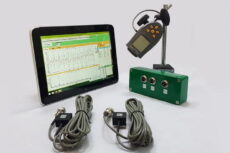
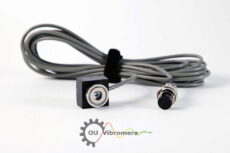
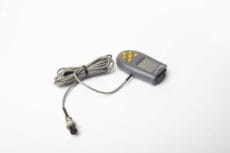
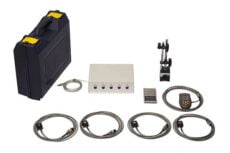

Definition: What is a Tachometer?
In the context of vibration analysis, a tachometer is a sensor used to generate a timing pulse that corresponds to the rotation of a shaft. Its primary function is to provide an accurate measure of the machine’s running speed (RPM) and, more importantly, to serve as a phase reference for advanced vibration diagnostics.
The signal from a tachometer is a series of pulses, most commonly a once-per-revolution pulse. This is functionally identical to the signal provided by a Keyphasor, and in the vibration analysis community, the terms are often used interchangeably. The tachometer signal provides the “t=”0″” timing mark for each rotation of the shaft.
How Does it Work?
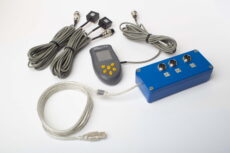
A tachometer setup for vibration analysis typically consists of:
- A Target on the Shaft: A unique feature on the rotating shaft that the sensor can detect once per revolution. This can be a piece of reflective tape, a bolt head, a keyway, or a pre-existing gear.
- A Sensor: A stationary sensor mounted with a clear view of the target. Common types include:
- Photoelectric/Laser Tachometers: These sensors emit a beam of light and detect the reflection from a piece of reflective tape on the shaft, generating a pulse each time the tape passes.
- Proximity Probes: Eddy-current probes (like a Keyphasor) or inductive pickups can detect a keyway, notch, or the tooth of a gear.
- Hall Effect Sensors: These sensors detect a passing magnet that has been attached to the shaft.
Regardless of the sensor type, the output is a clean, repeating pulse train that is fed into the vibration analyzer alongside the data from the accelerometers.
The Role of the Tachometer Signal
The tachometer signal is a prerequisite for many of the most powerful diagnostic techniques. Its two main roles are:
1. Speed Measurement
By measuring the time between pulses, the analyzer can calculate a very precise and instantaneous rotational speed (RPM) of the machine. This is far more accurate than using a handheld contact tachometer and is essential for correlating vibration frequencies with specific machine components.
2. Phase Reference
This is the most critical function. The tachometer pulse acts as a timing reference mark. The analyzer can measure the time delay between the tachometer pulse and the peak of a vibration signal (like the 1X unbalance vibration), and convert this delay into a phase angle. This phase information is essential for:
- Field Balancing: Phase is required to know where to place correction weights.
- Order Analysis: The tachometer signal allows the analyzer to normalize the frequency axis to multiples of the running speed (orders), which is vital for analyzing variable-speed machines.
- Advanced Diagnostics: Generating plots like Bode plots, Nyquist plots, and Orbits is impossible without a phase reference signal from a tachometer.
 EN
EN  AR
AR  AZ
AZ  BG
BG  ZH
ZH  HR
HR  CS
CS  DA
DA  NL
NL  ET
ET  FI
FI  FR
FR  DE
DE  KA
KA  EL
EL  HE
HE  HI
HI  HU
HU  ID
ID  IT
IT  JA
JA  KO
KO  LV
LV  LT
LT  MS
MS  NB
NB  FA
FA  PL
PL  PT_BR
PT_BR  PT
PT  RO
RO  SR
SR  SK
SK  SL
SL  ES
ES  SV
SV  TH
TH  TR
TR  UR
UR  UK
UK  VI
VI 