फिरणाऱ्या यंत्रसामग्रीतील शाफ्ट व्हिप समजून घेणे






शाफ्ट व्हिप — known as ऑइल व्हिप when it originates in hydrodynamic bearings — is a severe form of रोटर अस्थिरता marked by violent स्व-उत्तेजित कंपन. It appears when a rotor running in fluid-film bearings exceeds a critical threshold speed, typically around twice the first critical speed. Once whip takes hold, the vibration frequency “locks” onto the rotor’s first नैसर्गिक वारंवारता and stays there regardless of any further speed increase, with amplitude limited only by bearing clearance — or by catastrophic failure. It is one of the most dangerous conditions in high-speed machinery because it develops suddenly, grows to destructive levels within seconds, and cannot be cured by balancing or any other conventional correction. It demands immediate shutdown followed by changes to the bearing system to prevent recurrence.
1. The Progression: From Oil Whirl to Shaft Whip
Whip rarely arrives without warning — it is the end point of a four-stage progression that an attentive analyst can intercept long before the destructive stage.
Stage 1 — Stable Operation
- The rotor runs below the instability threshold.
- Only normal जबरदस्तीने लादलेल्या कंपन पासून unbalance is present.
- The bearing oil film provides stable, well-damped support.
Stage 2 — Oil Whirl Onset
As speed climbs past roughly 2× the first critical speed, ऑइल व्हर्ल begins:
- A उप-समकालिक vibration appears at about 0.43–0.48× shaft speed.
- Amplitude is initially moderate and speed-dependent.
- The whirl frequency rises proportionally with shaft speed.
- It may be intermittent or continuous.
- It can coexist with the normal 1× vibration from unbalance.
Stage 3 — The Whip Transition
When the rising oil-whirl frequency climbs far enough to match the first natural frequency, the behaviour changes character abruptly:
- Frequency lock-in: the vibration frequency stops tracking speed and pins itself to the natural frequency.
- Resonant amplification: amplitude grows dramatically because the system is now in resonance.
- Sudden onset: the jump from whirl to whip can be effectively instantaneous.
- गती स्वातंत्र्य: further speed increases no longer change the frequency — only the amplitude.
Stage 4 — Shaft Whip (Critical Condition)
- Vibration sits at a constant frequency — the first natural frequency, typically 40–60 Hz.
- Amplitude reaches 5–20 times the normal unbalance vibration.
- The shaft may strike its bearing-clearance limits.
- Bearings and oil heat rapidly.
- Catastrophic failure can follow within minutes if the machine is not stopped.
2. भौतिक यंत्रणा
Whip is driven by the fluid dynamics of the bearing oil film itself, which is why it cannot be balanced away — the destabilising energy comes from the lubricant, not from a heavy spot. The sequence runs as follows:
- Oil-wedge formation: the rotating shaft drags lubricant around the bearing, building a pressurised wedge.
- Tangential force: that wedge pushes on the journal in a direction perpendicular to the radial offset — a cross-coupled, tangential force.
- Orbit motion: the tangential force drives the shaft centre to व्हर्ल in an कक्षा at roughly half shaft speed.
- Energy extraction: the orbiting motion draws energy out of the shaft’s rotation to sustain itself — the hallmark of a self-excited vibration.
- Resonance lock: when the orbit frequency coincides with the natural frequency, resonance amplifies the motion.
- Limit cycle: amplitude grows until it is bounded by bearing clearance or by failure.
Because the exciting force scales with the lubricant’s behaviour, anything that raises the oil-film stiffness or the system damping raises the speed at which instability begins.
3. निदान पहिचान
Shaft whip leaves an unmistakable fingerprint in vibration data, which makes early recognition possible if the right plots are reviewed.
कंप स्वाक्षरी
- स्पेक्ट्रम: a large peak at the sub-synchronous (first natural) frequency that stays put regardless of speed changes.
- वॉटरफॉल प्लॉट: the sub-synchronous component shows up as a vertical line (constant frequency) rather than the diagonal line of a speed-proportional component.
- ऑर्डर विश्लेषण: a fractional order that कमी होते as speed rises — for example drifting from 0.5× to 0.4× to 0.35× — because the frequency is fixed while speed climbs.
- ऑर्बिट: a large circular or elliptical orbit at the natural frequency.
A बोड प्लॉट taken on कोस्टडाउन further separates a true resonance from a whip, since the locked sub-synchronous line behaves quite differently from the synchronous critical-speed peak.
प्रारंभिक वेग
- Typical threshold: 2.0–2.5× the first critical speed.
- Bearing-dependent: the exact threshold varies with bearing design, प्रीलोड, and oil viscosity.
- Sudden onset: a small speed increase can trip the rotor from stable to fully unstable.
४. प्रतिबंध धोरणे
Because whip cannot be balanced out, prevention focuses on the journal bearing and on how the machine is operated.
बेअरिंग डिझाइनमधील सुधारणा
1. Tilting-pad bearings — the most effective fix. The pads pivot independently, eliminating the destabilising cross-coupling force; they are inherently stable across a wide speed range and are the industry standard for high-speed turbomachinery.
2. Pressure-dam bearings — a modified cylindrical bearing with a groove or dam that raises effective damping and stiffness; cheaper than tilting-pad but less effective.
3. Bearing preload — applying radial preload (often through an offset-bore design) raises stiffness and pushes the instability threshold higher.
4. Squeeze-film dampers — an external damping element surrounding the bearing that adds damping without redesigning the bearing itself, well suited to retrofits.
कार्यकारी उपाय
- Speed limitation: hold maximum speed below the threshold — typically under 1.8× the first critical.
- भार व्यवस्थापन: run at higher bearing loads where possible, since load increases damping.
- Oil-temperature control: a cooler oil is more viscous and more stabilising.
- निगराणी: continuous कंपन निरीक्षण with alarms specifically watching the sub-synchronous band.
5. परिणाम आणि नुकसान
तात्कालिक प्रभाव
- Violent vibration: amplitudes can reach several millimetres (hundreds of mils).
- आवाज: a loud, distinctive sound quite unlike normal operation.
- Rapid bearing heating: temperatures can climb 20–50 °C in minutes.
- तेल हास: high temperature and intense shearing break down the lubricant.
संभाव्य बिघाड
- Bearing wipe: the babbitt lining melts and is wiped away.
- Shaft damage: scoring, galling, or permanent bending.
- Seal failure: excessive shaft motion destroys seals.
- Shaft breakage: उच्च-चक्र थकवा from the violent oscillation.
- Coupling damage: the transmitted forces wreck couplings.
6. Related Phenomena
ऑइल व्हर्ल
ऑइल व्हर्ल is the precursor to whip: the same mechanism, but the frequency has not yet locked onto the natural frequency. Its amplitude is lower, its frequency tracks speed at ~0.43–0.48×, and in some applications it is tolerable.
स्टीम व्हर्ल
स्टीम व्हर्ल is a similar instability in steam turbines, driven by aerodynamic forces in labyrinth seals rather than the bearing oil film. It shows the same sub-synchronous vibration locking onto a natural frequency.
Dry-Friction Whip
This variant arises at seal locations or from रोटर-स्टेटर संपर्क. Friction supplies the destabilising mechanism; it is less common than oil whip but equally dangerous and calls for a different remedy — eliminating the contact or improving the seal.
7. Case Study: Compressor Shaft Whip
प्रसंग: a high-speed centrifugal compressor on plain cylindrical bearings.
- Normal operation: 12,000 rpm with vibration of 2.5 mm/s.
- Speed increase: the operator pushed to 13,500 rpm for more capacity.
- सुरुवात: at 13,200 rpm a sudden violent vibration developed.
- लक्षणे: 25 mm/s at a constant 105 Hz; bearing temperature rose from 70 °C to 95 °C in three minutes.
- Emergency action: immediate shutdown averted a bearing failure.
- मूळ कारण: the first critical speed was 6,300 rpm (105 Hz); at 13,200 rpm the rotor crossed the whip threshold of roughly 2× critical ≈ 12,600 rpm, and the vibration locked onto the 105 Hz first natural frequency.
- उपाय: plain bearings were replaced with tilting-pad bearings, allowing safe operation to 15,000 rpm.
8. Standards, Practice, and Field Tools
- API 684: requires a rotordynamic stability analysis for high-speed turbomachinery.
- API 617: specifies bearing types and stability requirements for centrifugal compressors.
- ISO 10814: provides guidance on bearing selection for stability.
- Industry practice: tilting-pad bearings are standard for equipment running above 2× the first critical speed.
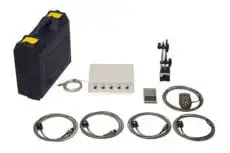
In the field, the everyday safeguard is to catch the precursor before the rotor ever reaches whip. A portable two-channel analyser such as the Balanset-1A lets an engineer record amplitude, phase and spectrum during a controlled run-up and watch the sub-synchronous band directly — if a stable 1× signature suddenly grows a locked, speed-independent peak near the first natural frequency, the rotor is on the edge of whip and the speed must be backed off. The same instrument confirms afterwards that the underlying unbalance is within tolerance, ruling it out as a contributing excitation. Shaft whip remains a catastrophic failure mode best handled by correct bearing selection and design; recognising its distinctive sub-synchronous, frequency-locked signature is what enables rapid diagnosis and the decisive emergency response that protects expensive high-speed equipment.

