Understanding Phase in Vibration Analysis





फेज describes the timing relationship between two signals or, more usefully in rotating-machinery work, the timing of a vibration signal relative to a fixed reference mark on the rotating shaft. It answers the question of जिथे in the rotation the vibration is happening, and it is normally measured in degrees from 0° to 360°, one full revolution of the shaft. If amplitude tells you how much a machine is vibrating and frequency tells you how fast, phase tells you how it is moving — which is precisely what separates faults that share the same frequency.
That last point is the heart of why phase matters. Unbalance, misalignment, a bent shaft and looseness can all raise the 1× running-speed peak; phase is often the only way to tell them apart without dismantling the machine.
1. How Phase Is Measured
Two signals are needed to read phase:
- A vibration signal — the primary measurement from an accelerometer or समीपता जाच watching the machine’s motion.
- A reference signal — a once-per-revolution timing pulse from a tachometer, aimed at a strip of प्रतिबिंबक टेप or a keyway so that it fires a clean pulse each time the mark passes the sensor. Functionally this is the same role played by a permanently installed कीफेजर.
The कंपन विश्लेषक then measures the time delay between the reference pulse and the first positive peak of the vibration signal at a chosen frequency — usually 1× running speed — and converts that delay into an angle. A reading of 90°, for instance, means the vibration peak arrives one-quarter of a revolution after the reference mark passes the tachometer. Because the result is tied to a specific frequency, phase is most often quoted alongside the 1× component; the same idea, generalised across the spectrum, is what makes the phase angle a building block of plots such as the बोडे and नायक्विस्ट diagrams.
2. The Diagnostic Power of Phase
Phase is far more than a number. By comparing readings taken at different points on a machine, in the same measurement direction, an analyst can confirm or eliminate specific diagnoses with high confidence. The recurring theme is the comparison of two locations: if they move together the picture points one way; if they move in opposition it points to another. The sub-sections below cover the classic patterns.
Confirming unbalance
Pure unbalance gives similar phase readings — typically within about ±30° — when measured in the same radial direction (say, horizontal) at both bearings of a rotor. The whole rotor is being pulled in one direction at one instant by the heavy spot, so the two ends march in step. Comparing horizontal and vertical readings at one bearing adds another clue: genuine unbalance tends to show a roughly 90° difference between them.
गलत संरेखण निदान करणे
Phase is one of the most definitive ways to confirm shaft misalignment. Take axial phase readings on either side of a coupling: a 180° phase shift (±30°) across it is the textbook signature of angular misalignment, showing that as one shaft moves axially out, the other moves in — a pivoting, see-saw motion at the coupling.
Distinguishing unbalance from a bent shaft
Both unbalance and a bent shaft raise 1× vibration, yet phase tells them apart. Axial phase readings taken at the two ends of the same motor or pump shaft that differ by about 180° indicate a bow: the ends move in opposite axial directions as the bend rotates.
Identifying looseness or a cracked foundation
When phase readings are erratic, unstable or non-repeatable, mechanical looseness is the usual suspect. A marked change in phase as the probe is moved from a machine foot to its baseplate, or from the baseplate to the foundation, points to a loose anchor bolt or a cracked foundation — and hints at inadequate पाया कडकपणा.
Confirming resonance
As a machine runs up or coasts through a critical speed, the 1× phase makes a characteristic 90° shift exactly at the resonance peak and a full 180° shift across the whole resonance region. Watching for that swing — easily captured during a coastdown — is a definitive way to confirm a resonance rather than a forcing problem.
3. A Quick Reference for Phase Patterns
| Observation | Likely diagnosis |
|---|---|
| Both bearings in phase, same radial direction | Unbalance |
| ≈180° across the coupling, axial | कोनीय गलिबद्धता |
| ≈180° across the two ends of one shaft, axial | Bent / bowed shaft |
| Erratic, non-repeatable phase | यांत्रिक शिथिलता |
| 90° shift at peak, 180° through the region | Resonance / critical speed |
These rules are guides, not guarantees: confirm with amplitude, spectrum shape and harmonic content before committing to a repair.
4. Phase as the Key to Balancing
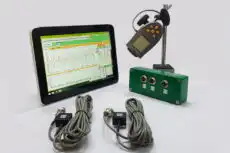
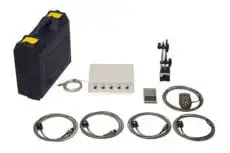
Phase is indispensable for रोटर संतुलन. The 1× phase reading points directly to the angular location of the heavy spot relative to the reference mark, telling the technician exactly where to add or remove a दुरुस्ती वजन. In practice the analyser records amplitude and phase before a trial weight is fitted, again afterwards, and uses the change to compute the इन्फ्लुअन्स कोइफिशंट्स that yield the final correction. A portable two-channel instrument such as the Balanset-1A performs this amplitude-and-phase measurement in the machine’s own bearings at operating speed, then verifies the अवशिष्ट असंतुलन once the weights are in place. For working out the angular split when a correction must be shared between weights, our कंपन फेज अँगल कॅल्क्युलेटर handles the vector geometry.
5. Why Phase Completes the Picture
Without phase, a vibration analyst sees only part of the story — magnitudes and frequencies, but no sense of how the structure actually deforms through each turn. Phase supplies that missing context, converting a list of peaks into a clear statement of motion and lifting diagnostic confidence dramatically. It is the difference between knowing that a machine vibrates and knowing why. For that reason, phase belongs in every serious diagnosis and is the non-negotiable foundation of field balancing.

