Understanding Signal Filtering

Signal filtering is a crucial signal-processing technique used in vibration analysis to remove unwanted frequency components from a signal or to isolate specific frequencies of interest. A filter is essentially an electronic circuit or a software algorithm that allows certain frequencies to “pass” through while blocking or attenuating others. It is one of the quiet workhorses of the discipline: filtering runs continuously inside every digital vibration analyzer to ensure that the data being analysed is clean, accurate, and relevant to the diagnostic task at hand.
1. Definition: What is Signal Filtering?
Every raw vibration measurement is a blend of the signals you want and the signals you do not — sensor noise, structural resonances, electrical hum, and energy from frequency ranges that simply do not concern the current job. A filter is defined by its cut-off frequency (the point at which it begins to attenuate) and its roll-off (how steeply it attenuates beyond that point). The art of filtering lies in passing the diagnostic content of a signal while suppressing everything that would obscure it. Done well, it is invisible; done badly, it can hide the very fault you are hunting for.
2. Common Types of Filters in Vibration Analysis
There are four basic types of filter used in signal processing, and each has a dedicated role in the analyser’s signal chain:
- Low-Pass Filter: allows low frequencies to pass through but blocks high frequencies. The frequency at which the signal starts to be attenuated is the cut-off frequency.
- High-Pass Filter: the opposite of a low-pass filter — it allows high frequencies to pass and blocks low frequencies.
- Band-Pass Filter: allows a specific band or range of frequencies to pass while blocking both lower and higher frequencies. It is, in effect, a high-pass and a low-pass filter working together.
- Band-Stop (or Notch) Filter: the opposite of a band-pass filter — it blocks a narrow band of frequencies while allowing all others through. A notch filter is the tool of choice for rejecting a single nuisance tone, such as mains-frequency electrical interference.
3. Key Applications of Filtering
Filters are used in several critical ways within a vibration analyser.
a) Anti-Aliasing Filters
This is arguably the most important application of filtering. The anti-aliasing filter is a steep low-pass filter applied to the analogue signal before it is digitised. Its purpose is to remove all frequency content above the maximum frequency (Fmax) the user has selected for the measurement.
This is essential to prevent aliasing, a serious digital-signal-processing error in which high frequencies “fold down” and disguise themselves as lower ones, producing a completely incorrect spectrum from otherwise good data. Because aliasing cannot be undone once the data is sampled — the false peaks are indistinguishable from real ones — the anti-aliasing filter must act in the analogue domain, ahead of the converter. It is the single component that guarantees the integrity of all digital vibration data.
b) Integration and Differentiation
Vibration is measured as acceleration, velocity, or displacement. While an accelerometer is the most common sensor, an analyst often wants to view the data in terms of velocity, which usually requires the analyser to integrate the acceleration signal. Integration severely amplifies very low-frequency noise — the familiar “ski-slope” that rises steeply toward zero Hz. A high-pass filter removes this noise before integration to produce a clean, usable velocity or displacement spectrum. The reverse operation, differentiation, has the opposite tendency and amplifies high-frequency noise instead.
c) Envelope Analysis (Demodulation)
Envelope analysis, the primary technique for detecting bearing defects, relies heavily on filtering. The process involves:
- Using a band-pass filter to isolate a high-frequency band where the bearing impact signals — and any structural resonance they excite — are present.
- Processing this filtered signal through demodulation to extract the repetition rate (the “envelope”) of the impacts.
- Analysing the spectrum of this envelope signal to identify the bearing fault frequencies.
The band-pass filter is crucial here for removing the high-energy, low-frequency signals — such as unbalance at running speed — that would otherwise swamp the tiny, low-energy bearing-defect signals long before they reach a dangerous size.
d) Diagnostic Filtering
Analysts can also apply digital filters to data after it has been collected, to aid diagnosis. For example, a band-pass filter can isolate the vibration around a specific gear mesh frequency to get a clearer look at the sidebands that reveal a developing gear fault. An order-tracking filter performs a related job on variable-speed machines, locking onto a chosen multiple of running speed as it changes.
4. Filtering in Field Balancing
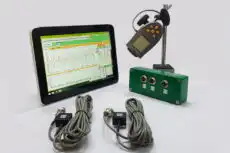
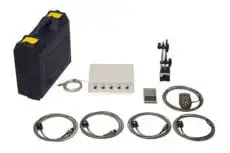
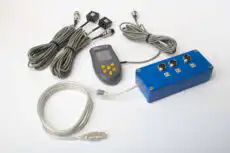
Filtering is not only a diagnostic aid — it is fundamental to field balancing. To balance a rotor, the instrument must extract the vibration at exactly 1× running speed and reject everything else. A portable two-channel analyser such as the Balanset-1A uses a synchronous tracking filter, referenced to the once-per-revolution pulse from its tachometer, to measure the 1× amplitude and phase cleanly even when broadband noise is high. Without that filtering, the small, repeatable 1× vector needed to compute a correction weight would be lost in the surrounding noise.
5. Pitfalls and Good Practice
- Filtering away the evidence: too aggressive a low-pass setting can remove the high-frequency content that holds the earliest bearing-defect symptoms. Choose Fmax to suit the fault you are looking for.
- Phase distortion: filters shift the phase of the signal near their cut-off. Where phase matters — balancing, orbit plots — a filter with a well-behaved, linear phase response is essential.
- Forgetting the band: in envelope analysis, picking a band-pass centre that misses the resonance carrying the bearing energy gives a flat, useless envelope spectrum.

