Understanding the Velometer (Velocity Sensor)
A velometer, more formally a velocity transducer or velocity sensor, is a type of transducer used to measure vibration. Its defining feature is that it produces an electrical output directly proportional to the velocity of the vibrating surface it is attached to. This sets it apart from an accelerometer, whose output is proportional to acceleration, and from a proximity probe, whose output is proportional to displacement.
Compare with the vibrometer, which reports overall vibration severity.
1. Definition: What Is a Velometer?
Because velocity is the parameter most international standards use to judge how rough a machine is running, a sensor that reports velocity directly is conceptually appealing. The classic velometer is a self-contained, self-generating device — it needs no power supply and no signal conditioning to produce a usable output. While it is now less common than the accelerometer in modern portable data collection, the velometer still has genuine applications, particularly in the permanent monitoring of medium-speed machinery and as a member of the broader family of seismic transducers that measure motion relative to free space rather than to a fixed structure.
2. How a Velometer Works
Traditional velometers are electrodynamic sensors. They work on the same principle as a dynamic microphone or a guitar pickup, governed by Faraday’s law of induction:
- Inside the housing is a coil of wire suspended on soft springs.
- A permanent magnet is fixed rigidly to the housing.
- When the sensor is mounted on a vibrating machine, the housing and magnet move with the machine surface.
- Because of its inertia, the spring-suspended coil tends to stay still in space (this is the seismic principle).
- The relative motion between the moving magnet and the near-stationary coil induces a voltage in the coil.
- By Faraday’s law, that induced voltage is directly proportional to the velocity of the relative motion — exactly the quantity we want.
The spring-mass system only behaves this way above its own natural frequency (often around 8–10 Hz), which is what sets the sensor’s low-frequency limit. Modern “piezoelectric velometers” also exist: these are essentially accelerometers with a built-in electronic integration circuit that converts acceleration to a velocity signal inside the sensor itself, sidestepping the fragile moving parts of the electrodynamic design.
3. Advantages and Disadvantages of Velometers
Advantages
- Direct velocity output: they measure velocity straight away — the parameter most used for assessing vibration severity on general-purpose machinery in the roughly 10 Hz to 1,000 Hz band (per ISO 20816, the modern successor to ISO 10816). No integration is required in the analyser, which keeps the signal chain simple.
- Self-powered (passive): traditional electrodynamic velometers generate their own signal and need no external power, which is useful in some industrial and hazardous-area installations.
- Good low-frequency response: above their natural frequency they are generally more sensitive at lower frequencies than many general-purpose accelerometers, giving a strong, clean signal where unbalance and misalignment live.
Disadvantages
- Limited frequency range: their usable band is narrower than an accelerometer’s. They are not suited to the high-frequency impacts of bearing defects or gear defects, which fall well above their roll-off.
- Moving parts: the internal spring-and-coil assembly can fatigue, drift or fail outright, especially in high-vibration service.
- Sensitivity to orientation: they must be installed in the orientation they were designed for (vertical or horizontal), because gravity preloads the spring suspension.
- Larger and heavier: they are typically much bigger and heavier than a modern accelerometer, which can mass-load lightweight structures.
- Sensitivity to magnetic fields: strong external fields, such as those near large motors, can couple into the coil and corrupt the reading.
4. Velometer vs. Accelerometer
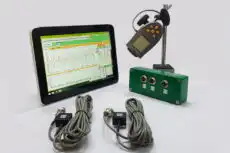
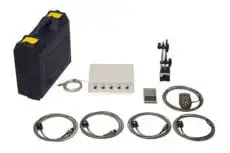
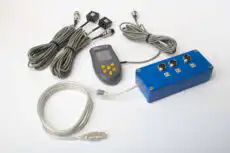
For modern portable data collection and vibration diagnostics, the accelerometer is the sensor of choice. Its frequency response is far wider and flatter, so a single accelerometer captures both the low-frequency vibration from unbalance and the very high-frequency vibration from bearing and gear faults. The vibration analyzer then integrates the acceleration signal electronically to display velocity or displacement on demand — one rugged sensor covering everything the velometer did and much more besides. This is exactly how the portable two-channel Balanset-1A works in the field: it takes acceleration from its accelerometers, integrates to velocity for severity assessment against the ISO grades, and uses the same signal to measure the 1× amplitude and phase needed for single- and two-plane balancing. If you need to translate readings between sensor types, our Vibration Unit Converter moves cleanly between mm/s, µm and g.
Velometers, then, are now found mostly as permanently installed sensors on medium-speed machines — fans, pumps and motors — and especially in older plants where they were the originally specified monitoring transducer and continue to do honest work decade after decade.