Understanding Vibration Displacement




Displacement is a measure of the total distance a vibrating object moves from its position of rest (equilibrium). It quantifies how far a component travels back and forth. As the most direct, physically intuitive representation of vibratory motion, displacement is a fundamental parameter in vibration analysis — particularly for low-frequency work and for any question that comes down to mechanical clearance. It is one of the three classic amplitude parameters, alongside velocity and acceleration, each describing the same motion seen through a different lens.
1. Definition: What is Displacement in Vibration?
The three amplitude parameters are linked by calculus: velocity is the rate of change of displacement, and acceleration is the rate of change of velocity. Mathematically, integrating an acceleration signal twice yields displacement, while differentiating a displacement signal twice yields acceleration. The practical consequence is that the same vibration looks very different depending on which parameter you plot — and displacement is the one that emphasises slow, large-amplitude motion. That bias is precisely what makes it valuable in the right situations and misleading in the wrong ones.
2. Why and When to Measure Displacement
While velocity is the most common parameter for general machine health, displacement is the preferred measurement in several specific, critical scenarios:
- Low-frequency analysis: for a given vibration energy, displacement dominates at low frequencies. On slow-speed machinery — typically below 600 RPM, or 10 Hz — such as large fans, cooling towers, and paper machines, displacement is the most sensitive and representative indicator of vibration severity.
- Assessing clearances: displacement is a direct measurement of physical movement. This is crucial for determining whether a rotating shaft retains enough clearance to avoid rubbing against stationary components such as bearings or seals — the prelude to a rotor rub.
- Structural deflection: when analysing the movement of bases, frames, or piping, displacement is used to understand the mode shapes and to confirm that deflections stay within design limits.
- Balancing of low-speed rotors: during the balancing of large, slow-moving rotors, displacement measurements are often used to quantify the unbalance.
3. Units and Measurement
Common Units
Vibration displacement is typically expressed in one of two units:
- Mils: the industry standard in the United States, where 1 mil equals one-thousandth of an inch (0.001″).
- Micrometres (µm): the SI unit, where 1 µm equals one-millionth of a metre. As a conversion, 1 mil ≈ 25.4 µm.
Displacement is almost always quoted in peak-to-peak (Pk-Pk) terms, because this value represents the total travel of the component — the figure that matters most for clearance analysis. Reporting displacement as a single peak or RMS value, while valid, hides the full swing the engineer actually cares about.
How is it Measured?
Displacement can be measured in several ways:
- Proximity probes: the most common method for shaft vibration. A non-contact eddy-current probe is mounted on a stationary part and measures the changing gap between its tip and the rotating shaft, giving the relative displacement of the shaft within its bearing. This is the sensor at the heart of permanently installed protection systems governed by standards such as API 670.
- Integration from accelerometers: a standard accelerometer measures acceleration; its signal can be electronically integrated once to obtain velocity and a second time to obtain displacement. This is a common feature of modern data collectors, but double integration is prone to noise and error at very low frequencies — the so-called “ski-slope” — and usually needs filtering to stay reliable. Note that this yields absolute housing displacement, not the shaft-relative value a proximity probe gives.
- Laser displacement sensors: non-contact optical sensors that use a laser beam to provide highly accurate displacement measurements without loading the structure.
4. Displacement in the Field and in Balancing
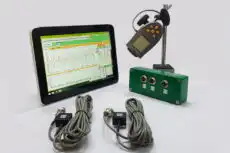
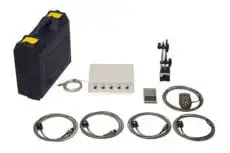
On rotating machinery the displacement question is often “is the shaft staying clear of the bearing?”, and on slow rotors it doubles as the balancing signal. A portable two-channel analyser such as the Balanset-1A captures the 1× amplitude and phase at running speed — referenced to a once-per-revolution tachometer pulse — and works equally in displacement, velocity, or acceleration terms. For a large, slow fan where the 1× motion barely registers as acceleration, viewing the same vibration as displacement makes the unbalance obvious and lets the instrument compute the right correction weight and verify the residual unbalance afterwards.
5. Displacement’s Role in Diagnostics
High displacement at the shaft’s rotational frequency (1× RPM) on a low-speed machine often points to unbalance, but displacement’s deeper diagnostic value comes from its relationship with velocity and acceleration. For a given amount of vibration energy:
- at low frequencies, displacement has the highest amplitude;
- at mid-range frequencies, velocity has the highest amplitude;
- at high frequencies, acceleration has the highest amplitude.
Because of this, analysts use displacement to focus on low-frequency phenomena that might be all but invisible in an acceleration spectrum — the kind of motion they would otherwise miss entirely. A machine can be undergoing severe, damaging low-frequency movement that generates very little acceleration — which is exactly why displacement remains a critical part of a complete diagnostic toolkit, and why no single parameter tells the whole story on its own.

