Understanding Wavelet Analysis


Wavelet Analysis is an advanced signal-processing technique used to analyse vibration signals whose frequency content changes over time. Unlike the traditional Fast Fourier Transform (FFT), which is best suited to stationary signals with constant frequency content, wavelet analysis effectively captures transient events, shocks, and other non-stationary behaviour. It is a specialist instrument in the vibration diagnostics toolkit — reached for precisely when the standard spectrum falls short.
It works by decomposing a signal into a set of basis functions called “wavelets.” Each wavelet is a short, oscillating wave-like packet that is localised in both time and frequency. This dual localisation — knowing both what frequency and when — is what gives the method its distinctive power.
1. Definition: What is Wavelet Analysis?
Most everyday vibration analysis assumes the machine runs at steady speed and load, so its vibration is “stationary” and a single spectrum describes it well. Many of the most revealing faults, however, are not steady at all: they are brief bursts of energy that come and go within a revolution. Wavelet analysis is built for exactly these signals. Rather than asking only which frequencies are present across the whole record, it slides wavelets of different sizes along the time waveform, measuring how strongly each one matches the signal at each instant. Short, high-frequency wavelets pinpoint sharp impacts in time; long, low-frequency wavelets resolve slow components in frequency.
2. Wavelet Analysis vs. the FFT
To appreciate the value of wavelet analysis, it helps to see the limitation of the FFT:
- FFT (Fast Fourier Transform): the FFT tells you what frequencies are present but gives no information about when they occurred. It analyses the entire record at once, providing excellent frequency resolution but zero time resolution.
- Wavelet Analysis: wavelet analysis tells you both what frequencies are present and when. It produces a “time-frequency” map of the signal, showing how the spectral content evolves through the measurement.
Imagine a signal containing a short “click” from a cracked gear tooth. The FFT might show only a slight rise in broadband energy, because the click is averaged out over the whole record. Wavelet analysis, by contrast, produces a plot that clearly shows a burst of high-frequency energy at the exact moment the click occurred. This is the practical advantage: it preserves the timing of events that the FFT smears away. It is closely related in spirit to order analysis, which also addresses signals where the simple fixed-frequency picture breaks down.
3. The Scalogram: A Time-Frequency Map
The most common output of wavelet analysis is a scalogram (or a similar time-frequency plot) — a 2D colour map where:
- The X-axis represents time.
- The Y-axis represents frequency (or scale).
- The colour represents the amplitude or energy of the vibration at that specific time and frequency.
This visualisation makes transient events easy to spot where they would be hidden in a standard spectrum. A vertical line of “hot” colour on a scalogram, for instance, marks a broadband event such as an impact that occurred at one precise instant — the visual fingerprint of a localised, repetitive fault. Conceptually the scalogram complements other advanced displays like the waterfall plot, which tracks how a spectrum changes across many successive averages or speeds.
4. Applications in Vibration Diagnostics
Wavelet analysis is not typically used for routine vibration monitoring, but it is a powerful tool for advanced diagnostics in specific situations:
- Gearbox Analysis: exceptionally good at detecting localised faults such as a single cracked or broken tooth, which generates a distinct impact once per revolution.
- Bearing Defect Analysis: able to detect the individual impacts caused by a rolling element passing over a spall, especially in very slow-speed machinery where conventional envelope analysis can be challenging.
- Transient Event Analysis: ideal for signals from machine startup, shutdown, or any process where speed and vibration characteristics change constantly.
- Structural Analysis: useful for analysing a structure’s response to an impact — a bump test — to understand its damping and natural frequencies.
5. Practical Use and Limitations
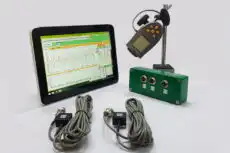
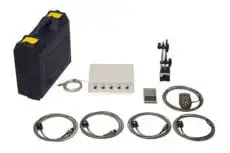
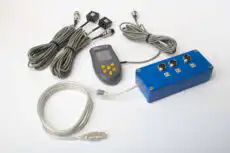
Wavelet analysis is computationally more intensive than the FFT, and interpreting a scalogram demands more experience than reading a line spectrum. For these reasons it sits alongside, rather than replacing, the everyday techniques. Day-to-day fault-finding still leans on the FFT spectrum, overall levels, and envelope analysis; wavelets are deployed when those tools flag something unusual but cannot localise it in time. In the field the data itself is gathered with a portable instrument — a two-channel analyzer such as the Balanset-1A captures the high-quality time waveforms, recorded in the machine’s own bearings at operating speed, that any subsequent time-frequency study depends on. Modern computer software has nonetheless made wavelet analysis an accessible and valuable resource for the advanced analyst dealing with complex, non-stationary signals.

