ISO 1940-1 — Balance Quality Requirements for Rigid Rotors



The foundational international standard defining the G-grade balance quality system — from G 0.4 (gyroscopes) to G 4000 (marine diesels). Now incorporated into ISO 21940-11, with identical G-grade values and methodology.
Permissible Residual Unbalance
ISO 1940-1 / ISO 21940-11 — enter rotor data, get Uper
Results — ISO 1940-1
Permissible residual unbalance
to calculate tolerance
G-Grade Balance Quality Grades
Logarithmic scale with factor 2.5 between adjacent grades — from ultra-precision G 0.4 to marine G 4000
| G-Grade | e·ω (mm/s) | Typical Rotor Types | Notes |
|---|---|---|---|
| G 0.4 | 0.4 | Gyroscopes, precision spindles, optical disc drives | Near limit of conventional balancing |
| G 1.0 | 1.0 | Grinding spindle drives, tape recorders, small precision armatures | Requires ultra-clean conditions |
| G 2.5 | 2.5 | Gas & steam turbines, turbo-generators, turbo-compressors, high-speed motors | Prevents premature bearing damage |
| G 6.3 | 6.3 | Fans, pumps, flywheels, electric motors, machine tools, paper rolls | Most common — default grade |
| G 16 | 16 | Cardan shafts (special), agricultural machinery, crushers, mine fans | Heavy-duty, severe conditions |
| G 40 | 40 | Car wheels and rims, cardan shafts (standard), slow fans | Tyre variation dominates |
| G 100 | 100 | Complete engines of cars, trucks, locomotives | IC engines as assemblies |
| G 250 | 250 | Crankshafts of high-speed diesel engines | Component-level |
| G 630 | 630 | Crankshafts of large 4-stroke engines, marine diesels on elastic mounts | Large low-speed reciprocating |
| G 1600 | 1600 | Crankshafts of large 2-stroke engines | Very slow, massive foundations |
| G 4000 | 4000 | Crankshafts of low-speed marine diesels on rigid foundations | Loosest requirements |
| Rotor Type | Mass (kg) | RPM | G | Uper (g·mm) | Per Plane | eper (µm) |
|---|---|---|---|---|---|---|
| Small motor | 8 | 2 900 | G 6.3 | 166 | 83 | 20.7 |
| HVAC fan | 45 | 1 480 | G 6.3 | 1 835 | 918 | 40.8 |
| Pump impeller | 25 | 2 950 | G 6.3 | 510 | 255 | 20.4 |
| Turbo-compressor | 120 | 8 000 | G 2.5 | 358 | 179 | 3.0 |
| Paper roll | 2 000 | 300 | G 6.3 | 401 000 | 200 500 | 200.5 |
| Power-plant fan | 350 | 990 | G 2.5 | 8 468 | 4 234 | 24.2 |
| Grinding spindle | 2 | 24 000 | G 1.0 | 0.80 | 0.40 | 0.40 |
| Car wheel | 12 | 800 | G 40 | 5 729 | 2 865 | 477 |
| Rotor Type | Allocation | Formula | Notes |
|---|---|---|---|
| Symmetric | Equal split | UL=UR=Uper/2 | Simplest case. Motors, some fans. |
| Asymmetric between-bearing | Proportional | UL=Uper·(b/L) | Most common method. |
| Overhung (cantilever) | Moment-based | Statics eqns | Tighter tolerances on overhung plane. |
| Narrow (planes close) | Separate static+couple | Per ISO 21940-12 | Different vibration effects. |
What is ISO 1940-1?
ISO 1940-1 (Mechanical vibration — Balance quality requirements of rotors in a constant (rigid) state) defines the G-grade balance quality system for rigid rotors. The formula Uper = (9 549 × G × M) / n calculates permissible residual unbalance. Superseded by ISO 21940-11:2016 with identical values. Default grade for industrial machinery: G 6.3.
ISO 1940-1 is the foundational document for rotor balancing worldwide. Its G-grade system is the de facto language of balancing: "balance to G 6.3" is understood by every specialist globally. The standard covers rigid rotors from tiny precision spindles to massive crankshafts, providing a universal framework for specifying, calculating, and verifying balance quality.
The standard applies only to rigid rotors — those whose elastic deformations under centrifugal forces are negligible across the operating speed range. Flexible rotors (operating above the first bending critical speed) are covered by ISO 21940-12.
The Rigid Rotor Concept
A rotor is classified as rigid if its mass distribution does not change significantly as speed varies from zero to maximum operating speed. The key consequence: a rotor balanced at low speed on a balancing machine remains balanced at its operating speed. This allows balancing at 300–600 RPM on a workshop machine while meeting tolerances at 3 000+ RPM in service.
If a rotor operates in the supercritical region (above the first bending critical speed) or near resonance, deflections change the effective mass distribution, and low-speed balancing may be ineffective at high speed. Such rotors are classified as flexible.
Rotors with changing geometry (articulated shafts, helicopter blades). Resonance in rotor–support–foundation systems. Aerodynamic and hydrodynamic forces not related to mass distribution. For fans specifically, see ISO 14694 (BV/FV categories).
Types of Unbalance
Unbalance = rotor's inertia axis ≠ rotation axis. In vector form: U = m × r (g·mm). ISO 1940-1 classifies three types:
- Static unbalance: Inertia axis parallel to rotation axis but displaced. Single unbalanced mass equivalent. Correctable in one plane. Typical: pulleys, narrow gears, fan impellers (L/D < 0.5).
- Couple unbalance: Inertia axis through centre of mass but tilted. Net force zero, but a couple (pair) rocks the rotor. Requires two planes.
- Dynamic unbalance: General case — static + couple combined. Inertia axis neither parallel nor intersecting rotation axis. Requires two planes. Most real rotors have dynamic unbalance.
Specific Unbalance (Eccentricity)
The G-grade is defined as the product e × ω (mm/s) — the linear velocity of the rotor's centre of mass orbiting the rotation axis. This single number characterises balance quality independently of rotor size and speed.
The G-Grade System — Physical Basis
Mass Similarity
For geometrically similar rotors: Uper ∝ M → specific unbalance eper should be constant. One standard applies across all sizes.
Speed Similarity
Centrifugal force F = M·e·ω². To maintain acceptable bearing loads at different speeds, eper must decrease as ω increases:
Calculating Permissible Residual Unbalance
Given: Centrifugal fan impeller, M = 200 kg, n = 1 500 RPM, G 6.3.
Total: Uper = 9 549 × 6.3 × 200 / 1 500 = 8 021 g·mm
Eccentricity: eper = 8 021 / 200 = 40.1 µm
Per plane (symmetric, 2): 8 021 / 2 = 4 011 g·mm
At R = 400 mm: 4 011 / 400 = 10.0 g per plane
The speed in the formula must be the highest RPM in service — not balancing machine speed. Many rotors are balanced at 300–600 RPM but tolerance must use actual service speed (e.g. 1 480 RPM). Using balancing machine speed produces dangerously loose tolerances.
Allocation to Correction Planes
Uper applies to the rotor's centre of mass. In practice, balance in two planes (near bearings). Chapter 7 rules:
Symmetric Rotors
CoM at midpoint → equal: UL = UR = Uper / 2.
Asymmetric Between-Bearing
Overhung Rotors
Overhung mass creates bending moment loading both bearings. Moment-based recalculation needed → typically much tighter tolerance on overhung plane. Common for pumps, single-stage compressors, cantilevered fan impellers.
Errors and Verification
Error Sources
- Systematic: Machine calibration drift, eccentric mandrels, keyway effects (ISO 8821), thermal distortion.
- Random: Sensor noise, support play, rotor seating variation.
Total error must not exceed 10–15% of tolerance. If larger, tighten working tolerance accordingly.
Assembly Effects
Component balancing ≠ assembly balance. Coupling eccentricity, radial runout, loose fits can negate component work. Trim balance the assembled rotor.
Verification Methods
- Index test: Rotate rotor 180° on mandrel, remeasure. Change = fixture error.
- Trial weight test: Add known mass, verify measured vector change matches expectation.
- Field check: Measure vibration on bearings per ISO 10816.
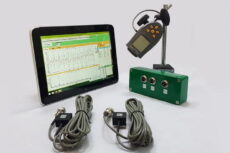
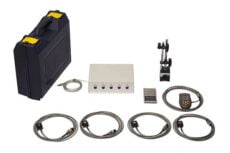
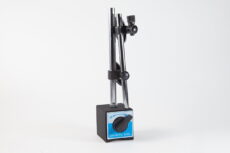
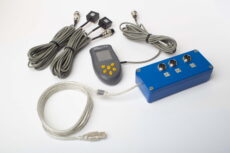
The Balanset-1A automates ISO 1940-1: enter mass, speed, G-grade → instant Uper with automatic plane allocation. After balancing, compares residual vs. limit. The F6 Reports function generates a formal protocol documenting the achieved G-grade. Accuracy ±5% velocity, ±1° phase — sufficient for G 16 through G 2.5. The Balanset-4 extends to four channels for complex multi-bearing rotors.
Worked Examples
Rotor: 15 kW, 1 460 RPM, 35 kg, between-bearing symmetric.
Tolerance: Uper = 9 549 × 6.3 × 35 / 1 460 = 1 442 g·mm → 721/plane.
At R = 80 mm: 721 / 80 = 9.0 g/plane. Shop balanced: 180 g·mm residual. ✅
Rotor: Shaft + impeller 18 kg, 2 950 RPM. Impeller 6 kg overhung 120 mm. Bearing span 250 mm.
Total: Uper = 367 g·mm. Moment allocation: front ≈ 202, rear ≈ 165 g·mm.
Field balanced with Balanset-1A single-plane: 8.5 g at 230°. Final: 95 g·mm. ✅
Rotor: 3-stage, 65 kg, 12 000 RPM. Slightly asymmetric.
Tolerance: Uper = 129 g·mm → 65/plane → at R = 95 mm: 0.68 g/plane.
Sub-gram precision → shop high-speed machine only. Index test: mandrel error < 5 g·mm. Final: 28 g·mm/plane. ✅
ISO 1940-1 → ISO 21940-11
- G-grade values, formulas, application tables — identical. No technical changes.
- ISO 21940 series: Part 11 (quality), Part 12 (flexible), Part 14 (procedures), Part 21 (descriptions), Part 31 (susceptibility), Part 32 (keys).
- Both designations used interchangeably in practice.
- ISO 14694 BV categories reference G-grades directly.
Related Standards
- ISO 21940-11: This standard — G-grade system.
- ISO 21940-12: Flexible rotor balancing.
- ISO 10816 / ISO 20816: Vibration evaluation — operational result of balance quality.
- ISO 14694: Fan-specific BV/FV categories → G-grades.
- ISO 8821: Keyway influence (half-key convention).
- API 610 / API 617: Petroleum pumps/compressors referencing ISO 1940.
Official standard: ISO 1940-1 on ISO Store →
Frequently Asked Questions — ISO 1940-1
G-grade balance quality system for rigid rotors
Related Glossary Articles
Balance to ISO 1940-1 — In the Field
Vibromera portable balancers include built-in ISO 1940 tolerance calculators, automatic plane allocation, and formal balance reports documenting the achieved G-grade.
Browse Balancing Equipment → EN
EN  AR
AR  AZ
AZ  BG
BG  ZH
ZH  HR
HR  CS
CS  DA
DA  NL
NL  ET
ET  FI
FI  FR
FR  DE
DE  KA
KA  EL
EL  HE
HE  HI
HI  HU
HU  ID
ID  IT
IT  JA
JA  KO
KO  LV
LV  LT
LT  MS
MS  NB
NB  FA
FA  PL
PL  PT_BR
PT_BR  PT
PT  RO
RO  SR
SR  SK
SK  SL
SL  ES
ES  SV
SV  TH
TH  TR
TR  UR
UR  UK
UK  VI
VI 