Understanding the Keyphasor
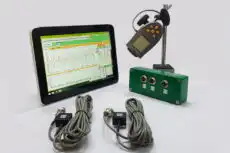
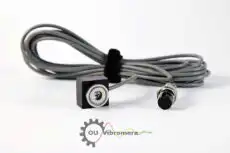
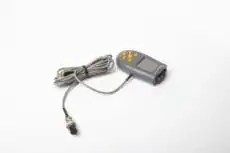
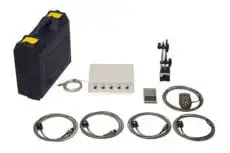
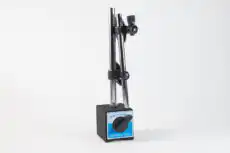

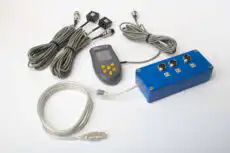
A Keyphasor is the Bently Nevada trade name for a sensor that supplies a once-per-revolution timing reference from a rotating shaft. Although “Keyphasor” is a trademark, the term is used generically across industry for any equivalent phase-reference transducer or tachometer. The sensor is most often an eddy-current proximity probe aimed at a single, unique feature on the shaft — a keyway, a notch, a drilled hole or a flat spot. Each time that feature sweeps past the probe tip the output voltage produces a sharp, repeating pulse that marks the exact rotational position of the shaft at that instant.
1. Definition: What Is a Keyphasor?
Functionally the Keyphasor pulse is identical to the signal from an optical tachometer firing on reflective tape; the difference is mainly the sensing technology and the fact that a proximity-probe Keyphasor is usually a permanent fixture on a critical machine. What matters is the information the pulse carries: it defines t = 0 for every revolution, giving the analyser a fixed angular datum against which every vibration sample can be timed. That one reference is what separates a raw vibration trace from a fully interpretable diagnostic record.
2. Why Is a Keyphasor Signal Essential?
After the vibration signal itself, the Keyphasor is arguably the most valuable signal in advanced rotor diagnostics. It unlocks several capabilities that are simply impossible with amplitude data alone.
Phase Measurement
The Keyphasor’s primary job is to enable measurement of phase — the timing relationship between the pulse and the peak of the 1× (running-speed) vibration. This phase angle is the rotor’s response phase relative to the pulse — it does not point at the heavy spot (unbalance) directly, because the response lags the heavy spot by an amount that depends on how close the running speed is to a resonance (from near 0° well below it, through 90° at it, to near 180° above it), plus instrumentation delays. The correction angle is therefore derived with the influence-coefficient (trial-weight) method, and a repeatable phase reading is indispensable for:
- Balancing: every balancing procedure, on a machine or in the field, relies on amplitude-and-phase data to decide where to add or remove a correction weight.
- Fault diagnostics: faults such as misalignment or a bent shaft carry characteristic phase signatures used to confirm the diagnosis.
If you need to combine or resolve vibration vectors by hand while interpreting these readings, our Vibration Phase Angle Calculator handles the trigonometry.
Accurate Speed Measurement
By timing the interval between pulses the analyser derives a highly accurate rotational speed (RPM), which is fundamental for relating vibration frequencies to the shaft’s actual motion and for separating shaft-related components from everything else.
Order Analysis
Using the Keyphasor as a timing reference lets a vibration analyzer perform order analysis. Instead of a spectrum with a frequency (Hz) axis, the analyser displays an order-based spectrum, where an “order” is a multiple of running speed (1×, 2×, 3× and so on). This is invaluable on variable-speed machines, because an order peak — the 1× unbalance peak, for instance — stays fixed on the plot even as RPM changes, making trends and patterns far easier to follow.
Advanced Plot Generation
The Keyphasor signal is a prerequisite for the most powerful diagnostic plots in vibration analysis:
- Bode plots: amplitude and phase versus speed, used to identify critical speeds during startup and shutdown.
- Polar plots: another view of run-up/coast-down data, tracking the vibration vector’s magnitude and phase as a single curve.
- Orbit plots: built from a pair of X-Y proximity probes, with the Keyphasor pulse placing a blanking dot on the orbit that reveals the direction of shaft precession and helps diagnose problems such as oil whirl or a shaft crack.
3. Installation and Setup
Proper installation is critical. The probe must be mounted rigidly and aimed at a single, clean, distinct event on the shaft — multiple features or a reflective second mark cause double triggering and a falsely doubled RPM. The gap between probe tip and shaft must be set within the linear range, and the voltage output configured so the data-acquisition system triggers on a clean, sharp edge every revolution. A weak, noisy or intermittent pulse corrupts phase and undermines every downstream calculation, so verifying pulse quality is time well spent before a balancing run.
4. The Keyphasor in Practical Field Work
On permanently instrumented turbomachinery the Keyphasor is a fixed proximity-probe channel wired into the monitoring system alongside its companion eddy current probes. On general-purpose machines that carry no such instrumentation, a portable analyser brings the same once-per-revolution reference to the job with an optical tachometer triggering off a strip of reflective tape. The two-channel Balanset-1A works this way: its tachometer pulse provides the phase datum the software needs to compute the mass and angle of each balance weight and to verify the residual unbalance after correction. Whether the pulse comes from a built-in Keyphasor or a clip-on optical sensor, that timing mark is the backbone of the entire balancing and diagnostic workflow.

