Understanding Air Gap in Electric Motors






The air gap is the narrow radial clearance between the outer surface of the rotor and the inner bore of the stator in an electric motor or generator. Typically only 0.3–2.0 mm (0.012–0.080 in) wide, this thin annular space is the magnetic bridge across which electromagnetic energy passes between the stationary windings and the rotating member. Despite its modest size, the air gap is one of the most decisive dimensions in machine design: it governs efficiency, power factor, starting torque, and — of direct interest to the reliability engineer — the machine’s susceptibility to unbalanced magnetic pull and the resulting vibration.
1. Definition: What is the Air Gap?
The air gap is the clearance that separates rotor and stator iron so the rotor can turn freely while still allowing magnetic flux to cross from one to the other. Functionally it is the highest-reluctance element in the entire magnetic circuit — air is roughly a thousand times less permeable than electrical steel — so its width and uniformity dominate how the magnetic field behaves. Two properties matter independently: the magnitude of the gap (how wide it is) and its uniformity (whether it is the same all the way around the bore).
Both have profound consequences. A non-uniform gap produces unbalanced radial magnetic forces that drive vibration and accelerate bearing wear, while an excessively wide gap quietly erodes efficiency and inflates the magnetising current the motor draws to establish its flux. The art of motor design is choosing the smallest gap the mechanics will safely tolerate.
2. Typical Air Gap Dimensions
Absolute gap grows with machine size, but as a fraction of bore diameter it shrinks — large machines run proportionally tighter gaps because their rotors are stiffer relative to their diameter.
By Motor Size
- Small motors (< 10 HP): 0.3–0.6 mm (0.012–0.024 in).
- Medium motors (10–200 HP): 0.5–1.2 mm (0.020–0.047 in).
- Large motors (200–1000 HP): 1.0–2.0 mm (0.040–0.080 in).
- Very large motors (> 1000 HP): 1.5–3.0 mm (0.060–0.120 in).
- General trend: larger machines have larger absolute gaps but a smaller gap as a percentage of diameter.
By Motor Type
- Induction motors: larger gaps, 0.5–2.0 mm typical.
- Synchronous motors: broadly similar to induction machines.
- DC motors: very small armature gaps, 0.3–1.0 mm.
- High-efficiency designs: tend toward the smaller end of their class for better performance.
3. Why the Air Gap Matters
Electromagnetic performance
- Magnetic-circuit reluctance: the air gap is the dominant reluctance in the flux path; everything else (the steel) is comparatively transparent.
- Magnetising current: a smaller gap needs less magnetising current to establish the same flux, which lifts the power factor.
- Efficiency: smaller gaps are generally more efficient because they reduce magnetising losses.
- Torque production: a tighter gap gives stronger magnetic coupling and therefore better torque, including starting torque.
Mechanical considerations
- Clearance: the gap must absorb shaft deflection, bearing tolerances and thermal growth without the rotor ever touching the stator.
- Safety margin: it prevents rotor–stator contact during vibration transients or unusual operating conditions.
- Manufacturability: the chosen gap must be achievable repeatably within normal production tolerances.
These two pressures pull in opposite directions, which is why the air gap is fundamentally a trade-off rather than a value to minimise blindly. The mechanical reality of eccentricity in service means a designer who chooses too tight a gap simply trades efficiency for the risk of a destructive rub.
4. Air Gap Eccentricity
Air gap eccentricity is non-uniformity of the clearance around the circumference — the single most important air-gap fault for the vibration analyst.
- Uniform gap: the same dimension at every angular position.
- Eccentric gap: varies around the bore — small on one side, larger on the opposite side.
- Quantification: eccentricity = (gmax − gmin) / gaverage, expressed as a percentage.
- Acceptable limit: typically < 10% for sound operation.
Engineers further distinguish static eccentricity (the rotor sits off-centre but the narrow point stays in one fixed location — usually a bore or assembly error) from dynamic eccentricity (the narrow point rotates with the shaft — a bent or eccentric rotor). The two produce subtly different spectral signatures, which is what lets diagnostics tell them apart.
Causes of eccentricity
- Bearing wear: lets the rotor settle off-centre in its housing.
- Manufacturing tolerances: stator bore or rotor not perfectly concentric.
- Assembly errors: misaligned end bells or a cocked rotor.
- Thermal distortion: uneven heating warping roundness.
- Frame distortion: soft foot or mounting stress twisting the frame and bore.
Effects of eccentricity
- Unbalanced magnetic pull (UMP): a net radial force pulling the rotor toward the small-gap side, which tends to worsen the eccentricity in a feedback loop.
- Vibration at line-related frequencies: static eccentricity typically raises a peak at 2× the supply electrical frequency (100 Hz on a 50 Hz supply, 120 Hz on 60 Hz), while dynamic eccentricity appears mainly at 1× running speed with pole-pass sidebands.
- Pole-pass frequency sidebands: a tell-tale diagnostic signature straddling the line-frequency peak.
- Bearing overload: the asymmetric UMP loads one side of the bearing, accelerating wear.
- Efficiency loss: a distorted magnetic circuit is never optimal.
5. Measuring and Assessing the Air Gap
Direct measurement (motor disassembled)
- Feeler gauges: insert blade gauges between rotor and stator at several locations.
- Procedure: measure at 8–12 positions evenly spaced around the circumference.
- Calculate: the average, minimum, maximum and the resulting eccentricity percentage.
- When: during a motor overhaul or bearing replacement, when the rotor is out.
Indirect assessment (motor running)
You rarely get to dismantle a running machine, so the gap’s health is usually inferred from its electrical and mechanical signatures using vibration analysis:
- Vibration at 2× line frequency: elevated amplitude suggests a non-uniform gap — confirm with current and load/no-load checks, since supply imbalance and frame resonance can raise the same peak.
- Pole-pass sidebands: their presence and amplitude track the degree of eccentricity.
- Motor-current signature analysis (MCSA): air-gap effects modulate the stator current and appear in its spectrum.
- Acoustic noise: the intensity of the electromagnetic hum often rises with eccentricity.
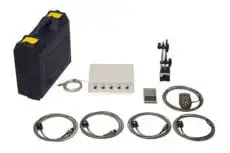
In the field, a two-channel instrument such as the Balanset-1A makes this assessment practical: with accelerometers on the motor’s bearing housings it captures the vibration spectrum at operating speed, letting the analyst spot the 2× line-frequency peak and its pole-pass sidebands without stopping production. Because air-gap symptoms overlap with simple mechanical unbalance, the analyst confirms the electrical origin by watching whether the suspect peak vanishes the instant the motor is de-energised — a coast-down trick that mechanical faults cannot fake. You can convert running speed and line frequency into the exact peaks to look for with our Motor Electrical Defect Frequency Calculator, and check the measured overall level against limits with the ISO 20816 vibration velocity tool.
6. Air Gap Problems and Solutions
Too small (below minimum specification)
Consequences: risk of rotor–stator contact under vibration or deflection; very high magnetic pull if the gap is also eccentric; damage during starting or transients.
- Manufacturing error → remachine the rotor or rebore the stator.
- Wrong rotor installed → replace with the correct rotor.
- Bearing wear letting the rotor shift → replace bearings and verify the gap is restored.
Too large (above maximum specification)
Consequences: reduced efficiency from higher magnetising current, lower power factor, reduced starting torque and higher no-load current. This condition is usually less critical — the machine can run, but with degraded performance.
Non-uniform (eccentric) — the common, problematic case
Eccentricity is the most frequent and most damaging air-gap defect because it is self-reinforcing: UMP pulls the rotor further off-centre, which increases UMP. It typically creates 2× line-frequency vibration (static eccentricity) or 1× vibration with pole-pass sidebands (dynamic eccentricity) and accelerates bearing wear through that positive-feedback loop. The remedy is to replace worn bearings, correct any frame distortion, and verify rotor concentricity.
Diagnostic quick-reference
| Symptom | Likely air-gap issue |
|---|---|
| High 2× line-frequency vibration | Eccentric gap, unbalanced magnetic pull |
| Pole-pass frequency sidebands | Non-uniform gap |
| High no-load current | Excessive gap |
| Low starting torque | Excessive gap |
| Evidence of rubbing | Insufficient gap clearance |
| Asymmetric bearing wear | Eccentric gap creating UMP |
7. Trending, Design and Manufacturing
Because eccentricity develops slowly, the 2× line-frequency component is an ideal parameter to trend over a motor’s life. A steadily rising 2× peak signals developing eccentricity — almost always from bearing wear — and feeds directly into bearing-replacement decisions. Good practice is to document feeler-gauge gap measurements at every overhaul and compare them against both the nameplate specification and the previous reading.
On the design side, the gap is the product of a deliberate trade-off:
- Smaller gap: better efficiency, power factor and torque, but higher magnetic pull when eccentric and less mechanical clearance.
- Larger gap: more mechanical clearance and lower magnetic pull, but worse efficiency and higher magnetising current.
- Optimisation: the smallest gap consistent with the mechanical requirements and the achievable manufacturing tolerances.
Drawings specify a nominal gap with tolerances of roughly ±10–20%, an eccentricity limit (often < 10%), and quality-control verification during manufacture. Maintaining that uniform gap through disciplined bearing maintenance — and verifying it through vibration trending — is what keeps a motor efficient, quiet, and safe from the catastrophic rotor-stator contact that ends a machine’s life in seconds.

