Understanding the Transfer Function



A transfer function — used almost interchangeably with the frequency response function (FRF) in vibration work — is a complex-valued function describing how a mechanical system responds to an input force or motion across frequency. Mathematically it is the ratio of output to input at each frequency, H(f) = Output(f) / Input(f), carrying both magnitude information (how much the system amplifies or attenuates) and phase information (the time delay and resonance behaviour). Where a raw vibration spectrum tells you what a machine is doing, the transfer function tells you what it would do in response to any excitation.
That distinction is what makes the transfer function so powerful. It characterises a structure’s inherent properties — its natural frequencies, damping, stiffness, and mode shapes — independently of whatever forcing happens to be present during operation. This makes it the backbone of modal analysis, structural-modification prediction, resonance diagnosis, and vibration-isolation design.
1. Mathematical Formulation
The basic definition is simply the ratio of two simultaneously measured spectra: H(f) = Y(f) / X(f), where Y(f) is the output (response) spectrum and X(f) the input (excitation) spectrum.
The Cross-Spectrum Estimator
In the real world both signals contain noise, so a naive division amplifies error. The standard practical estimator instead uses spectral averages: H(f) = Gxy(f) / Gxx(f), where Gxy is the cross-spectrum between input and output and Gxx is the auto-spectrum of the input. Because uncorrelated noise on the output averages toward zero in the cross-spectrum, this form (the “H1” estimator) suppresses bias from output noise and is the method used in practice.
The Four Components
Being complex-valued, a transfer function can be viewed four ways, each emphasising something different:
- Magnitude |H(f)|: the amplification factor at each frequency.
- Phase ∠H(f): the phase lag of the output relative to the input.
- Real part: the in-phase component of the response.
- Imaginary part: the quadrature (90°) component, whose peaks neatly mark resonances.
2. Physical Meaning — Reading Magnitude and Phase
What the Magnitude Tells You
- |H| > 1: the system amplifies at this frequency — the resonance region.
- |H| = 1: output equals input, a neutral response.
- |H| < 1: the system attenuates, as in effective isolation or operation well off resonance.
- Peaks occur at natural frequencies, and their height is governed by damping — the taller and sharper the peak, the lower the damping.
What the Phase Tells You
Phase is the more reliable resonance indicator, because it behaves the same regardless of how the plot is scaled:
- 0°: output in phase with input — stiffness-controlled region, below resonance.
- 90°: output lags by a quarter cycle — precisely at resonance.
- 180°: output exactly opposed to input — mass-controlled region, above resonance.
The hallmark of a genuine resonance is this characteristic 180° phase shift as frequency sweeps from below the peak to above it; a magnitude bump without the accompanying phase rollover is usually something else.
3. How the Transfer Function Is Measured
Impact Testing (Bump Test)
The most common approach on installed machinery is the bump test: strike the structure with an instrumented hammer (which measures the input force) while an accelerometer records the response. It is quick and needs no equipment beyond the hammer and sensor, though a single impact offers limited averaging and the usable force spectrum is shaped by the hammer tip.
Shaker Testing
A controlled electromagnetic shaker drives the structure with random, swept-sine, or chirp excitation, giving excellent control over both force level and spectral content. It is the gold standard for modal testing accuracy, at the cost of needing dedicated shaker hardware.
Operational Measurement
Here the running machine’s own forces serve as the input, capturing genuine operating conditions but sacrificing control — the challenge becomes identifying or measuring that input, whether through a force gauge or a suitable reference point.
4. Where Transfer Functions Are Used
- Modal analysis: magnitude peaks locate natural frequencies, the phase rollover confirms each is a true resonance, peak width quantifies damping, and combining measurements from many points reconstructs the mode shapes.
- Resonance diagnosis: comparing operating frequency to the measured natural frequencies establishes the separation margin and flags problematic resonances, guiding any modification strategy.
- Vibration isolation design: the transfer function directly shows transmission versus frequency. The isolator’s own natural frequency appears as a peak, and above roughly 1.4× that frequency the response drops below unity, with good isolation typically beyond 2×.
- Structural modification prediction: the measured function lets engineers predict the effect of adding mass, stiffness, or damping, then validate the change with a before-and-after comparison.
5. Interpretation in a Machinery Context
The Rotor-Bearing System
Treating unbalance force as the input and bearing vibration as the output, the transfer function reveals exactly how unbalance is converted into measurable vibration. Its peaks sit at the machine’s critical speeds, which is why the concept is central to rotor dynamics analysis and to understanding why a rotor responds violently at some speeds and quietly at others.
Foundation and Transmission Paths
With bearing-housing vibration as the input and floor or foundation motion as the output, the transfer function maps the transmission path, exposing the frequencies at which energy passes most readily into the structure and guiding decisions about isolation or stiffening.
Where field instruments fit
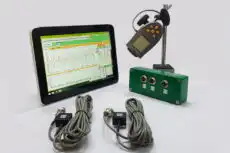
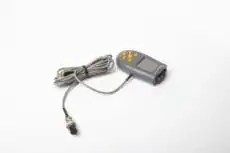
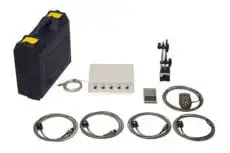
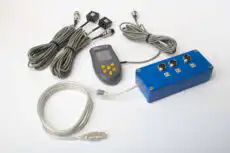
This thinking shapes everyday field work even when no formal FRF is computed. In field balancing, a portable two-channel analyser such as the Balanset-1A measures the rotor’s 1× amplitude-and-phase response to a known trial weight and effectively builds a single-frequency transfer function — the influence coefficient — that tells the software precisely how the rotor reacts to mass at each plane, and therefore how to correct it.
Validating Quality with Coherence
A transfer function is only trustworthy if input and output are genuinely related, and coherence is the metric that confirms it. Coherence above about 0.9 indicates a reliable function; low coherence warns of a poor measurement or uncorrelated noise — so it should always be checked before any transfer function is relied upon.
The transfer function is among the most powerful analytical tools in machinery dynamics, distilling the fundamental input–output relationship of a structure into a single complex function. Mastering its measurement, its interpretation — especially recognising resonances from magnitude peaks and their telltale phase transitions — and its applications unlocks modal analysis, resonance diagnosis, structural-modification prediction, and the transmission analysis that underpins advanced vibration control.

