Understanding Coastdown Analysis





Coastdown analysis is the systematic measurement and evaluation of machine vibration during deceleration from operating speed to a standstill after power has been disconnected. Throughout the speed range the analyser records amplitude, phase, and spectral content, so that a single unpowered run-down captures how the rotor behaves across every speed it must pass through. Interpreted through Bode plots and waterfall displays, that data reveals critical speeds, natural frequencies, damping characteristics, and the broader rotor-dynamic behaviour that underpins commissioning, troubleshooting, and periodic condition verification.
Coastdown analysis is closely related to run-up analysis, but it carries two distinct advantages: the deceleration is natural and unpowered, which makes the test simpler and safer, and it is performed with the machine still hot at operating temperature rather than cold at startup. It is a standard acceptance test for turbomachinery and an extremely valuable periodic diagnostic to run during a planned shutdown.
1. The Test Procedure
A coastdown is straightforward to execute but rewards careful preparation. Because the event happens only once and cannot be paused, every channel must be configured and armed before power is cut.
Preparation
- Sensors: install accelerometers at all bearing locations; on machines with fluid-film bearings, proximity probes in an X-Y pair are added to capture shaft motion directly.
- Speed reference: connect a tachometer for speed and, critically, for the phase reference that allows amplitude and phase to be tracked against rpm.
- Acquisition: configure the system for continuous recording at a sample rate adequate for the highest frequency of interest.
- Triggering: establish the trigger conditions — the speed range and duration to be captured.
Execution
- Stabilise: hold the equipment at a steady operating speed.
- Initiate recording: start data acquisition before anything else changes.
- Disconnect power: switch off motor power, cut turbine fuel, or otherwise remove the driving torque.
- Monitor: watch the vibration develop as the machine slows.
- Record complete: continue capturing to a full stop or to the minimum speed of interest.
- Save data: archive the complete coastdown dataset for analysis and future comparison.
Duration
How long a coastdown lasts depends on the rotor’s inertia and the friction and windage that brake it. Small motors may stop in 30–60 seconds, while large turbines can take 10–30 minutes to roll to rest. A longer coastdown is generally better data: the rotor lingers at each speed, yielding more measurement points and finer resolution through the resonances that matter most.
2. Analysing the Data
The same recording can be processed several complementary ways, each emphasising a different facet of the machine’s behaviour.
Bode Plot Generation
- Extract the synchronous (1×) vibration amplitude at each speed using a tracking filter.
- Extract the corresponding phase angle at each speed.
- Plot both amplitude and phase against speed.
- Critical speeds announce themselves as amplitude peaks accompanied by a characteristic phase transition — ideally close to 180° through the resonance.
Waterfall Plot
- Compute an FFT at regular speed intervals.
- Stack the spectra to build a three-dimensional waterfall display.
- Speed-synchronous components (1×, 2×, and higher harmonics) track diagonally as speed falls.
- Fixed-frequency components — structural natural frequencies — appear as vertical ridges that do not move with speed.
- Critical speeds are visible where a synchronous order crosses one of those fixed-frequency ridges.
Orbit Analysis
- With X-Y proximity probes installed, the shaft orbit can be reconstructed at any speed.
- The orbit changes shape as the rotor passes through a critical speed.
- Both the precession direction and the evolution of the orbit shape are recorded.
- Together these give an advanced characterisation of rotor-dynamic behaviour that scalar amplitude alone cannot.
3. Information Extracted
A well-executed coastdown answers several distinct engineering questions in one test.
Critical-Speed Locations
- The precise rpm at which each resonance occurs.
- The first, second, and third critical speeds, if they fall within the operating range.
- Verification of the measured values against the original design calculations.
- An assessment of the separation margin between operating speed and the nearest critical speed.
Resonance Severity
- The peak amplitude indicates the amplification factor at resonance.
- High peaks — roughly 5–10× the baseline level — indicate low damping.
- A sharp, narrow peak is more concerning than a broad, gentle one.
- The data shows whether vibration stays acceptable while the machine transits the resonance.
Damping Quantification
- Damping can be calculated from the sharpness of the peak (the Q-factor method).
- It can also be derived from the decay rate in the time domain.
- For typical industrial machinery the damping ratio falls in the range 0.01–0.10.
- Lower damping always means higher resonance peaks, so this figure directly governs how much vibration a critical speed produces.
4. Applications
New-Equipment Commissioning
- First-run validation of a freshly installed machine.
- Confirmation that measured critical speeds match the predicted values, usually within ±10–15%.
- Verification of adequate separation margins.
- Establishment of a baseline for future comparison.
- Satisfying the acceptance-testing requirement of the contract or standard.
Troubleshooting High Vibration
- Determining whether the machine is running too close to a critical speed.
- Identifying previously unknown resonances in the structure or rotor-bearing system.
- Assessing the effect of modifications such as bearing changes or added mass.
- Comparing before-and-after coastdowns to confirm a repair worked.
Periodic Health Assessment
- An annual coastdown taken during a planned shutdown.
- Comparison against the commissioning baseline as part of a condition-monitoring programme.
- Detection of critical-speed shifts, which signal mechanical changes such as looseness or a change in support stiffness.
- Tracking of damping degradation over the life of the machine.
5. Where the Balanset-1A Fits, and Why Coastdowns Beat Run-Ups
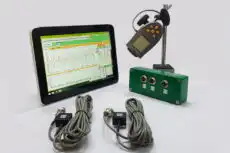
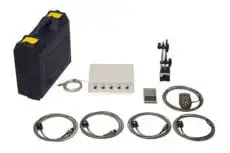
In the field, a coastdown needs nothing more exotic than accelerometers, a phase reference, and an analyser that can track amplitude and phase against falling speed. A portable two-channel instrument such as the Balanset-1A captures synchronous amplitude and phase throughout the run-down and builds the Bode and spectral views directly, so an engineer can confirm a machine’s critical speeds and separation margins on site — and, when the diagnosis is unbalance rather than resonance, move straight into field balancing with the same kit.
Coastdown testing is often preferred over a powered run-up for three reasons:
- Unpowered deceleration: the machine coasts down naturally on friction and windage, free of control-system complications, which makes execution simpler.
- Slower speed changes: the rotor spends longer at each speed, giving better data resolution, more points through each critical speed, and improved damping measurement.
- Hot-condition testing: the equipment is at operating temperature with bearings at their true operating clearances, so the measured dynamics represent the machine as it actually runs — not a cold approximation.
6. Practical Considerations
Safety
- Monitor vibration continuously during the coastdown.
- If it becomes excessive, decide deliberately between an emergency stop and riding through the resonance.
- Keep personnel clear of the equipment throughout.
- Confirm that all machinery-protection and safety systems are functional before starting.
Data Quality
- Ensure a stable, smooth deceleration rather than an erratic one.
- Use a sampling rate adequate for the highest frequencies of interest to avoid aliasing.
- Maintain a good tachometer signal throughout — a dropout corrupts the phase track.
- Collect sufficient averages at each speed.
Repeatability
- Perform several coastdowns to verify the result.
- Compare them for consistency.
- Significant run-to-run variation points to changing conditions or a measurement problem rather than a real shift in the machine.
Coastdown analysis is a fundamental rotor-dynamics diagnostic that provides a comprehensive picture of a machine’s dynamic behaviour from a single natural deceleration. The resulting Bode and waterfall plots locate critical speeds, quantify damping, and let an engineer compare the machine against design predictions or historical baselines — which is exactly why coastdown testing is essential for commissioning validation, periodic condition assessment, and resonance troubleshooting in rotating equipment.

