Balance Quality Grade (G-Grade)



The international standard for rotor balancing precision — how ISO 1940-1 and ISO 21940-11 G-grades define permissible residual unbalance, why they matter for bearing life and machine reliability, and how to calculate tolerances for any rotor.
Balancing Tolerance Calculator
Calculate permissible residual unbalance per ISO 21940-11 / ISO 1940-1
Results
Permissible residual unbalance and balancing targets
to see balancing tolerances
Balance Quality Grades at a Glance
From ultra-precision gyroscopes (G 0.4) to coarse reciprocating engines (G 4000) — the complete ISO classification
| G-Grade | e·ω (mm/s) | Precision Class | Typical Rotor Types / Applications |
|---|---|---|---|
| G 4000 | 4000 | Very Coarse | Crankshaft drives of inherently unbalanced, rigidly mounted slow marine diesel engines |
| G 1600 | 1600 | Very Coarse | Crankshaft drives, rigidly mounted |
| G 630 | 630 | Coarse | Crankshaft drives of inherently unbalanced, elastically mounted engines |
| G 250 | 250 | Coarse | Crankshaft drives of fast 4-cylinder engines, elastically mounted |
| G 100 | 100 | General | Complete engines (gasoline/diesel) for cars, trucks; crankshafts for rigidly mounted 6+ cylinder engines |
| G 40 | 40 | General | Car wheels; wheel rims; drive shafts; crankshafts, elastically mounted, of fast 4-cylinder engines |
| G 16 | 16 | Standard | Drive shafts (cardan); parts of crushing machinery; parts of agricultural machinery; crankshafts, elastically mounted, of 6+ cylinder engines |
| G 6.3 | 6.3 | Standard | Fans; flywheels; pump impellers; general machinery parts; normal electric motor rotors; process plant machinery |
| G 2.5 | 2.5 | Precision | Gas and steam turbines; turbo-generators; turbocompressors; machine tool drives; medium and large electric motor rotors with special requirements |
| G 1.0 | 1.0 | Precision | Grinding machine drives; small high-speed electric motors; turbochargers |
| G 0.4 | 0.4 | Ultra-precision | Gyroscopes; precision spindles; hard disk drives; ultra-high-speed spindles for microelectronics |
| Rotor Type | Mass (kg) | Speed (RPM) | Grade | Uper Total (g·mm) | Uper per Plane (g·mm) | eper (µm) |
|---|---|---|---|---|---|---|
| Small electric motor | 8 | 2900 | G 6.3 | 166 | 83 | 20.7 |
| Pump impeller | 12 | 2950 | G 6.3 | 245 | 122 | 20.4 |
| Industrial fan | 85 | 1480 | G 6.3 | 3459 | 1730 | 40.7 |
| Large motor rotor | 350 | 1500 | G 2.5 | 5578 | 2789 | 15.9 |
| Steam turbine | 1200 | 3600 | G 2.5 | 7958 | 3979 | 6.6 |
| Turbocharger | 0.8 | 90000 | G 1.0 | 0.085 | 0.042 | 0.11 |
| Grinding spindle | 5 | 12000 | G 1.0 | 3.98 | 1.99 | 0.80 |
| Crusher flywheel | 500 | 600 | G 16 | 127,320 | 63,660 | 254.6 |
| Drive shaft (cardan) | 15 | 4500 | G 16 | 509 | 255 | 33.9 |
| HVAC blower | 45 | 1750 | G 6.3 | 1546 | 773 | 34.4 |
| Car wheel assembly | 20 | 900 | G 40 | 8488 | 4244 | 424.4 |
| Centrifuge | 30 | 6000 | G 2.5 | 119 | 60 | 3.98 |
| Standard | Scope | G-Grade System? | Key Difference | Status |
|---|---|---|---|---|
| ISO 21940-11:2016 | All rigid rotors — general procedures | Yes (primary) | Current international standard; replaces ISO 1940-1 | Current |
| ISO 1940-1:2003 | All rigid rotors | Yes (original) | Established the G-grade system; still widely referenced | Superseded |
| ISO 21940-12 | Balancing procedures and tolerances | Yes (references Part 11) | Practical balancing procedures, correction plane allocation | Current |
| API 610 / 617 / 611 | Pumps / compressors / turbines (petroleum industry) | References ISO; adds stricter limits | Often specifies 4W/N (≈ G 1.0) for API 617 rotors; more conservative | Current |
| ANSI S2.19 | US-adopted version of ISO 1940 | Yes (identical) | Direct adoption of ISO G-grade system for US market | Current |
| VDI 2060 | German standard (pre-ISO) | Equivalent system | Historical predecessor to ISO 1940; still referenced in German industry | Superseded by ISO |
| MIL-STD-167-1 | US military — shipboard equipment | No (vibration limits) | Specifies vibration amplitude limits, not unbalance tolerances | Active |
What is a Balance Quality Grade (G-Grade)?
A Balance Quality Grade (G-Grade) is an international standard classification per ISO 21940-11 (formerly ISO 1940-1) that defines the maximum permissible residual unbalance for a rigid rotor. The G number represents the maximum velocity of the rotor's center-of-gravity displacement in mm/s. Common grades: G 6.3 for general machinery (pumps, fans, motors), G 2.5 for turbines and precision equipment, G 1.0 for grinding spindles and turbochargers. The formula for permissible unbalance: Uper = 9549 × G × m / n (g·mm), where m = mass (kg), n = speed (RPM).
A Balance Quality Grade, commonly called a "G-Grade," is a standardized classification defined in ISO 21940-11 (which superseded ISO 1940-1) that specifies the maximum permissible residual unbalance for a rigid rotor. The G-grade defines how precisely a rotor must be balanced — not a vibration measurement in the installed machine, but a quality specification for the rotor itself based on its mass and maximum service speed.
The number following the letter "G" represents the maximum permissible velocity of the rotor's center-of-mass displacement, expressed in millimeters per second (mm/s). For example, G 6.3 means the product of the specific eccentricity (eper) and the angular velocity (ω) must not exceed 6.3 mm/s. G 2.5 limits this velocity to 2.5 mm/s. The lower the G number, the tighter the balancing tolerance — meaning higher precision and less permissible residual unbalance.
The G value represents the maximum permissible velocity of the rotor's center of gravity relative to the geometric rotation axis, at the maximum service speed. G 6.3 means the center of gravity may move at no more than 6.3 mm/s relative to the spin axis. Since centrifugal force is proportional to this velocity squared, even small reductions in G-grade produce significant reductions in dynamic bearing loads.
The Purpose of the G-Grade System
Before the G-grade system was established, balancing specifications were vague — "balance as well as possible" or "balance until smooth." The ISO G-grade system replaced this ambiguity with a universal, verifiable standard. It provides a common language for manufacturers, service engineers, and end users worldwide. The main objectives are:
1. Limiting Unbalance-Induced Vibration to Acceptable Levels
Unbalance produces centrifugal forces that increase with the square of rotational speed. These forces cause vibration, noise, fatigue loading, and ultimately mechanical failure. By specifying a G-grade, the engineer limits these forces to levels the machine's bearings, seals, and structure can safely tolerate throughout the intended service life.
2. Minimizing Dynamic Loads on Bearings
Bearings are the components most directly affected by unbalance. The cyclic radial load from residual unbalance acts as a fatigue load on rolling elements and raceways. Bearing life (L10) is inversely proportional to the cube of the applied load — so even a modest reduction in unbalance force can dramatically extend bearing service life. Balancing a motor rotor from G 16 to G 6.3 typically doubles bearing L10 life; balancing to G 2.5 can quadruple it.
3. Ensuring Safe Operation at Maximum Design Speed
Centrifugal force from unbalance is proportional to ω² — doubling the speed quadruples the force from the same unbalance. A rotor that is acceptably balanced at 1500 RPM may produce dangerous vibration at 3000 RPM. The G-grade system accounts for this by incorporating speed into the tolerance calculation, ensuring the rotor is safe at its maximum rated speed.
4. Providing a Clear, Measurable Acceptance Criterion
The G-grade converts "balance quality" from a subjective judgment into an objective, measurable pass/fail criterion. After balancing, the residual unbalance is compared against the calculated tolerance. If the measured value is below the limit, the rotor passes. This is essential for manufacturing quality control, contractual specifications, warranty claims, and regulatory compliance.
Calculating Permissible Residual Unbalance
The core of the G-grade system is the ability to calculate a specific, numerical unbalance tolerance for any rotor. Two key quantities are derived from the G-grade:
Specific Unbalance (Permissible Eccentricity)
The specific unbalance (eper) represents the maximum permissible displacement of the rotor's center of gravity from the rotation axis, in micrometers. It depends only on the G-grade and the speed — not on the rotor mass. This makes it useful for comparing the balance quality of rotors of different sizes.
Total Permissible Residual Unbalance
The total permissible residual unbalance (Uper) is the actual target the balancing technician must achieve. It is expressed in g·mm (gram-millimeters) — the product of the residual unbalance mass times its distance from the rotation axis. This is the number displayed on the balancing machine and compared against the tolerance.
Centrifugal Force from Residual Unbalance
This formula shows the actual dynamic force the bearings must withstand from the permissible residual unbalance at operating speed. It is useful for verifying that the bearing load rating is adequate and for understanding the real-world impact of the G-grade specification.
Variables Reference
| Symbol | Name | Unit | Description |
|---|---|---|---|
| G | Balance quality grade | mm/s | Product eper·ω; defines the ISO grade (e.g. 6.3, 2.5, 1.0) |
| eper | Permissible specific unbalance | µm | Maximum CG offset from rotation axis |
| Uper | Permissible residual unbalance | g·mm | Total unbalance tolerance = eper × mass |
| m | Rotor mass | kg | Total mass of the rotor being balanced |
| n | Maximum service speed | RPM | Highest speed at which the rotor will operate |
| ω | Angular velocity | rad/s | = 2π × n / 60 |
| F | Centrifugal force | N | Dynamic force from residual unbalance at speed |
How to Select the Right G-Grade
The ISO standard provides recommendations for hundreds of rotor types, but in practice the selection depends on several interrelated factors:
Machine Type and Application
The standard groups rotors by application and recommends a G-grade for each group (see the ISO table above). A high-speed turbine needs much tighter balance (G 2.5 or G 1.0) than a slow-speed agricultural mechanism (G 16 or G 40). The designer considers how sensitive the machine is to vibration and what the consequences of unbalance-induced failure would be.
Rotor Speed
Speed is the single most important factor. For the same G-grade, permissible unbalance (Uper) decreases linearly with speed. A rotor at 6000 RPM has half the tolerance of the same rotor at 3000 RPM. For high-speed rotors (turbines, turbochargers, grinding spindles), the tolerance becomes extremely small, requiring specialized balancing equipment and procedures.
Bearing Type and Support Stiffness
A rotor mounted on flexible (elastic) supports typically requires tighter balance than one on a rigid foundation, because the flexible system transmits vibration more readily. The same crankshaft may require G 16 on elastic mounts but G 40 on rigid mounts. Similarly, rotors on fluid-film bearings may tolerate more unbalance than those on rolling-element bearings due to the damping effect of the oil film.
Environmental and Safety Requirements
Equipment operating near personnel (HVAC, medical devices), in noise-sensitive environments, or in safety-critical applications (power generation, aviation, offshore) may require tighter balance than the standard recommends for the rotor type. Some industries (petrochemical, power generation) have their own standards (API, IEEE) that specify tighter limits than ISO.
Industry-Specific Recommendations
| Industry / Application | Typical G-Grade | Notes |
|---|---|---|
| Power generation (turbines) | G 1.0 – G 2.5 | API 612/617 often specifies even tighter than ISO |
| Petroleum / chemical (pumps, compressors) | G 2.5 – G 6.3 | API 610 pumps often G 2.5 or tighter |
| HVAC (fans, blowers, AHU) | G 6.3 | Noise-sensitive installations may require G 2.5 |
| Pulp & paper (rollers, dryers) | G 6.3 – G 16 | Large slow rollers; high mass compensates for lower precision |
| Mining & minerals (crushers, screens) | G 16 – G 40 | Harsh environment; moderate precision acceptable |
| Automotive (wheels, driveshafts) | G 16 – G 40 | NVH requirements may tighten beyond ISO minimum |
| Machine tools (spindles, drives) | G 1.0 – G 2.5 | Surface finish quality depends on spindle balance |
| Marine (propeller shafts, engines) | G 6.3 – G 40 | Classification society rules (DNV, Lloyd's, ABS) apply |
| Wind energy (rotor hubs, generators) | G 6.3 | Blade pitch imbalance handled separately from hub balance |
| Aerospace (turbofan, gyros) | G 0.4 – G 2.5 | Extremely tight; military standards (MIL-STD) may override ISO |
Two-Plane Balancing — Distributing the Tolerance
The total permissible unbalance Uper calculated from the G-grade formula is for the entire rotor. In practice, most rotors are balanced in two correction planes (dynamic balancing), so the tolerance must be apportioned between the planes.
ISO Guidance for Tolerance Distribution
- Symmetric rotors (CG approximately at midspan): Divide Uper equally between the two planes. Each plane gets Uper/2.
- Asymmetric rotors (CG offset toward one end): Distribute proportionally to the bearing distances from the CG. The plane closest to the CG receives the larger share of the tolerance.
- Single-plane balancing: The entire Uper applies to the single correction plane. This is appropriate for narrow disc-shaped rotors (L/D < 0.5) where couple unbalance is negligible.
A common error is to calculate Uper and then apply this value to each plane, effectively doubling the total tolerance. The correct approach: Uper is the total; divide it between planes. Each plane receives Uper/2 for a symmetric rotor.
Worked Examples
Given: Pump impeller, mass = 12 kg, operating speed = 2950 RPM, required grade G 6.3.
Step 1 — Specific unbalance: eper = 9549 × 6.3 / 2950 = 20.4 µm
Step 2 — Total tolerance: Uper = 20.4 × 12 = 245 g·mm
Step 3 — Per plane (symmetric): 245 / 2 = 122 g·mm per plane
Step 4 — Correction weight: At correction radius R = 100 mm: weight = 122 / 100 = 1.22 grams per plane maximum
Step 5 — Centrifugal force: ω = 2π × 2950/60 = 308.9 rad/s. F = 245 × 10⁻⁶ × 308.9² = 23.4 N — well within bearing capacity.
Given: Fan rotor, mass = 85 kg, operating speed = 1480 RPM, required grade G 6.3.
Step 1 — Specific unbalance: eper = 9549 × 6.3 / 1480 = 40.6 µm
Step 2 — Total tolerance: Uper = 40.6 × 85 = 3,455 g·mm
Step 3 — Per plane: 3,455 / 2 = 1,728 g·mm per plane
Step 4 — Correction weight: At R = 400 mm: weight = 1728 / 400 = 4.3 grams per plane maximum.
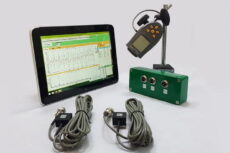
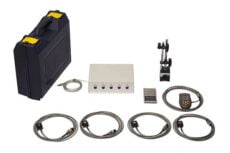
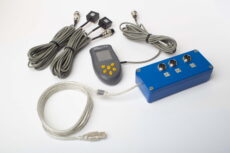
Practical note: This fan can be balanced in the field using a Balanset-1A portable balancer with the rotor installed. The device automatically calculates the G 6.3 tolerance based on rotor mass and speed.
Given: Turbine wheel, mass = 0.8 kg, max speed = 90,000 RPM, required grade G 1.0.
Step 1 — Specific unbalance: eper = 9549 × 1.0 / 90000 = 0.106 µm — about 100 nanometers!
Step 2 — Total tolerance: Uper = 0.106 × 0.8 = 0.085 g·mm
Step 3 — Correction weight: At R = 20 mm: weight = 0.085 / 20 = 0.004 grams (4 milligrams!) per plane maximum.
Practical note: This extremely tight tolerance requires specialized high-speed balancing machines with sub-milligram resolution. Material removal (grinding/drilling) is typically used rather than adding weights at this precision level.
Historical Context — ISO 1940-1 to ISO 21940-11
The G-grade system has evolved through several iterations:
- VDI 2060 (1966): The original German standard that established the concept of balance quality grades. Developed by the Verein Deutscher Ingenieure (Association of German Engineers).
- ISO 1940 (1973, rev. 1986, 2003): International adoption of the VDI 2060 concept. ISO 1940-1:2003 "Mechanical vibration — Balance quality requirements for rotors in a constant (rigid) state" became the worldwide reference for G-grades.
- ISO 21940-11:2016: The current standard. Part of the comprehensive ISO 21940 series covering all aspects of rotor balancing. Part 11 specifically covers balance quality requirements and replaces ISO 1940-1. The G-grade values and application tables remain essentially the same; the main changes are editorial and structural.
Despite the formal supersession, "ISO 1940" remains the most commonly used reference in industry conversations, purchase specifications, and equipment manuals. Both designations refer to the same G-grade system.
Common Mistakes in Applying G-Grades
Mistake 1: Using Balancing Speed Instead of Service Speed
The G-grade tolerance must be calculated using the maximum service speed (operating speed), not the balancing machine speed. Many rotors are balanced at a lower RPM than their service speed. Using the balancing speed in the formula produces a tolerance that is too loose for the actual operating conditions. The Balanset-1A software allows you to enter the service speed separately from the balancing speed to avoid this error.
Mistake 2: Confusing G-Grade with Vibration Level
G 6.3 does NOT mean the installed machine will vibrate at 6.3 mm/s. The G value is a property of the rotor alone, measured or calculated as a free-body tolerance. The vibration of the installed machine depends on many additional factors: bearing condition, alignment, structural natural frequencies, damping, and more. A rotor balanced to G 6.3 may produce 1 mm/s vibration in one machine and 4 mm/s in another, depending on the installation.
Mistake 3: Over-Specifying the Grade
Specifying G 1.0 for a slow-speed fan that only needs G 6.3 wastes time and money. Tighter grades require more balancing iterations, more precise equipment, and longer balancing times. Specify the grade appropriate to the application — better balance than needed provides diminishing returns while increasing cost.
Mistake 4: Applying Total Tolerance to Each Plane
As noted above, Uper is the total tolerance for the rotor. For two-plane balancing, divide by 2 (or distribute proportionally for asymmetric rotors). Applying Uper to each plane doubles the actual total tolerance, potentially exceeding the intended grade.
Mistake 5: Ignoring Temperature and Assembly Changes
Some rotors change balance state between cold (ambient) and hot (operating) conditions due to thermal distortion, centrifugal growth, or fit changes. A rotor that meets G 2.5 on the balancing machine at room temperature may exceed this tolerance at operating temperature. For critical rotors, high-speed balancing at or near operating conditions is recommended.
Mistake 6: Neglecting Key and Keyway Convention
ISO 21940-11 specifies that the half-key convention should be used when balancing a rotor with a keyway (add a half-key to the keyway during balancing to approximate the installed condition). Using a full key, no key, or ignoring this convention introduces an initial unbalance error that may be significant for tight G-grades.
Why G-Grades Matter — The Business Case
Proper application of G-grades delivers measurable benefits:
- Bearing life: Bearing L10 life is proportional to (C/P)³ where P includes the unbalance force. Reducing unbalance by half can increase bearing life by up to 8× (2³ = 8). This translates directly to reduced maintenance costs and downtime.
- Energy efficiency: Unbalance-induced vibration dissipates energy as heat in bearings, seals, and dampers. Well-balanced rotors run cooler and consume less power — typically 1–3% energy savings on industrial motors.
- Noise reduction: Vibration from unbalance transmits through the structure and radiates as noise. Meeting the correct G-grade is often the most cost-effective way to comply with workplace noise regulations.
- Standardization and interoperability: The G-grade system ensures that a rotor balanced by Manufacturer A meets the same quality standard as one balanced by Manufacturer B — essential for global supply chains and interchangeable components.
- Regulatory compliance: Many industries require documented evidence of balance quality for insurance, warranty, and safety certification. The G-grade provides a universally recognized documentation standard.
The Balanset-1A portable balancer includes a built-in ISO 1940 / ISO 21940-11 tolerance calculator. Enter the rotor mass, service speed, and desired G-grade — the software automatically calculates Uper, distributes the tolerance between planes, and provides a clear pass/fail indication after each balancing run. The Balanset-4 extends this capability to four-channel measurement for complex balancing setups.
Frequently Asked Questions — Balance Quality Grades
Common questions about G-grades, ISO 1940, and balancing tolerances
Related Glossary Articles
Achieve ISO Balance Quality — In the Field
Vibromera's portable balancing devices calculate G-grade tolerances automatically and guide you to precise correction weights — no rotor removal required.
Browse Balancing Equipment → EN
EN  AR
AR  AZ
AZ  BG
BG  ZH
ZH  HR
HR  CS
CS  DA
DA  NL
NL  ET
ET  FI
FI  FR
FR  DE
DE  KA
KA  EL
EL  HE
HE  HI
HI  HU
HU  ID
ID  IT
IT  JA
JA  KO
KO  LV
LV  LT
LT  MS
MS  NB
NB  FA
FA  PL
PL  PT_BR
PT_BR  PT
PT  RO
RO  SR
SR  SK
SK  SL
SL  ES
ES  SV
SV  TH
TH  TR
TR  UR
UR  UK
UK  VI
VI 