Understanding Subharmonics

A subharmonic is a frequency component in a vibration spectrum that occurs at an integer fraction of a fundamental forcing frequency. In machinery analysis that fundamental is almost always the running speed (1X), so subharmonics appear at orders like 1/2X, 1/3X or 1/4X. Because they sit below the main synchronous component, they are also called sub-synchronous vibrations, and they are some of the most diagnostically valuable peaks an analyst can find — they rarely appear without a clear physical cause.
1. Definition: What is a Subharmonic?
Where ordinary harmonics are whole-number multiples of the running speed (2X, 3X, 4X), subharmonics are the reciprocal: whole-number divisions of it. A peak at exactly half the shaft speed is the classic example, often written 1/2X or 0.5X. A true subharmonic therefore always sits below 1X — 0.5X, 0.33X, 0.25X. In practice the most informative pattern is not the 1/2X line alone but a half-order family — peaks at 1/2X, 3/2X (1.5X) and 5/2X (2.5X), all spaced by half an order. Strictly speaking, only the 1/2X member is a subharmonic and sub-synchronous; the members above 1X (1.5X, 2.5X, …) are fractional-order (half-order) harmonics, not sub-synchronous components. The appearance of such a comb is a textbook signature of specific mechanical faults rather than random noise.
It is worth distinguishing a true subharmonic from a non-integer sub-synchronous component. A peak locked precisely at 0.50X is a genuine subharmonic of running speed; a peak at, say, 0.43X is sub-synchronous but not an exact fraction, and that distinction immediately narrows the list of suspects. Subharmonics are not as common as harmonics, but when they do appear they almost always point to one of the causes below.
2. Mechanical Looseness — the Most Common Cause
The leading source of a 1/2X subharmonic is mechanical looseness. When a component is loose — a bearing slack in its housing, a worn fit, or a loose mounting bolt — it introduces a strongly non-linear “bouncing” or “rattling” response. The clearance lets the part impact against its seat, and because that impact tends to recur effectively every other revolution, the system responds at half the forcing frequency.
The resulting spectrum shows the 1X peak accompanied by a half-order series at 1/2X, 3/2X, 5/2X and so on — the 1/2X subharmonic together with its fractional-order harmonics above 1X. That half-order family is one of the most reliable fingerprints in vibration diagnostics: it almost unambiguously indicates severe structural looseness, and its growth over time tracks the worsening of the fit. The more pronounced and numerous the half-order peaks, the looser the joint has become.
3. Journal-Bearing Instability
In machines supported on fluid-film or journal bearings, sub-synchronous vibration is a critical warning of oil-film instability. These are self-excited vibrations — energy from the steady rotation feeds the vibration directly, so they can grow without any external forcing.
- Oil whirl: Typically occurs between 0.42X and 0.48X of running speed, appearing as a strong, distinct peak just below half-order. It arises when the oil wedge supporting the shaft begins to circulate (whirl) within the bearing clearance, dragging the shaft around its journal. Because it is slightly below 0.5X rather than exactly at it, the precise frequency is the tell-tale that separates whirl from looseness.
- Oil whip: A far more severe and destructive form of instability. It occurs when the whirl frequency coincides with the rotor’s first natural frequency, or critical speed. The vibration then “locks on” to that natural frequency and stays there even as machine speed increases — a hallmark that distinguishes whip from a speed-tracking whirl. The amplitudes can become violent enough to damage the bearing or shaft.
The journal-bearing frequencies that bracket these instabilities can be estimated up front with a dedicated journal-bearing defect frequency calculator, which helps confirm whether a sub-synchronous peak falls in the whirl band.
4. Other Sources of Sub-Synchronous Peaks
- Belt-drive problems: A worn or damaged belt can generate sub-synchronous components tied to the belt’s own rotational rate, which is lower than either pulley speed. Suspected belt-drive defects — and especially V-belt faults — can be confirmed against the calculated belt frequency using a belt defect frequency calculator.
- Flow-related effects: In pumps and fans, sub-synchronous energy can come from flow turbulence or rotating stall. These components are typically not exact fractions of 1X, which itself is a useful clue that the source is hydraulic or aerodynamic rather than mechanical. In compressors the related phenomenon of surging can also raise the floor below running speed.
5. Analysis and Confirmation
Because the diagnosis hinges on small frequency differences, the first task is to pin down the exact peak frequency. A line at precisely 0.50X strongly implicates looseness; one at 0.47X is almost certainly oil whirl; a complete 1/2X, 3/2X, 5/2X series confirms looseness with high confidence. High spectral resolution and an accurate speed reference are therefore essential, since 0.48X and 0.50X can look identical at coarse resolution.
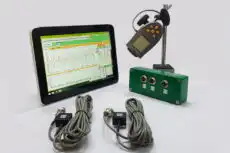
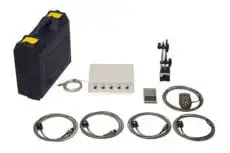
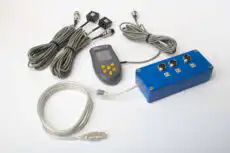
The time waveform provides valuable corroboration. Looseness usually shows clear impacting or truncation — flattened or clipped peaks where the loose part bottoms out — whereas oil whirl appears as a smoother, modulating signal without sharp impacts. In the field, a portable two-channel analyser such as the Balanset-1A lets an engineer capture both the spectrum and the synchronised time waveform at operating speed, so the exact sub-synchronous frequency and its waveform character can be judged together before any teardown is scheduled.

