Comprensione dell'accelerazione nell'analisi delle vibrazioni







Accelerazione è la variazione della velocità di un oggetto nel tempo. Nell' analisi delle vibrazioni è uno dei tre parametri di misura fondamentali e quantifica la rapidità con cui velocità di un componente vibrante sta variando. Mentre spostamento indica di quanto si sposta un componente e la velocità indica quanto velocemente, l'accelerazione è in realtà una misura delle forze che agiscono sul componente — il che la rende particolarmente sensibile agli eventi ad alta frequenza, come gli impatti e le variazioni brusche di moto.
1. Definizione: Cos'è l'accelerazione di vibrazione?
Matematicamente, l'accelerazione è la prima derivata temporale della velocità e la seconda derivata dello spostamento. Per un corpo che vibra sinusoidalmente alla frequenza f, l'ampiezza dell'accelerazione scala con il quadrato della frequenza a spostamento fisso — raddoppiando la frequenza si quadruplica l'accelerazione. Questo unico fatto spiega perché l'accelerazione è il linguaggio naturale per gli eventi rapidi e bruschi: più è elevato il contenuto in frequenza di un guasto, più esso risalta nel segnale di accelerazione. È anche il motivo per cui un analista sceglie l'accelerazione quando i fenomeni di interesse si trovano nella regione dei kilohertz piuttosto che in prossimità della velocità di rotazione.
2. Perché la misura dell'accelerazione è importante?
La misurazione dell'accelerazione è fondamentale per un monitoraggio delle condizioni programma approfondito, poiché eccelle nell'individuare guasti che parametri meno sensibili potrebbero non rilevare. La sua importanza si basa su alcuni fattori chiave:
- Rilevamento di guasti ad alta frequenza: l'accelerazione è intrinsecamente più sensibile alle vibrazioni ad alta frequenza, rendendola il parametro ideale per il rilevamento precoce di danni ai cuscinetti volventi, problemi di ingranamento e eccitazioni di passaggio palette, tutti fenomeni che irradiano energia nelle zone alte dello spettro.
- Relazione diretta con la forza: per la seconda legge di Newton (Forza = Massa × Accelerazione), l'accelerazione è direttamente proporzionale alle forze dinamiche interne a una macchina. La lettura dell'accelerazione offre quindi una finestra diretta sulle forze che generano sollecitazioni e fatica nei componenti.
- Ampio intervallo dinamico: gli accelerometri utilizzati per rilevarla coprono un'ampia gamma di frequenze e ampiezze, rendendoli versatili per molti tipi di macchine e velocità di rotazione.
3. Unità e misure
Unità comuni
L'accelerazione di vibrazione è solitamente espressa in una delle due unità di misura:
- g: un'unità riferita all'accelerazione di gravità terrestre, dove 1 g ≈ 9,81 m/s². Il g è molto diffuso perché offre una percezione standardizzata e intuitiva dell'intensità con cui un componente viene sollecitato dalla vibrazione.
- m/s² (o mm/s²): l'unità SI, metri al secondo quadrato, preferita per la reportistica formale e il calcolo.
Vale la pena specificare esplicitamente se un valore è di picco, picco reale o RMS, poiché la stessa vibrazione può essere espressa in tre modi diversi. La conversione tra g, m/s² e gli equivalenti in velocità o spostamento a una determinata frequenza è esattamente ciò che il nostro Calcolatore dell'accelerazione delle vibrazioni è per.
Come si misura?
L'accelerazione viene misurata quasi esclusivamente con un accelerometro — un trasduttore che converte la forza meccanica della vibrazione in un segnale elettrico proporzionale. Il accelerometro piezoelettrico è il tipo più comune nel monitoraggio delle condizioni industriali, apprezzato per la sua robustezza, la precisione e la risposta in frequenza ampia e piatta. Il suo segnale può essere analizzato direttamente oppure, tramite integrazione elettronica integrazione, presentato come velocità o spostamento.
4. Applicazioni pratiche nella diagnostica
Nella diagnostica quotidiana, i dati di accelerazione consentono di individuare problemi specifici:
- Difetti nei cuscinetti: difetti microscopici su piste, rulli e sfere generano piccoli picchi d'impatto ad alta frequenza. Le misurazioni dell'accelerazione — specialmente se combinate con analisi dell'inviluppo per demodulearle — rappresentano la via principale per rilevare questi guasti nella fase più precoce e più utile all'intervento, spesso monitorando il frequenze di guasto dei cuscinetti.
- Analisi del riduttore: il contenuto ad alta frequenza derivante dal meshing dei denti, oltre agli impatti provocati da denti incrinati o scheggiati, emerge chiaramente nello spettro dell'accelerazione, spesso proprio in corrispondenza del frequenza di ingranamento e le sue bande laterali.
- Macchinari ad alta velocità: per turbine e compressori ad alta velocità le frequenze dominanti si collocano nella banda in cui l'accelerazione è più sensibile, per cui è spesso la misura complessiva preferita.
Questa stessa versatilità è ciò che consente a uno strumento portatile a due canali come il Balanset-1A di fungere sia da strumento di bilanciamento sia da strumento diagnostico: acquisisce l'accelerazione dai sensori, la integra in velocità per le verifiche di severità rispetto a ISO 20816 (il moderno sostituto della ISO 10816), e utilizza gli stessi canali per misurare l'ampiezza e la fase 1× ai fini del bilanciamento sul campo.
5. Relazione con velocità e spostamento
Spostamento, velocità e accelerazione sono matematicamente legati da integrazione e differenziazione. Per una vibrazione sinusoidale semplice, la velocità è l'integrale dell'accelerazione e lo spostamento è l'integrale della velocità; al contrario, differenziazione procede in senso opposto. La conseguenza pratica è che, a parità di energia vibrazionale, le ampiezze di accelerazione sono naturalmente maggiori alle alte frequenze, mentre le ampiezze di spostamento predominano alle basse frequenze — con la velocità che si colloca nel mezzo e rimane relativamente costante nella banda intermedia. Questo è esattamente il motivo per cui gli analisti scelgono il parametro più adatto all'intervallo di frequenza del guasto atteso: lo spostamento per le oscillazioni lente dell'albero, la velocità per la salute generale del macchinario e l'accelerazione per gli eventi rapidi e dinamici di cuscinetti e ingranaggi.
6. Che cosa mostra il Balanset-1A sull'accelerazione
Il Balanset-1A rileva la vibrazione con accelerometri MEMS e indica la velocità di vibrazione in mm/s RMS; il suo spettro può essere visualizzato in velocità o in accelerazione. Confrontare le due viste è un controllo rapido di dove si concentra l'energia vibratoria prima di decidere di eseguire l'equilibratura.
- Montare entrambi i sensori in direzione radiale su una parte rigida dei supporti dei cuscinetti, con l'intera faccia del magnete a contatto. Non applicarli su protezioni, coperchi o sulla faccia frontale. Applicare e spostare i sensori solo a macchina ferma e bloccata (lockout).
- Aprire il Vibration Meter (F5) e restare nella scheda Wave Spectrum. Confrontare V1s con V1o. Se la componente 1× è vicina al valore globale, la vibrazione è prevalentemente squilibrio. Se è molto più piccola, la maggior parte dell'energia è nelle armoniche e nel rumore.
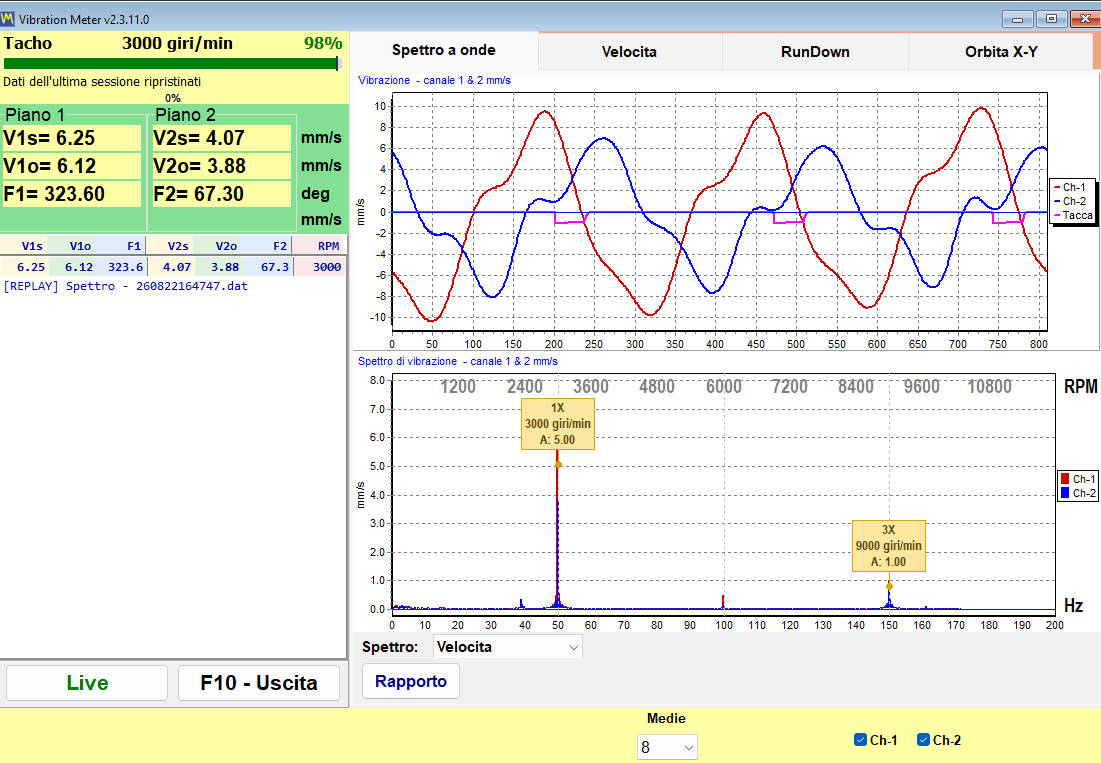
- Portare il selettore Spectrum sotto il grafico da Velocity ad Acceleration (m/s2). L'accelerazione dà più peso alle frequenze alte, quindi i picchi a 2×, 3× e oltre crescono rispetto a 1×. A parità di velocità, 3× mostra un'accelerazione tripla rispetto a 1×: a 3000 rpm, 1 mm/s RMS corrisponde a circa 0,31 m/s2 a 1× (50 Hz) e a 0,94 m/s2 a 3× (150 Hz). Passare il cursore su un picco per leggerne frequenza e ampiezza nel titolo del grafico.
- Valutare la severità sulle letture di velocità, perché le zone di vibrazione ISO sono espresse in mm/s. Per colorare V1s e V2s in base alla zona, selezionare una norma di valutazione delle vibrazioni (Vibration evaluation standard) nella scheda F4 - Settings della finestra principale.
- Se 1× è il picco maggiore nella vista di velocità e V1o è vicino a V1s, procedere con l'equilibratura. Se i picchi 2× o 3× raggiungono l'entità di 1× nella vista di velocità, controllare prima allineamento, cuscinetti e fissaggio, poi equilibrare. Un picco che è grande solo nella vista di accelerazione è amplificato dalla sua frequenza; verificarlo nella vista di velocità prima di intervenire.

