Understanding Trending in Vibration Analysis

Trending — also called trend analysis or data trending — is the practice of tracking vibration parameters over time through repeated periodic measurements and plotting the results chronologically to reveal patterns of change. It transforms isolated readings into a time history that shows whether equipment condition is stable, improving or deteriorating, and at what rate. That temporal dimension is exactly what makes predictive maintenance possible: it is not enough to know the current condition, the value is in predicting the future condition from observed trends. Trending is the heart of condition-based maintenance because it provides the early warning that separates proactive maintenance from reactive repair. A single measurement tells you the current state; trending tells you where you are heading and roughly when you will get there.
1. Purpose and Benefits of Trending
Early Fault Detection
- Gradual increases are detected months before failure.
- Small changes become visible when compared against a baseline.
- The lead time obtained allows maintenance to be planned rather than forced.
- Catastrophic, unplanned failures are prevented.
Failure Prediction
- Extrapolate the trend line to predict when an alarm threshold will be crossed.
- Estimate the remaining useful life.
- Schedule maintenance at the optimal time — neither too early nor too late.
- Order parts in advance, before the machine forces the issue.
The arithmetic of projecting a trend to an alarm limit and reading off a date is easy to do informally on a chart, but a structured estimate helps; our Remaining Life from Vibration Trend calculator turns a growth rate and an alarm level into an estimated time-to-threshold.
Rate-of-Change Assessment
- Slow increase: normal wear, on a months-to-years timeline.
- Moderate increase: a developing defect, weeks to months.
- Rapid increase: active fault progression, days to weeks.
- Exponential growth: imminent failure, immediate action required.
Maintenance-Effectiveness Verification
- Compare before-and-after vibration around a maintenance event.
- Confirm that the repair achieved the expected improvement.
- Validate that the root cause was correctly identified.
- Document the quality of the work for the equipment history.
2. What to Trend
Primary Parameters
Overall Vibration Levels
- The simplest and most common trending parameter.
- Usually RMS velocity at each measurement point.
- Gives a quick assessment of general condition.
- Can miss an early fault whose energy is still buried in the overall level.
Specific Frequency Amplitudes
Tracking individual lines in the vibration spectrum is far more diagnostic than the overall level alone:
- 1× (running speed): trends unbalance progression.
- 2×: tracks misalignment or crack development.
- Bearing frequencies: BPFO and BPFI for bearing condition.
- Gear-mesh frequency: for gearbox condition.
- VPF/BPF: vane- and blade-passing frequencies for pumps and fans.
Derived Parameters
- Crest factor: peak-to-RMS ratio, sensitive to early impacting.
- Kurtosis: a statistical measure and an early bearing-damage indicator.
- High-frequency defect (HFD): acceleration energy in the bearing-frequency range.
- Spectral band energy: integrated energy within a defined frequency band.
Non-Vibration Parameters
The strongest programs trend vibration alongside other condition indicators:
- Bearing temperatures.
- Oil analysis results — particle counts and wear metals.
- Performance parameters such as efficiency and power.
- Ultrasonic levels.
- Thermographic results.
3. Trend Plot Types
Single-Parameter Trends
- X-axis: time (date); Y-axis: vibration amplitude.
- A simple line plot showing the progression.
- The most common and intuitive format.
Multi-Parameter Trends
- Several parameters share one time axis.
- Plotted on different scales or normalised to baseline.
- Reveals correlations between parameters.
- Example: overall level plus bearing frequency plus temperature on one chart.
Spectral Trends (Waterfall)
- A 3-D plot of frequency, time and amplitude — the waterfall plot.
- Shows how the entire spectrum evolves rather than a single number.
- Reveals emerging frequencies as they first appear.
- Lets you follow frequency-specific progressions independently.
4. Interpreting Trends
Stable Trend (Horizontal)
- Vibration remains essentially constant over time.
- Small scatter around the average (±10–20% is normal).
- Indicates a stable, healthy condition.
- Action: continue routine monitoring.
Gradual Linear Increase
- A steady, predictable rise.
- Typical of normal wear progression.
- Can be extrapolated to predict maintenance timing.
- Action: plan maintenance as the trend approaches the alarm.
Accelerating (Exponential) Increase
- The rate of increase is itself increasing.
- Characteristic of fault propagation — cracks and spalls.
- Indicates active deterioration.
- Action: increase monitoring frequency and plan urgent maintenance.
Sudden Step Change
- An abrupt jump between two consecutive measurements.
- Indicates a discrete event — an impact, a partial failure, or an operating-condition change.
- Action: investigate the cause immediately.
- First verify it is not a measurement error.
Cyclic or Seasonal Variation
- Regular ups and downs.
- Often correlated with load cycles, temperature or seasons.
- Normal, provided the pattern is repeatable and understood.
- Action: trend the underlying average rather than individual points.
5. Trending Best Practices
Measurement Consistency
A trend is only as trustworthy as the repeatability of its data. The cardinal rule is to change nothing but the machine:
- The same measurement locations every time.
- The same sensor types and mounting method.
- The same instrument settings — frequency range and resolution.
- Similar operating conditions (speed, load, temperature).
- A consistent measurement technique between technicians.
Appropriate Frequency
- Critical equipment: weekly or monthly.
- Important equipment: monthly or quarterly.
- General equipment: quarterly or semi-annually.
- Increase frequency as soon as a trend begins to climb.
Data Quality
- Verify that measurements are repeatable.
- Flag suspect data points rather than deleting them silently.
- Document unusual conditions present at the time of measurement.
- Investigate anomalies before accepting them into the trend.
6. Alarm and Action Levels
Threshold Definition
Trends are made actionable by overlaying decision thresholds:
- Alert level: typically 2× baseline, or a 50–100% increase — see warning level.
- Alarm level: roughly 4× baseline, or a 200–300% increase.
- Critical level: around 8× baseline, or the ISO 20816 zone limits — approaching a trip level.
- Rate-based alarms: triggered by a rapid rate of change, not just an absolute level.
Response Actions
- Alert: increase monitoring frequency and investigate the cause.
- Alarm: plan maintenance, order parts and carry out a detailed diagnosis.
- Critical: take immediate action — consider shutdown and emergency repair.
7. Trending in the Balancing Workflow
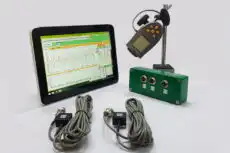
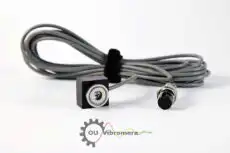
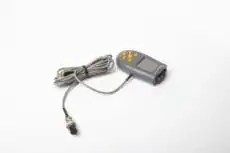
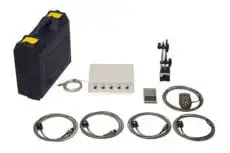
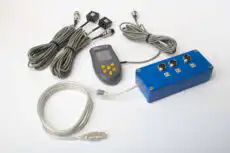
Trending and balancing reinforce each other. A slowly climbing 1× line is the classic fingerprint of progressive unbalance — from product build-up, erosion or a shifting mounted component — and the trend itself tells you when correction is worthwhile. When that point arrives, a portable two-channel analyser such as the Balanset-1A measures the 1× amplitude and phase in the machine’s own bearings, guides single- or two-plane correction, and verifies that the residual unbalance is back inside its ISO 21940-11 grade. Logging that post-balance reading as the new baseline closes the loop, giving the next trend a clean reference point to grow from.
Trending is the temporal analysis that turns vibration monitoring from a set of snapshots into a motion picture, revealing the dynamic evolution of equipment condition. Implemented well — consistent measurements, the right parameters, quality data and intelligent interpretation — it delivers the predictive capability that justifies the investment in condition monitoring and optimises maintenance for maximum reliability and uptime.

 English
  العربية
  Azərbaycan dili
  বাংলা
বাংলা  Български
  简体中文
简体中文  Hrvatski
  Čeština
  Dansk
Dansk  Nederlands
  Eesti
Eesti  Suomi
Suomi  Français
  ქართული
  Deutsch
  Ελληνικά
  עִבְרִית
  हिन्दी
  Magyar
  Bahasa Indonesia
  Italiano
  日本語
日本語  한국어
한국어  Latviešu valoda
  Lietuvių kalba
  Bahasa Melayu
  Norsk bokmål
  فارسی
فارسی  Polski
  Português do Brasil
  Português
  Română
  Русский
  Српски језик
  Slovenčina
  Slovenščina
  Español
  Svenska
  ไทย
ไทย  Türkçe
  Українська
  اردو
اردو  Tiếng Việt