Understanding Predictive Maintenance




Predictive maintenance (PdM) is a maintenance strategy that uses condition monitoring data to predict when an equipment failure will occur and to schedule the repair at the optimal moment — after a problem has been detected but before functional failure happens. PdM combines periodic or continuous measurements (vibration, temperature, oil analysis and more) with trend analysis and diagnostic expertise to forecast remaining useful life and to time interventions so that equipment utilisation is maximised while both maintenance costs and failure risk are minimised.
It represents the evolution from reactive (run-to-failure) and preventive (fixed-schedule) maintenance toward data-driven, condition-based strategies that optimise the balance between reliability and spend. Done well, PdM typically returns 5–10 times its cost through reduced downtime, extended component life and the elimination of unnecessary maintenance — which is why it has become the centrepiece of reliability programmes across heavy industry.
1. Predictive versus Other Maintenance Strategies
PdM is best understood by contrast with the two older philosophies it improves upon.
Reactive maintenance (run-to-failure)
- Approach: repair only after a failure occurs.
- Cost: the lowest planned cost, but the highest total cost once collateral damage and lost production are counted.
- Downtime: unplanned and often extended.
- Appropriate for: non-critical, low-cost or redundant equipment.
Preventive maintenance (time-based)
- Approach: scheduled maintenance at fixed intervals.
- Cost: moderate, with a degree of unnecessary work built in.
- Downtime: planned, but the timing may be premature.
- Issues: may replace components that still had useful life, yet still miss faults that develop between scheduled intervals.
Predictive maintenance (condition-based)
- Approach: maintain when the measured condition shows it is needed.
- Cost: requires investment in monitoring, but delivers the lowest total cost.
- Downtime: planned, and timed for the optimal moment.
- Benefits: maximum equipment utilisation with minimal unnecessary work.
2. PdM Technologies and Methods
No single technique sees everything, so a mature programme layers several complementary ones.
Vibration monitoring
- Route-based measurements with portable instruments, and online continuous monitoring for the most important machines.
- Spectral analysis and trending of the data.
- Envelope analysis for early bearing diagnosis.
- Detects unbalance, misalignment, looseness, bearing defects and gear problems. It is the workhorse of PdM for rotating machinery.
Thermography
- Infrared camera surveys that detect electrical hot spots and mechanical friction.
- Fast, facility-wide screening that complements vibration work. (See thermography.)
Tribology (oil analysis)
- Particle counting and identification, plus wear-metal analysis.
- Assessment of lubricant condition and, through it, the internal condition of components hidden from other methods. (See oil analysis.)
Ultrasonic testing
- Bearing condition assessment and leak detection (steam, compressed air).
- Detection of electrical corona and arcing. (See ultrasound analysis.)
Motor current signature analysis
- Reads the electrical signature of motor condition, exposing rotor-bar defects and stator problems.
- Entirely non-invasive — the motor keeps running while it is monitored.
3. PdM Program Implementation
A successful programme is rolled out in deliberate phases rather than all at once.
- Phase 1 — Assessment and planning: equipment criticality analysis, technology selection, resource requirements and ROI justification.
- Phase 2 — Baseline and setup: instrument acquisition, personnel training, baseline measurements, database setup and the establishment of alarm limits.
- Phase 3 — Operation: regular data collection, analysis and trending, alarm management, work-order generation and maintenance execution.
- Phase 4 — Optimisation: refining routes and frequencies, adjusting alarm limits, expanding coverage and pursuing continuous improvement.
4. Success Metrics
The value of a programme is proven with numbers across three dimensions.
- Reliability metrics: rising mean time between failures (MTBF), falling unplanned downtime, improved equipment availability, and the elimination of catastrophic failures.
- Economic metrics: lower maintenance cost, reduced spare-parts inventory, avoided production losses, and a clear ROI calculation — readily modelled with the Predictive Maintenance ROI Calculator and the MTBF / MTTR Availability Calculator.
- Operational metrics: defects detected per inspection, lead time from detection to failure, the proportion of planned versus unplanned work, and overall programme coverage (the percentage of equipment monitored).
5. Challenges and Solutions
Programmes stall for predictable reasons, each with a known remedy.
- Initial investment: the cost of equipment, training and personnel is met with phased implementation, a solid ROI case, and a start on the most critical equipment first.
- Cultural change: resistance to a new way of working is overcome through training, demonstrated early successes and visible management support.
- Data overload: the sheer volume of data is tamed with automated analysis, exception-based reporting and clear prioritisation.
- Integration: connecting condition monitoring to the CMMS and to operations is solved with software integration, defined workflows and cross-training.
6. Industry Standards
PdM practice is anchored by a family of international standards:
- ISO 17359: general guidelines for condition monitoring and diagnostics.
- ISO 13372: vocabulary for condition monitoring and diagnostics of machines.
- ISO 13373: procedures for vibration condition monitoring.
- ISO 18436: personnel certification for condition monitoring and diagnostics.
Evaluation of measured vibration against acceptance zones is governed by the modern ISO 20816 series, which has replaced the older ISO 10816.
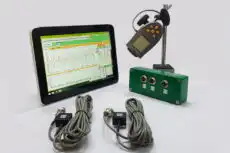
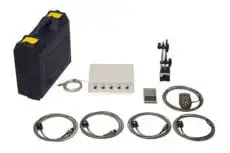
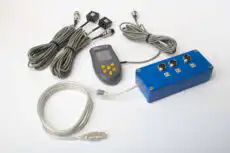
7. Where Field Instruments Fit
Detection is only half the job; PdM is judged by what happens once a fault is found. A great many of those faults are unbalance and misalignment, and the most efficient response is to correct them in place rather than send the rotor away. This is where field balancing closes the loop: a portable two-channel analyser such as the Balanset-1A measures the 1× amplitude and phase in the machine’s own bearings at operating speed, computes the correction weights, and verifies the result against ISO 21940-11 balance grades — all without disassembly. In this way the same instrument that helps screen a machine’s vibration also restores it to service, turning a predictive-maintenance finding directly into a completed repair. That is the essence of PdM: by predicting failures before they happen and timing the fix precisely, it converts maintenance from a cost centre into a value driver, delivering the promise of condition-based asset management in modern industrial operations.

