Understanding the Rotor-Bearing System






A rotor-bearing system is the complete, integrated mechanical assembly made up of a rotating rotor (a shaft with its attached components), the bearings that constrain its motion and carry its loads, and the stationary structure — housings, pedestals, frame, and foundation — that ties the bearings to ground. In rotor dynamics this whole chain is analysed as one entity, because the dynamic behaviour of each part shapes the behaviour of all the others.
Rather than studying the rotor in isolation, sound rotor-dynamic analysis treats the system as a coupled mechanical network. Rotor properties (mass, stiffness, damping), bearing characteristics (stiffness, damping, clearances), and support-structure properties (flexibility, damping) all interact to set the machine’s critical speeds, its vibration response, and its stability. Change any one element and the others respond.
1. Components of the System
The Rotor Assembly
The rotating part of the system, comprising:
- Shaft: the main rotating element, providing most of the bending stiffness.
- Discs and wheels: impellers, turbine wheels, couplings, and pulleys that add mass and inertia.
- Distributed mass: drum-type rotors, or the mass of the shaft itself.
- Couplings: the links to the driver or driven equipment.
The rotor’s dynamic character is set by its mass distribution along the axis, its shaft bending stiffness (a function of diameter, length, and material), its polar and diametral moments of inertia (which drive the gyroscopic effect), and its internal damping, which is usually small. Whether the shaft behaves as a rigid rotor or a flexible rotor in its operating range follows directly from these properties.
Bearings
The interface elements that support the rotor and permit rotation come in three broad families:
- Rolling-element bearings: ball and roller bearings.
- Fluid-film bearings: journal bearings, tilting-pad bearings, and thrust bearings.
- Magnetic bearings: active electromagnetic suspension.
What matters dynamically is each bearing’s stiffness (resistance to deflection under load, in N/m or lbf/in), its damping (energy dissipation, in N·s/m), the small mass of its moving parts, its radial and axial clearances (which set stiffness and introduce non-linearity), and — crucially for fluid-film types — a strong speed dependence: a journal bearing’s stiffness and damping change markedly with running speed.
Support Structure
The stationary foundation elements include the bearing housings and pedestals, the baseplate or frame that connects them, the concrete or steel foundation that carries loads to ground, and any isolation elements — springs, pads, or mounts — used to control vibration. The support contributes additional stiffness (sometimes comparable to, sometimes less than, the rotor’s own), damping through material and joints, and mass that shifts the overall system natural frequencies. Where that foundation stiffness is inadequate, it can dominate the machine’s behaviour.
2. Why System-Level Analysis Is Essential
Coupled Behaviour
The defining feature of the system is that every component acts on the others:
- Rotor deflection creates forces on the bearings.
- Bearing deflection changes the rotor’s support conditions.
- Support flexibility lets the bearings move, lowering the apparent bearing stiffness.
- Foundation vibration feeds back into the rotor through the bearings.
System Natural Frequencies
The natural frequencies belong to the complete system, not to any one part:
- Soft bearings with a stiff rotor give lower critical speeds.
- Stiff bearings with a flexible rotor give higher critical speeds.
- A flexible foundation can drag critical speeds down even when the bearings are stiff.
- The system natural frequency is never simply the rotor’s natural frequency on its own.
Mapping how these frequencies move with speed is exactly what a Campbell diagram is for, and each crossing corresponds to a mode shape of the assembled system.
3. Analysis Methods
Simplified Models
For preliminary work, engineers reach for reduced models:
- Simply-supported beam: the rotor as a beam on rigid supports, neglecting bearing and foundation flexibility.
- Jeffcott rotor: a concentrated mass on a flexible shaft with spring supports — the classic teaching model that includes bearing stiffness.
- Transfer-matrix method: the traditional hand approach for multi-disc rotors.
Advanced Models
For accurate analysis of real machinery:
- Finite-element analysis (FEA): a detailed rotor model with spring elements representing the bearings.
- Bearing models: non-linear stiffness and damping that vary with speed, load, and temperature.
- Foundation flexibility: an FEA or modal model of the support structure.
- Coupled analysis: the full system, including every interactive effect.
4. Key System Parameters
Stiffness Contributions
Total system stiffness is a series combination of the rotor, bearing, and foundation stiffnesses:
1/ktotal = 1/krotor + 1/kbearing + 1/kfoundation
- The softest element dominates the overall stiffness — just as the weakest link governs a chain.
- A common real-world case is foundation flexibility pulling system stiffness below the rotor’s stiffness alone.
Damping Contributions
- Bearing damping: usually the dominant source, especially in fluid-film bearings.
- Foundation damping: structural and material damping in the supports.
- Rotor internal damping: typically very small and usually neglected.
- Total damping: the sum of the parallel damping elements.
5. Practical Implications
For Machine Design
- A rotor cannot be designed in isolation from its bearings and foundation.
- Bearing selection sets the achievable critical speeds.
- Foundation stiffness must be adequate to support the rotor.
- True optimisation considers all the elements at once.
For Balancing
- Influence coefficients capture the response of the complete system, not the bare rotor.
- Field balancing automatically accounts for the as-installed system characteristics.
- Shop balancing on a different bearing-and-support set may not transfer perfectly to the installed machine.
- System changes — bearing wear, foundation settling — alter the balance response over time.
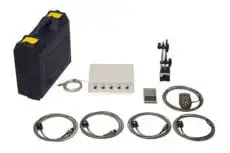
This is precisely why on-site measurement is so valuable. A portable two-channel analyser such as the Balanset-1A balances the rotor in its own bearings, at operating speed, on its real foundation — so the amplitude-and-phase data it gathers and the influence coefficients it computes reflect the true rotor-bearing system the machine actually runs in, including support and thermal effects a balancing machine never sees. The residual unbalance it verifies is therefore the residual the rotor will live with in service.
For Troubleshooting
- A vibration problem may originate in the rotor, the bearings, or the foundation.
- Diagnosis must consider the complete system, not one suspect part.
- A change in one component shifts the behaviour of the whole.
- For example, foundation deterioration can lower a machine’s critical speeds into the running range.
6. Common System Configurations
Simple Between-Bearings Configuration
- The rotor is carried by two bearings at its ends.
- The most common industrial layout, and the simplest to analyse.
- Suits the standard two-plane balancing approach.
Overhung Rotor Configuration
- An overhung rotor extends beyond its bearing support.
- The moment arm raises the bearing loads.
- It is more sensitive to unbalance, and prone to a stronger couple-unbalance component.
- Common in fans, pumps, and some motors.
Multi-Bearing Systems
- Three or more bearings carry a single rotor.
- Load distribution is more complex.
- Alignment between bearings becomes critical.
- Common in large turbines, generators, and paper-machine rolls.
Coupled Multi-Rotor Systems
- Several rotors joined by couplings, as in motor-pump and turbine-generator sets.
- Each rotor has its own bearings, but the systems are dynamically coupled.
- This is the most complex configuration to analyse.
- Misalignment at a coupling generates interaction forces between the rotors.
Seeing rotating machinery as an integrated rotor-bearing system — rather than a collection of isolated components — is fundamental to effective design, analysis, and troubleshooting. The system-level perspective explains a great many vibration phenomena that make no sense in isolation, and it points the way to corrective actions that actually work, for reliable and efficient operation.

