Understanding Thrust Bearings






A thrust bearing (also called an axial bearing) is a specialised bearing designed to carry loads acting parallel to the shaft axis — axial or thrust loads — and to control the axial position of a rotor. Unlike a radial journal bearing, which supports loads perpendicular to the shaft, a thrust bearing presents contact surfaces perpendicular to the shaft axis, so it can resist forces trying to push the shaft in either axial direction. Together the radial and thrust bearings define the complete rotor-bearing system.
Thrust bearings are essential wherever axial forces are present — pumps, compressors, turbines, propeller shafts and vertically oriented equipment. Failure or inadequate capacity of a thrust bearing leads to excessive axial vibration, shaft end-play, and potentially catastrophic damage when the rotor contacts stationary components.
1. Thrust Bearing vs. Radial Bearing: What Is the Difference?
The clearest way to understand a thrust bearing is to contrast it with the radial bearing it works alongside. The two are defined by the direction of the load they are built to carry, not by their size or construction.
- A radial bearing (such as a journal bearing) carries load perpendicular to the shaft — the weight of the rotor and any radial forces from unbalance. Its load-carrying surfaces are cylindrical and wrap around the shaft.
- A thrust bearing carries load parallel to the shaft — the axial push along the centreline. Its load-carrying surfaces are flat (or shaped) faces set at right angles to the shaft, bearing against a collar or shoulder on the rotor.
A typical machine needs both: two radial bearings locate the shaft sideways and support its weight, while a single thrust bearing fixes the rotor’s axial position and absorbs the net axial force. Some designs combine the two duties — an angular-contact or tapered-roller bearing carries radial and axial load simultaneously — but in large turbomachinery the thrust bearing is almost always a dedicated component, separate from the radial bearings, because the axial forces are too large to share.
2. Types of Thrust Bearing
Thrust bearings divide into two broad families: rolling-element types that carry load through balls or rollers, and fluid-film types that float the rotor on a pressurised oil film. The choice between them is driven mainly by load, speed and machine size.
Rolling-Element Thrust Bearings
These carry thrust through balls or rollers and are common in moderate-load, general machinery. Their condition can be tracked through the same rolling-element defect signatures used for radial bearings.
- Ball thrust bearings: ball elements run between flat or grooved thrust washers. Moderate load capacity, medium-to-high speed, good axial positioning accuracy. Used in machine tools, automotive transmissions and other moderate-thrust duties.
- Cylindrical roller thrust bearings: rollers between thrust washers give very high capacity through line contact rather than point contact, but only at low-to-medium speed. Used in heavy machinery, vertical pumps and crane hooks.
- Tapered roller thrust bearings: the tapered rollers give a true rolling action that suits combined and high axial loads. A single bearing carries both radial and axial loads, and preload is adjustable through spacing. Common in automotive wheel hubs, gearboxes and combined-load situations.
- Spherical roller thrust bearings: the barrel-shaped rollers and curved raceway accept very high axial load while tolerating shaft misalignment — useful on long, slightly deflecting shafts in heavy industry.
- Angular contact ball bearings: the ball contact is set at an angle so the bearing takes both radial and axial load, often mounted in pairs (back-to-back or face-to-face). High-speed capable; used in machine-tool spindles and high-speed pumps.
Fluid-Film Thrust Bearings
These float the rotor on a hydrodynamic oil film and dominate large, high-power machines. With no metal-to-metal contact in normal running, they offer near-unlimited life and excellent damping, at the cost of a continuous pressurised oil supply.
- Tilting-pad thrust bearings (often called Kingsbury or Michell bearings after their inventors): multiple pivoting pads each tilt to form a converging oil wedge that lifts the thrust collar clear of the pads. Capacity reaches megawatts in large turbines, speed is effectively unlimited (used to 30,000+ rpm), and damping is excellent. Found in steam turbines, gas turbines, large compressors and generators.
- Fixed-pad (tapered-land) thrust bearings: stationary pads machined with a tapered ramp generate the oil wedge without any moving pivots. High capacity, simple and robust with no moving parts, though less tolerant of load reversal than tilting pads. Used in vertical pumps and hydro turbines.
3. Where Thrust Bearings Are Used: Applications
Any machine whose rotor experiences a net push along its axis needs a thrust bearing to absorb that force and hold the rotor in place. The most common applications are:
- Centrifugal pumps and compressors: the pressure rise across each impeller creates a large axial force toward the suction side, which the thrust bearing must carry.
- Steam, gas and hydro turbines: the working fluid pushes axially on the blade rows; the thrust bearing — usually a tilting-pad type — holds the rotor against this force and against the closely set clearances of the seals and blade tips.
- Marine propulsion (ship and boat thrust bearings): the propeller’s thrust drives the whole vessel forward through the propeller shaft, and a heavy-duty marine thrust bearing transmits that thrust from the shaft into the hull. This is one of the most demanding thrust-bearing duties in engineering.
- Generators and electric motors: in vertical machines the thrust bearing additionally carries the dead weight of the rotor, and in all machines it resists axial magnetic pull.
- Gearboxes: helical and bevel gears generate axial reactions that the shaft thrust bearings must absorb.
- Machine-tool spindles, automotive drivetrains and cranes: smaller rolling-element thrust bearings position the shaft and carry moderate axial loads.
4. Thrust Bearings for Vertical Shafts
Vertical machines — vertical pumps, hydro generators, large vertical motors — place a special demand on the thrust bearing because it must carry not only the process axial force but also the entire static weight of the rotating assembly, which on a large hydro generator can be hundreds of tonnes. In a horizontal machine the radial bearings carry that weight; in a vertical machine the weight acts straight down the shaft axis and lands squarely on the thrust bearing.
For this reason vertical machines almost always use a large fluid-film thrust bearing — typically a tilting-pad design — sized for the combined weight-plus-process load and mounted at the top or bottom of the shaft. The bearing’s oil film and cooling must be designed for continuous full-load operation, and its temperature and axial position are among the most closely watched parameters on the whole machine, because a vertical-shaft thrust-bearing failure drops the rotor onto the stator with no margin to recover.
5. Sources of Axial Load
In Pumps and Compressors
- Impeller hydraulic thrust: the pressure differential across an impeller creates a net axial force, one of the principal hydraulic forces in a pump.
- Magnitude: this can run to thousands of pounds even in a moderate-size pump.
- Direction: typically toward the suction side.
- Balancing: balance holes, back vanes or opposed impellers reduce the net thrust.
In Turbines
- Steam or gas flow creates axial pressure on the blades — part of the aerodynamic forces acting on the rotor.
- Thrust magnitude increases with power output.
- It may reverse direction during startup or load changes.
- Dummy pistons or balance pistons are used to counteract it.
In Gearboxes
- Helical gears generate axial thrust proportional to the transmitted torque.
- Bevel gears create axial force components.
- The thrust direction depends on the gear hand (the direction of the helix angle).
Other Sources
- Magnetic pull: in electric motors, magnetic unbalance creates axial forces.
- Propellers and fans: aerodynamic thrust from accelerating the working fluid.
- Belt drives: angled belts create axial force components.
- Misalignment: angular misalignment in couplings generates oscillating axial forces.
6. Thrust-Bearing Problems and Diagnosis
Common Failure Modes
- Overload: thrust exceeds the bearing’s rated capacity — often because a process upset or worn balance device lets the net axial force grow beyond design.
- Inadequate lubrication: insufficient oil flow or grease starves the contact, allowing the oil film to collapse and the surfaces to touch.
- Contamination: particles in the oil score and damage the thrust surfaces.
- Wear and fatigue: surface deterioration from abrasion or cyclic loading, ranging from pitting through to spalling of the babbitt or raceway.
- Misalignment: a thrust collar that is not square to the shaft loads the pads unevenly and overheats one side.
- Electrical erosion: shaft currents passing through the oil film pit the bearing surfaces, a growing problem on variable-frequency-drive machines.
- Overheating: the end result of most of the above — excessive friction or inadequate cooling that softens the babbitt and wipes the pads.
Sizing margin against these modes can be checked quantitatively. When a bearing sees both radial and axial load, the bearing equivalent dynamic load calculator combines them into a single value, the static safety factor calculator guards against brinelling under standstill thrust, and the L10 bearing life calculator projects the expected service life.
Vibration and Axial-Measurement Symptoms
- High axial vibration: the primary indicator of a thrust-bearing problem, usually best seen in the axial direction rather than the radial.
- Rising axial position: on fluid-film machines, the shaft drifting toward its limit as the pads wear is a direct measure of bearing loss.
- Low-frequency oscillation: the shaft floating axially within its clearance.
- Impacting: if axial clearance is excessive, the shaft impacts its stops, producing sharp peaks in the vibration signal.
- Measurement: axial proximity probes or accelerometers reveal these symptoms.
Other Indicators
- Temperature rise: the thrust bearing running hot — often the very first symptom on a fluid-film bearing.
- Noise: unusual sounds from the thrust-bearing location.
- Axial play: measurable shaft movement in the axial direction.
- Oil quality: metallic particles appearing in the lubricant.
7. Measuring Thrust-Bearing Health in the Field
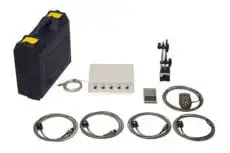
On assembled machines, thrust-bearing condition is judged from axial measurements taken in situ rather than on a test stand. A portable two-channel analyser such as the Balanset-1A lets an engineer record axial vibration amplitude and phase at the thrust end, compare it against the radial readings, and separate genuine thrust-bearing distress from the axial vibration that misalignment or a bent shaft can also produce — all without stopping production for a teardown. Because the same instrument captures the broader vibration picture and can balance the rotor in its own bearings once unbalance is confirmed, it ties the thrust reading back into the machine’s overall condition.
8. Monitoring and Maintenance
Critical Monitoring Parameters
- Axial vibration: measured continuously or on a periodic route as part of a vibration monitoring programme.
- Axial position: proximity probes tracking the shaft’s axial position relative to the thrust bearing.
- Thrust-bearing temperature: RTD or thermocouple monitoring, often the earliest warning of distress (see temperature sensors).
- Oil flow and pressure: for fluid-film thrust bearings, a loss of supply is an immediate alarm condition.
Maintenance Practices
- Verify adequate thrust-bearing lubrication and oil supply.
- Check axial clearances during overhauls.
- Inspect the thrust surfaces for wear or damage.
- Measure actual thrust loads where possible, using strain gauges or load cells.
- Trend temperature and vibration data, and confirm findings with detailed vibration analysis, as part of a condition monitoring programme.
Thrust bearings often receive less attention than radial bearings, yet they are critical for controlling axial position and carrying axial load in rotating machinery. Understanding the available types, the sources of thrust, and the failure modes enables proper bearing selection, effective monitoring, and timely maintenance — preventing the kind of failure that ends in rotor-to-stator contact and the destruction of the machine.
9. Frequently Asked Questions
What does a thrust bearing do?
A thrust bearing carries axial load — force acting parallel to the shaft — and fixes the rotor’s axial position. It absorbs the net push that the process creates (impeller thrust, blade thrust, propeller thrust) and prevents the shaft from drifting into stationary parts.
What is the difference between a thrust bearing and a radial bearing?
Direction of load. A radial bearing carries load perpendicular to the shaft (the rotor’s weight and side forces); a thrust bearing carries load parallel to the shaft (the axial push). Most machines use both, and a few combined-load types such as angular-contact or tapered-roller bearings do both jobs at once.
What are the main types of thrust bearing?
Two families. Rolling-element types — ball, cylindrical-roller, tapered-roller, spherical-roller and angular-contact — suit moderate loads and general machinery. Fluid-film types — tilting-pad (Kingsbury) and fixed-pad tapered-land — float the rotor on an oil film and handle the very high loads of large turbines, compressors and vertical machines.
Why do vertical machines need a special thrust bearing?
On a vertical shaft the thrust bearing carries not only the process axial force but the full static weight of the rotor, which acts straight down the shaft axis. This is why vertical pumps and hydro generators use large fluid-film thrust bearings sized for the combined load.
How is a failing thrust bearing detected?
The clearest signs are rising axial vibration, a drift in the measured axial position of the shaft, and an increase in bearing temperature. Axial proximity probes, accelerometers and temperature sensors are trended over time, and a portable analyser can confirm the diagnosis on a running machine.
What causes thrust bearings to fail?
Overload beyond rated capacity, lubrication failure, oil contamination, surface fatigue (pitting and spalling), misalignment of the thrust collar, and electrical erosion from shaft currents. Overheating is usually the common end-point that wipes the bearing.

