Understanding Bearing Wear


Bearing wear is the progressive loss of material from bearing surfaces — the raceways, the rolling elements, and the cage — through mechanical processes such as abrasion, adhesion, corrosion or surface fatigue. Unlike the sudden failure of fatigue spalling, wear is a gradual, distributed degradation: it slowly enlarges bearing clearances, erodes running precision, and ends in functional failure only once the clearance grows excessive or the surfaces become badly roughened. Because the process is slow, it is also one of the most rewarding to catch early — it gives ample warning through vibration trends, temperature changes and physical inspection long before the bearing seizes.
1. Definition: What Is Bearing Wear?
Wear differs from a localised defect in both mechanism and signature. A localised defect — a single spall or a brinell dent — is a discrete fault that strikes the rolling elements once per pass and rings the bearing’s fault frequencies. Wear, by contrast, removes material more or less everywhere the surfaces rub, raising the general roughness rather than creating one sharp scar. The practical consequence is that wear shows up as a rising broadband noise floor and growing clearance, whereas a defect announces itself with crisp tones. Understanding which wear mechanism is at work is the first step toward sensible bearing selection, lubrication practice and maintenance strategy — and toward distinguishing manageable ageing from impending failure among the broader family of bearing defects.
2. Mechanisms of Bearing Wear
Abrasive Wear
The most common wear mechanism in industrial bearings.
- Cause: hard particles — dirt, machining chips, wear debris — finding their way into the bearing.
- Process: particles trapped between the rolling elements and raceways act like a grinding compound.
- Result: material is removed from the softer surface, usually the races, leaving grooves or polished wear tracks.
- Rate: roughly proportional to both the contamination level and the hardness of the particles.
- Prevention: effective sealing, filtration of the lubricant, and clean assembly practices.
Adhesive Wear (Scuffing)
Occurs under boundary lubrication or outright dry contact.
- Cause: inadequate lubrication that allows metal-to-metal contact.
- Process: microscopic welding and tearing at the asperity contact points.
- Result: rough, discoloured surfaces with material transferred between races and rolling elements.
- Progression: can escalate rapidly once it starts, since each torn asperity worsens the contact.
- Prevention: the right lubricant in the right quantity, maintaining a load-bearing film.
Fretting Wear (False Brinelling)
Occurs in stationary or oscillating bearings rather than rotating ones.
- Cause: small-amplitude oscillatory motion while the bearing is not turning — typically vibration during transport or storage.
- Process: micro-slip between rolling elements and races generates fine oxide debris.
- Result: reddish-brown deposits in the contact zones and shallow depressions at each rolling-element position.
- Appearance: resembles true brinelling, but without the permanent plastic deformation of a genuine overload dent.
- Prevention: vibration isolation in storage and transit, occasional rotation of stored machines, or adequate preload.
Corrosive Wear
- Cause: moisture, chemicals or otherwise aggressive environments.
- Process: chemical attack that pits and roughens the surface, often combining with mechanical action; the underlying corrosion seeds further damage.
- Result: rust-coloured deposits, roughened surfaces and net material loss.
- Common in: food processing, marine environments and chemical plants.
- Prevention: corrosion-resistant bearings, effective sealing and correct lubricant selection.
Erosive Wear
- Cause: high-velocity fluid flow carrying entrained particles.
- Common in: contaminated lubricants served by circulation systems.
- Result: smoothly eroded surfaces and gradual material removal.
- Prevention: filtration, clean lubricant and sound seal design.
Left unchecked, several of these mechanisms feed into surface fatigue, with micro-pitting giving way to full spalling — the point at which gradual wear hands over to rapid, defect-driven failure.
3. Vibration Symptoms of Bearing Wear
Gradual Changes
Wear produces a characteristic, progressive shift in the vibration signature:
- Rising overall level: the total RMS vibration creeps upward over weeks and months.
- More high-frequency content: energy grows in the high-frequency range, above roughly 1000 Hz.
- Elevated noise floor: broadband “grass” rises across the whole spectrum.
- Many small peaks: a forest of low, distributed peaks rather than one dominant defect tone.
- Loss of tracking: the 1× component may become less prominent relative to the rising high-frequency content.
Distinguishing Wear from a Localised Defect
| Characteristic | Localised defect (spall) | General wear |
|---|---|---|
| Fault frequencies | Clear BPFO, BPFI, BSF peaks | No clear defect frequencies |
| Spectrum appearance | Discrete peaks with harmonics | Broad, elevated noise floor |
| Progression | Exponential amplitude growth | Gradual, near-linear increase |
| Envelope analysis | Strong response, clear peaks | Moderate broadband increase |
| Time to failure | Weeks to months once detected | Months to years of slow degradation |
This distinction matters because it changes the maintenance response: a spall calls for prompt replacement planning, whereas steady wear can often be trended and the bearing changed at a convenient outage.
4. Detection Methods
Vibration Monitoring
- Trend the overall RMS level over time rather than reading a single snapshot.
- Watch high-frequency acceleration (often reported as a high-frequency defect or HFD band), which is sensitive to surface roughening.
- Crest factor tends to stay relatively normal under distributed wear — unlike spalling, where sharp impacts drive it up.
- Kurtosis likewise shows little dramatic change, because wear lacks the impulsive impacts that kurtosis is designed to flag.
Because wear roughens surfaces without producing strong discrete tones, demodulation techniques such as envelope analysis are valuable for confirming early-stage degradation before it dominates the overall reading.
Temperature Monitoring
- Trend bearing temperature alongside vibration.
- Wear often raises temperature through increased friction.
- A gradual rise — on the order of 2–5 °C per year — points to slow, progressive wear.
- A sudden jump signals a transition to more severe damage and warrants immediate attention.
Ultrasound Monitoring
- Ultrasonic emissions increase as surfaces roughen, making ultrasound analysis sensitive to early wear.
- It is effective for detecting degradation well before it appears at lower frequencies.
- Portable ultrasound instruments suit route-based inspections.
Oil Analysis
- Wear debris accumulates in the lubricant and can be quantified through oil analysis.
- Particle counting and analysis track the quantity and size distribution of debris.
- Ferrography characterises the wear particles, hinting at the mechanism that produced them.
- A rising particle concentration is a direct indicator of progressive wear.
5. Causes and Contributing Factors
Lubrication-Related
- Inadequate lubricant quantity, leading to starvation.
- Wrong viscosity for the operating speed and temperature.
- Contaminated lubricant carrying particles, water or chemicals.
- Degraded lubricant that has oxidised or lost its additive package.
- Improper re-lubrication intervals — too long, or too short and over-greased.
Setting the right interval is largely a calculable problem; a bearing re-lubrication interval calculator turns speed, size and operating conditions into a recommended grease interval, removing much of the guesswork from bearing lubrication.
Operating Conditions
- Excessive static or dynamic bearing loads.
- High operating temperatures that thin the film.
- A contaminated environment that overwhelms the seals.
- Inadequate sealing that permits particle ingress.
- Vibration transmitted from nearby equipment, promoting fretting.
Installation and Maintenance
- Improper installation that introduces misalignment and edge loading.
- Incorrect internal clearance selection for the duty.
- Contamination introduced during fitting.
- Damaged seals that let contaminants in from the start.
6. Prevention and Life Extension
Lubrication Best Practice
- Use the correct lubricant type and grade for the application.
- Maintain the proper quantity — neither starved nor over-packed.
- Establish appropriate re-lubrication intervals and stick to them.
- Monitor lubricant condition and replace it once degraded.
- Keep the work clean during every lubrication event.
Contamination Control
- Seal effectively to bar particle ingress.
- Keep installation practices clean.
- Filter circulating-oil systems where fitted.
- Use environmental controls such as enclosures or slight positive pressure.
- Inspect and replace seals on a regular schedule.
Managing Operating Conditions
- Operate within the bearing’s design limits for load, speed and temperature.
- Maintain good balance to minimise the cyclic dynamic loads imposed on the bearing.
- Ensure precision alignment to avoid edge loading.
- Control operating temperature with supplementary cooling where needed.
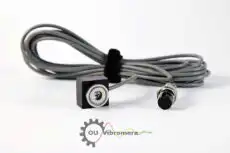
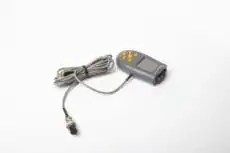
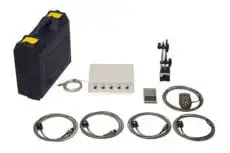
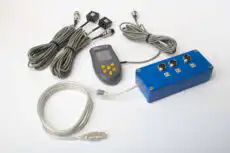
Two of these levers — balance and alignment — are squarely within a maintenance team’s control in the field. Residual unbalance imposes a rotating dynamic load on the bearing at every revolution, and reducing it directly lightens the duty the bearing has to carry. A portable two-channel analyser such as the Balanset-1A lets a technician balance the rotor in its own bearings at operating speed and trend the resulting vibration over time, so a creeping rise in level can be caught and acted on before wear runs away. Where a worn bearing is finally removed, classifying the damage pattern against ISO 15243 — a step a bearing damage classifier makes systematic — closes the loop by revealing the root cause for the next bearing.
Bearing wear, though gradual and far less dramatic than a sudden spalling failure, accounts for a large share of bearing deterioration in industrial service. Sound lubrication, disciplined contamination control and consistent trend analysis together allow wear to be detected early and the bearing replaced on plan — before degradation reaches functional failure — optimising both reliability and maintenance cost.

