Understanding Bearing Lubrication






Bearing lubrication is the practice of applying and maintaining a lubricant — oil or grease — between the rolling or sliding surfaces of a bearing so that the metal parts are separated by a load-carrying film rather than rubbing directly on one another. That single film does six jobs at once: it reduces friction, prevents wear, carries away heat, protects against corrosion, flushes out contamination, and helps spread the contact load. Lubrication is arguably the single most important factor in bearing life. A bearing starved of lubricant can fail in hours or days; a properly lubricated one can run for decades. The link is so strong that an estimated 50–80% of premature bearing failures trace back to a lubrication problem — the wrong lubricant, too little (or too much) of it, contamination, or a lubricant that has simply degraded in service.
1. What Lubrication Actually Does
It is tempting to think of a lubricant as merely “slippery oil,” but in a rolling-element bearing it performs several distinct functions, each of which matters for reliability and for the vibration signature the bearing produces.
Friction reduction
- Separates the metal surfaces with a fluid film, preventing direct contact.
- Drops the friction coefficient from roughly 0.3–0.5 (dry) to 0.001–0.01 (lubricated) — two to three orders of magnitude.
- Minimises power loss and the heat that friction would otherwise generate.
- Enables smooth, quiet running — the quiet operation a healthy bearing should show.
Wear prevention
- Stops the metal-to-metal contact that drives adhesive and abrasive wear.
- Extends usable life from hours to years.
- Preserves the original bearing clearance and running precision.
Heat dissipation
- The lubricant absorbs frictional heat and carries it away from the contact.
- Especially important in oil-lubricated bearings with circulating systems.
- Prevents the overheating that would soften the hardened raceways and accelerate failure.
Corrosion protection, contamination control and load distribution
- Corrosion protection: the film blocks moisture and corrosive agents; additives add further inhibition; this matters most during storage and idle periods.
- Contamination control: the lubricant flushes small particles out of the contact zone, grease provides a sealing action against ingress, and oil systems often add filtration.
- Load distribution: the film spreads load more evenly, and elastohydrodynamic lubrication (EHL) in the rolling contacts provides genuine load support, lowering peak contact stresses.
That last point deserves emphasis. In a loaded rolling contact the pressure is so high that the oil momentarily behaves almost like a solid and the surfaces deform elastically — the EHL regime. The film is only a fraction of a micrometre thick, which is why even small amounts of contamination or the wrong viscosity have such an outsized effect.
2. Grease vs Oil: Choosing the Lubricant
Grease lubrication
Grease is the most common choice for rolling-element bearings and is essentially oil held in place by a thickener.
- Composition: base oil + thickener (a metallic soap) + additives.
- Advantages: simple, needs no external system, and provides its own sealing.
- Limitations: limited heat dissipation and the need for periodic regreasing.
- Speed limit: typically up to a DN value of 300,000–500,000 (bearing bore in mm × shaft RPM).
- Applications: electric motors, general industrial equipment, and sealed-for-life bearings.
Oil lubrication
Oil is required where speeds or temperatures climb beyond what grease can handle.
- Types: mineral or synthetic, with a range of additive packages.
- Advantages: excellent heat removal, can be filtered and cooled, and generally gives longer life.
- Requirements: an oil supply system, seals and drainage.
- Speed range: no practical upper speed limit.
- Applications: high-speed machinery, journal bearings, and large circulating-oil systems.
Selecting the right grade is not guesswork. The base-oil viscosity must be high enough to build a film at operating temperature and speed, yet not so high that churning losses overheat the bearing. When you do need to put numbers to it, our Bearing Grease Quantity Calculator sizes the initial fill, and the Bearing Relubrication Interval Calculator turns speed, size and temperature into a sensible regreasing schedule.
3. Lubrication Methods
For grease
- Packed bearings: the bearing cavity is filled 30–50% with grease (overfilling causes churning).
- Periodic regreasing: fresh grease added at intervals ranging from months to years.
- Automatic lubricators: electromechanical devices that meter out measured doses continuously.
- Sealed bearings: pre-packed and not relubricated — replaced once the grease is exhausted.
For oil
- Oil bath: the bearing is partially submerged in an oil sump.
- Oil ring: a ring riding on the shaft lifts oil from the sump and delivers it to the bearing.
- Oil mist: an atomised spray for high-speed work.
- Circulating system: pumped oil supply with integral cooling and filtration.
- Jet lubrication: high-pressure oil jets for the most extreme speeds.
4. Lubrication Failure Modes — and the Vibration They Cause
Because so many bearing failures are lubrication failures, the maintenance engineer should know each mode and its early symptoms. Most of these announce themselves first as a rise in temperature and in high-frequency vibration well before the bearing seizes.
Insufficient lubrication
- Symptoms: high temperature, increased vibration, audible noise.
- Damage: surface scoring, discolouration, rapid wear.
- Causes: wrong intervals, blocked passages, inadequate supply.
- Time to failure: hours to days.
Excess lubrication
- Symptoms: high temperature from grease churning, seal leakage.
- Damage: accelerated grease degradation, seal damage.
- Causes: overgreasing, overfilled oil sumps.
- Effect: severe overgreasing can cut bearing life to 50–80% of optimal.
Wrong, contaminated or degraded lubricant
- Wrong viscosity: too thin gives an inadequate film; too thick raises friction and heat.
- Incompatible type: mixing incompatible greases or oils can break the thickener structure down.
- Wrong temperature range: the lubricant either breaks down or becomes too viscous.
- Contamination: dirt, metal particles or water act as an abrasive compound, accelerating wear and fatigue, and can block passages.
- Degradation: oxidation with age or heat, loss of additives, and thickening or thinning all reduce the lubricant’s protective capability.
When the film finally breaks down, the resulting metal-to-metal impacts excite the bearing’s natural frequencies and produce the classic bearing fault frequencies. These show up best under envelope analysis, which is why a lubrication problem and an incipient spalling defect are often caught by the same measurement.
5. Best Practices and Condition Monitoring
Selection and application
- Follow the bearing and machine manufacturer’s recommendations, and account for speed, load and temperature when choosing the viscosity grade.
- Use quality lubricants from reputable suppliers.
- Clean every surface before lubricating, apply the correct quantity (neither too much nor too little), use clean tools and containers, and purge old grease during regreasing.
Monitoring
- Set relubrication intervals from actual operating conditions, not habit.
- Track bearing temperature — a rise is one of the first signs of a lubrication issue.
- Trend lubricant consumption and inspect seals periodically.
- Use oil analysis (tribology) to judge lubricant condition and contamination, and fold the bearing into the wider condition monitoring programme.
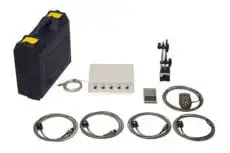
Vibration measurement closes the loop. A portable two-channel analyser such as the Balanset-1A lets a technician walk a route of machines and capture the high-frequency vibration and overall levels that reveal a starved or contaminated bearing long before it becomes audible — and, because the same instrument balances rotors, it confirms that any rise in 1× vibration is genuinely a bearing-lubrication symptom and not simply unbalance masquerading as one. Used alongside temperature and oil analysis, it turns lubrication management from a calendar task into a genuinely condition-based one. Understanding lubrication principles, choosing the right lubricant, applying the correct quantity by the correct method, and maintaining its condition through monitoring together form the foundation of every effective bearing-reliability programme.

