Understanding Non-Destructive Testing (NDT)





Non-Destructive Testing (NDT) — also called Non-Destructive Examination (NDE) or Non-Destructive Inspection (NDI) — is a broad family of analysis techniques used across science and industry to evaluate the properties of a material, component or system without causing damage. The defining feature is in the name: the item being tested remains fully usable after the inspection. In maintenance and reliability work, NDT covers the condition monitoring technologies that assess machinery from the “outside” — during operation or a brief shutdown — without disassembly, and vibration analysis is one of its most prominent and powerful methods.
1. Definition: What is Non-Destructive Testing?
Because nothing is cut open, consumed or destroyed, the same component can be inspected repeatedly over its life and returned to service each time. That property is what makes NDT the practical foundation of any modern reliability strategy: it lets engineers gather evidence about an asset’s integrity without taking it out of production or sacrificing the part to find out whether it was sound.
2. The Goal of NDT in Maintenance
The primary purpose of NDT in a maintenance and reliability program is to detect and characterise flaws, defects and degradation in machinery and structures at the earliest possible stage. Early detection lets work be planned and performed proactively, heading off catastrophic failures and minimising downtime. NDT is therefore the enabling science behind Condition-Based Maintenance (CBM) and, more broadly, predictive maintenance — the discipline of repairing a machine on the evidence of its measured condition rather than on a fixed calendar. The collected results feed directly into trend analysis and, ultimately, an estimate of remaining useful life.
3. Common NDT Methods in Plant Maintenance
While dozens of NDT methods exist, a core group is routinely used to assess the health of plant assets. These are often grouped together as the condition-monitoring technologies:
- Vibration analysis: measuring and interpreting the vibration signatures of rotating machinery to detect mechanical faults such as unbalance, misalignment, bearing defects and gear problems.
- Oil analysis (tribology): laboratory analysis of lubricating oil to judge the health of both the oil and the machine by identifying wear particles, contaminants and chemical changes.
- Thermography (infrared analysis): using thermal cameras to spot temperature anomalies that signal electrical faults, lubrication problems and other issues.
- Ultrasound analysis: detecting high-frequency sound to find compressed-air leaks, electrical faults and lubrication problems, and closely related to acoustic emission monitoring of stress waves.
- Motor Circuit Analysis (MCA): an electrical test method used to assess the health of a motor’s windings and insulation.
No single technology sees everything, which is why robust programs layer several. ISO 17359 provides the general framework for selecting and combining condition-monitoring techniques, and the choice can be guided in practice with an ISO 17359 Condition Monitoring Method Selector.
4. NDT for Flaw Detection in Materials
Beyond monitoring active machinery, NDT also includes a set of techniques focused on finding physical flaws in static components, welds and materials:
- Visual Testing (VT): the most basic method — direct visual inspection of a component, sometimes aided by borescopes or magnifiers.
- Liquid Penetrant Testing (PT): a low-cost way to locate surface-breaking defects in non-porous materials. A dye is applied to the surface and seeps into any cracks, which are then revealed under UV light.
- Magnetic Particle Testing (MT): used to find surface and near-surface flaws in ferromagnetic materials. The part is magnetised and fine iron particles are applied; they gather at the magnetic flux-leakage field that forms over any crack or flaw.
- Radiographic Testing (RT): uses X-rays or gamma rays to see inside a material. The radiation passes through the object onto film or a digital detector; voids, cracks or density changes appear in the image, much like a medical X-ray.
- Ultrasonic Testing (UT): sends high-frequency sound waves into a material through a probe. The sound reflects off internal features — the back wall or a flaw — and by timing the returning echoes an inspector can measure wall thickness and detect, locate and size internal defects. Beam path and near-field length can be worked out with a UT beam-path and near-field calculator.
Choosing the right flaw-detection method, and the personnel certification it requires, is itself standardised; an NDT Method Selector (ISO 9712) helps match technique to defect type and material.
5. Where Vibration Analysis Fits
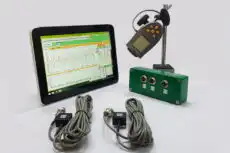
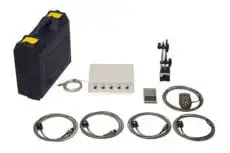
For rotating equipment, vibration analysis is usually the first and most informative NDT method, because it reports on the dynamic condition of the machine while it runs. Faults reveal themselves as characteristic peaks in the vibration spectrum, and severity is judged against standards such as ISO 20816 (the modern successor to ISO 10816). When the spectrum shows a dominant once-per-revolution component, the non-destructive remedy is often field balancing — performed without removing the rotor. A portable two-channel analyser such as the Balanset-1A measures the 1× amplitude and phase in the machine’s own bearings and computes the correction weights on the spot, turning a diagnostic NDT measurement directly into a non-destructive repair.
All of these methods share a single aim: to provide critical information about the condition and integrity of an asset without damaging it, so that informed decisions can be made about maintenance, repair and replacement.

