ॲक्सेलरोमीटर म्हणजे काय? कंप विश्लेषणासाठी मार्गदर्शक
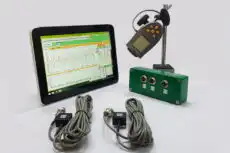
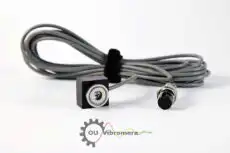
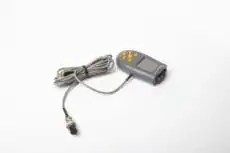
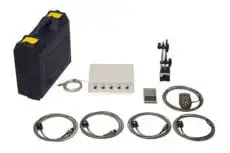

एक accelerometer आहे ट्रान्सड्यूसर (or sensor) that converts mechanical motion — specifically the त्वरण produced by vibration or shock — into a proportional electrical signal. It is by far the most widely used sensor in भविष्यसूचक देखभाल and कंडिशन मॉनिटरिंग. By measuring how quickly a point on a machine is changing velocity, an accelerometer supplies the raw data that lets an analyst diagnose a wide range of mechanical and electrical faults — from बेअरिंग दोष ते unbalance and misalignment.
1. Definition: The Core of Vibration Measurement
Acceleration is the natural quantity to measure on rotating machinery because the dynamic forces that damage a machine — centrifugal force from a heavy spot, impact from a spalled bearing race — scale with acceleration. An accelerometer responds directly to those forces, which is why it sits at the heart of nearly every modern कंपन विश्लेषक and डेटा कलेक्टर.
One of the practical strengths of the accelerometer is that its acceleration signal can be electronically समाकलित once to give वेग (mm/s), and twice to give विस्थापन (µm). A single, well-mounted sensor therefore covers all three classic vibration units, letting the analyst pick whichever best reveals a given fault.
2. How Do Accelerometers Work? The Piezoelectric Principle
Although several physical principles exist, the overwhelming majority of accelerometers used for industrial machinery are based on the पायझोइलेक्ट्रिक प्रभाव. The working sequence is straightforward:
- Piezoelectric crystal: Inside the sensor a small seismic mass is attached to a piezoelectric element — typically a ceramic such as PZT, or in premium sensors a precision-cut quartz crystal.
- Applying force: When the machine vibrates, the housing moves with it. By inertia, the internal mass resists that motion and exerts a force on the crystal — equal, by Newton’s second law, to mass times acceleration.
- Generating a signal: A stressed piezoelectric crystal produces a tiny electrical charge directly proportional to the applied force, and therefore to the acceleration.
- आउटपुट: Internal electronics condition this charge and pass it down a cable to a data collector or monitoring system as an analog representation of the acceleration at that point.
How that charge is conditioned defines two common families. A charge-output sensor delivers the raw charge to an external चार्ज अॅम्प्लिफायर and tolerates very high temperatures. Far more common in industry is the IEPE (or voltage-mode) type, which builds the amplifier into the sensor and outputs a low-impedance voltage that travels well down ordinary two-wire cable. The most robust designs use a shear construction, which isolates the crystal from base bending and thermal transients.
3. Types of Accelerometers
Different applications call for different sensors, each with its own strengths.
General-Purpose Accelerometers
These are the workhorses of industrial monitoring. They typically offer a संवेदनशीलता of 100 mV/g and a frequency range suited to most common machinery such as pumps, motors and fans — roughly 2 Hz to 10 kHz.
MEMS ॲक्सेलरोमीटर
Micro-Electro-Mechanical Systems (MEMS) accelerometers are silicon-based, very small, low-power and cost-effective. Historically less sensitive than piezoelectric types, modern MEMS devices are improving rapidly and are common in portable electronics, automotive systems, वायरलेस निरीक्षण nodes and lower-cost condition-monitoring installations.
पायझोरेझिस्टिव्ह ॲक्सेलरोमीटर
Used for shock testing and low-frequency motion, these sensors respond all the way down to 0 Hz (DC acceleration), which makes them useful for measuring the steady acceleration in a centrifuge or the slow ride motion of a vehicle.
उच्च-वारंवारता ॲक्सेलरोमीटर
Designed to catch high-frequency events such as early-stage gear and bearing damage, these sensors use a smaller seismic mass and a higher resonant frequency, allowing accurate measurement to 20 kHz or beyond — the range where techniques like लिफाफा विश्लेषण आणि shock pulse पद्धत live.
4. Key Specifications and Selection
When choosing an accelerometer, engineers weigh several parameters:
- संवेदनशीलता (mV/g): Higher sensitivity yields a stronger output, better for resolving low-level vibration; 100 mV/g is the common industrial standard.
- वारंवारता प्रतिक्रिया: The band over which the sensor reads accurately. It must span the expected दोष वारंवारता of the machine, with a comfortable margin below the sensor’s own नैसर्गिक (अनुनादी) वारंवारिता.
- तापमान श्रेणी: The sensor must withstand the surface temperature where it is mounted; a तापमान सेंसर is often co-located for combined monitoring.
- Mounting method: How the sensor attaches — stud, adhesive or magnet — strongly affects high-frequency accuracy. A stud mount per ISO 5348 gives the best coupling and the widest usable bandwidth; a magnet is convenient for route work but lowers the upper frequency limit. Poor माउंटिंग can introduce a false स्थापन अनुनाद that masquerades as a machine fault.
You can estimate the bandwidth penalty of a given attachment with the प्रवेगमापी माउंटिंग अनुनाद कॅल्क्युलेटर before committing to a mounting scheme.
5. Applications in Condition Monitoring
Accelerometers underpin nearly every कंपन विश्लेषण task, including:
- Predictive maintenance programs: collecting routine data on a route to trend machine health and forecast failures.
- दोष निदान: pinpointing unbalance, misalignment, सैलपणा and बेअरिंग घिसावट from the कंपन स्पेक्ट्रम.
- स्वीकृती परीक्षण: verifying that new or repaired machinery meets vibration specifications such as ISO 20816 (ISO 10816 चा आधुनिक उत्तराधिकारी).
- मोडल विश्लेषण: studying the प्राकृतिक वारंवारतेशी and मोड आकार of a structure.
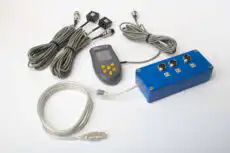
Field balancing is one of the most demanding of these jobs, because it needs both the amplitude and तो phase of the once-per-revolution vibration. A portable two-channel instrument such as the Balanset-1A takes its two accelerometers, locks them to a tachometer pulse, and measures the 1× amplitude and phase directly in the machine’s own bearings at operating speed — turning the raw accelerometer signal into the influence coefficients and correction weights needed to balance the rotor on site.

