फिरत्या यंत्रसामग्रीतील त्रिज्यीय कंपन समजून घेणे






त्रिज्यीय कंपन is the motion of a rotating shaft perpendicular to its axis of rotation, radiating outward from the centre like the spokes of a wheel. The word “radial” covers any direction that points away from the shaft centreline, so it embraces both horizontal (side-to-side) and vertical (up-and-down) movement. It is the same quantity engineers call पार्श्व कंपन or transverse vibration, and it is by far the most commonly measured and trended form of vibration in rotating machinery — the first number a reliability technician looks at, and the one most international standards are written around. In practice it is measured in two perpendicular directions at each bearing so that the shaft’s full path through space can be reconstructed.
1. Definition and Measurement Directions
Because a shaft can move in any direction within the plane perpendicular to its axis, a single sensor never tells the whole story. Two probes mounted 90° apart at each bearing capture the complete radial picture, and their readings are usually reported separately as well as combined.
आडवे त्रिज्यीय कंपन
Horizontal vibration is the side-to-side motion of the shaft:
- Perpendicular to the shaft axis and parallel to the floor.
- Often the most accessible measurement point on a horizontal machine.
- Reflects gravity, foundation-stiffness asymmetry, and horizontal forcing functions.
- The standard measurement orientation for most routine monitoring programmes.
उभे त्रिज्यीय कंपन
Vertical vibration is the up-and-down motion of the shaft:
- Perpendicular to the shaft axis and perpendicular to the floor.
- Directly influenced by gravity and the static weight of the rotor.
- Frequently higher in amplitude than horizontal because rotor weight creates asymmetric support stiffness.
- Critical for diagnosing vertically oriented machines such as vertical pumps and motors, where “horizontal” and “vertical” lose their usual meaning and the two radial axes are simply orthogonal.
एकूण त्रिज्यीय कंपन
The two directional readings are sometimes combined into a single vector total:
त्रिज्यीय एकूण = √(Horizontal² + Vertical²)
- Can be a convenient in-house metric for trending, condensing both directions into one number.
- Not a standard severity number: ISO 20816 (like ISO 10816 before it) evaluates the जास्त of the two individually measured orthogonal radial values against its zone boundaries — do not compare this combined total directly to ISO 20816 limits, or use it for ISO-based alarm setting, unless the standard or procedure you follow explicitly defines such a combined metric.
- Because the two axes rarely peak at the same instant, the orbit the shaft traces is usually an ellipse rather than a circle — a fact that becomes important in orbit analysis.
2. Primary Causes of Radial Vibration
Radial vibration is produced by any force acting perpendicular to the shaft axis. Identifying the dominant frequency is the heart of diagnosis, because each fault leaves a characteristic signature.
1. Unbalance (the Dominant Cause)
Unbalance is the single most common source of radial vibration in rotating equipment:
- It creates a केंद्रापसारक बल that rotates with the shaft, appearing at चालवताना गती (1X).
- The force grows with the unbalance mass, its radius, and — critically — the square of speed, so a small heavy spot becomes a serious problem as RPM rises.
- It produces a broadly circular or elliptical शाफ्टची कक्षा.
- It is correctable through balancing, the only one of these faults that can usually be fixed without replacing parts.
2. विसंरेखन
शाफ्ट गैरसंरेखण between coupled machines generates both radial and अक्षीय कंपन:
- It shows predominantly as 2X (twice-per-revolution) radial vibration.
- It also generates 1X, 3X, and higher harmonics.
- High axial vibration accompanying the radial signal is a strong clue.
- The phase relationship between the two bearings tells you whether the misalignment is angular, parallel (offset), or both.
3. यांत्रिक दोष
Several mechanical problems produce distinctive radial patterns:
- बेअरिंग दोष: high-frequency impacts at the बेअरिंग दोष वारंवारता.
- Bent or bowed shaft: 1X vibration that resembles unbalance but is present even at slow roll — see शाफ्ट वाकणे.
- सैलपणा: multiple harmonics (1X, 2X, 3X and beyond) with non-linear, often directional, behaviour.
- भेगा: 1X and 2X vibration that changes during start-up and shutdown — a hallmark of a भेग पडलेला रोटर.
- घर्षण संपर्क: a mix of sub-synchronous and synchronous components, characteristic of रोटर घर्षण-स्पर्श.
4. वायुगतिक आणि जलगतिक बल
Process forces inside pumps, fans, and compressors apply radial forcing of their own:
- ब्लेड पासिंग वारंवारता (ब्लेडांची संख्या × RPM).
- Hydraulic unbalance arising from asymmetric flow.
- Vortex shedding and flow turbulence.
- Recirculation and off-design operation, including कॅव्हिटेशन in pumps.
5. अनुनाद स्थिती
When the machine operates near a critical speed, त्रिज्यीय कंपन नाट्यमयरीत्या वाढते:
- A natural frequency coincides with a forcing frequency, the classic condition for resonance.
- Amplitude is then limited only by the system’s damping.
- Levels can climb toward catastrophic values within a narrow speed band.
- Design therefore requires adequate separation margins between operating speed and critical speeds.
3. Measurement Standards and Parameters
मापन एकके
Radial vibration can be expressed in three related parameters, each suited to a different frequency range:
- विस्थापन: the actual distance moved (micrometres µm, or mils). Used for low-speed machinery and proximity-probe shaft measurements.
- वेग: the rate of change of displacement (mm/s, in/s). The most common parameter for general industrial machinery and the basis of the ISO severity standards.
- त्वरण: the rate of change of velocity (m/s², g). Used for high-frequency work such as bearing-defect detection.
The choice matters because the same physical motion can look benign in one unit and alarming in another — velocity tends to flatten the spectrum across the mid-frequency band where most rotating-machinery faults live, which is exactly why it underpins the ISO limits.
आंतरराष्ट्रीय मानके
The ISO 20816 series provides radial-vibration severity limits. (It supersedes the older ISO 10816 family, and the earlier ISO 2372; cite ISO 20816 as authoritative.)
- ISO 20816-1: general guidelines for evaluating machinery vibration.
- ISO 20816-3: specific criteria for industrial machines above 15 kW.
- Severity zones: A (good), B (acceptable), C (unsatisfactory), D (unacceptable).
- Measurement location: typically on the bearing housings in the radial directions.
उद्योग-विशिष्ट मानके
- API 610: radial-vibration limits for centrifugal pumps.
- API 617: vibration criteria for centrifugal compressors.
- API 684: rotor-dynamics analysis procedures for predicting radial vibration.
- NEMA MG-1: vibration limits for electric motors.
4. Monitoring and Diagnostic Techniques
नियमित निरीक्षण
Standard programmes track radial vibration on a schedule:
- Route-based collection: periodic readings at fixed intervals (monthly, quarterly).
- Overall-level trending: watching the total amplitude rise over time.
- Alarm limits: set from ISO or equipment-specific standards.
- तुलना: current versus baseline, and horizontal versus vertical.
प्रगत विश्लेषण
When a problem is suspected, deeper tools reveal its nature:
- FFT विश्लेषण: a frequency spectrum separating the vibration into its components.
- टाइम वेव्हफॉर्म: the raw signal over time, exposing transients and modulation.
- टप्प्यातील विश्लेषण: the timing relationships between measurement points.
- Orbit analysis: the shaft-centreline path that maps directly onto the radial measurements.
- आवरण विश्लेषण: high-frequency demodulation for early bearing-defect detection.
सतत निरीक्षण
Critical equipment is usually monitored permanently:
- Proximity probes for direct measurement of shaft motion.
- Permanently mounted accelerometers on the bearing housings.
- Real-time trending and alarming.
- Integration with automatic machinery-protection प्रणाली.
5. Horizontal vs Vertical Differences
ठराविक आयाम संबंध
On many machines the vertical reading exceeds the horizontal:
- Gravity effect: rotor weight creates a static deflection that stiffens the vertical direction.
- असममित stiffness: foundations and support structures are often stiffer horizontally.
- Typical ratio: vertical vibration of 1.5–2× the horizontal value is common.
- Balance-weight effect: correction weights placed at the bottom of a rotor (the easiest access point) tend to reduce vertical vibration preferentially.
निदानात्मक फरक
- असंतुलन: may read more strongly in one direction, depending on where the heavy spot sits.
- सैलपणा: often shows its non-linearity more clearly in the vertical direction.
- पाया समस्या: vertical vibration is more sensitive to foundation deterioration.
- मिसअलाइनमेंट: can appear differently in horizontal versus vertical readings depending on the misalignment type.
6. Relationship to Rotor Dynamics
Radial vibration sits at the centre of rotor dynamics analysis, because the radial bending behaviour of a shaft governs how — and where — it will misbehave.
क्रिटिकल वेग
- The radial natural frequencies set the critical speeds.
- The first critical speed typically corresponds to the first radial bending mode.
- कॅम्पबेल आरेख predict radial behaviour as a function of speed.
- Separation margins from critical speeds keep radial vibration in check.
मोड आकार
- Each radial mode has a characteristic deflection shape.
- First mode: a simple arc.
- Second mode: an S-curve with a node point.
- Higher modes: progressively more complex patterns.
बॅलन्सिंगसाठी विचार
- Balancing targets the reduction of radial vibration at the 1X frequency.
- प्रभाव गुणांक relate each correction weight to the resulting change in radial vibration.
- The best correction-plane locations follow from the radial mode shapes.
7. Correction, Control, and Field Practice
असमतोलासाठी
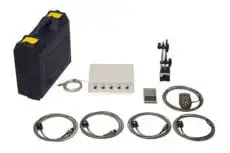
- क्षेत्र संतुलन using a portable analyser. A two-channel instrument such as the Balanset-1A measures the 1X radial amplitude and phase at each bearing, computes the influence coefficients, and lets an engineer balance the rotor in its own bearings at operating speed — no disassembly and no balancing machine. To turn a measured level into a corrective mass you can also use the चाचणी-वजन कॅलक्युलेटर.
- एक-समतलीय or द्विस्तरीय संतुलन procedures, chosen according to rotor geometry.
- Precision shop balancing on a संतुलन यंत्र for the most critical components.
यांत्रिक समस्यांसाठी
- Precision alignment to correct misalignment.
- Bearing replacement for bearing defects.
- Tightening of loose components.
- Foundation repairs for structural issues.
- Shaft straightening or replacement for bent shafts.
अनुनाद समस्यांसाठी
- Speed changes to avoid critical-speed ranges.
- Stiffness modifications (shaft diameter, bearing-location changes).
- Damping enhancements such as squeeze-film dampers or revised bearing selection.
- Mass changes to shift the natural frequencies away from operating speed.
8. Importance in Predictive Maintenance
Radial-vibration monitoring is the cornerstone of भविष्यसूचक देखभाल:
- Early fault detection: changes in radial vibration precede failures by weeks or months.
- ट्रेंडिंग: gradual increases signal a developing problem.
- दोष निदान: the frequency content identifies the specific fault type.
- तीव्रता मूल्यांकन: the amplitude indicates how serious and urgent the problem is.
- देखभाल शेड्यूलिंग: work is driven by condition rather than the calendar.
- Cost savings: catastrophic failures are avoided and maintenance intervals optimised.
As the primary vibration measurement on rotating machinery, radial vibration provides the essential evidence of equipment condition — making it indispensable for reliable, safe, and efficient operation of industrial rotating equipment.

