Understanding Frequency in Vibration Analysis

Frequency is a measure of how often a repetitive event recurs in a given unit of time — in vibration analysis, it quantifies how fast an object is oscillating. It is the single most important parameter for diagnosing the root cause of a machinery problem. While amplitude tells you the severity of a vibration, frequency tells you the source. Read an amplitude reading and you know how bad the problem is; read its frequency and you know what the problem is.
1. Definition: What is Vibration Frequency?
Frequency describes the rate of a cyclic motion — the number of complete oscillation cycles a vibrating part completes per unit of time. A rotor turning at 1,800 rpm completes thirty revolutions every second, so the once-per-turn force it generates repeats thirty times a second. Every periodic component buried inside a machine’s time waveform has its own frequency, and separating those components is the foundation of all diagnostic work.
Crucially, frequency is independent of amplitude. A vibration can be violent or barely perceptible at exactly the same frequency; what changes when a fault grows is usually the amplitude, while the frequency stays pinned to the physical mechanism producing it. That stability is precisely what makes frequency such a reliable fingerprint.
2. The Diagnostic Power of Frequency
The core principle of vibration diagnostics is that different mechanical and electrical components generate vibration at specific, predictable frequencies as they begin to fail. By identifying which frequencies are present in a machine’s vibration signature — and how strong each one is — an analyst can pinpoint the exact component causing the problem. It is closely analogous to how a doctor uses a stethoscope to listen for the particular sounds that betray different conditions.
Each potential fault carries a characteristic frequency signature:
- Unbalance: a problem with the whole rotating assembly, such as unbalance, appears at the frequency of the shaft’s rotation — 1× running speed.
- Misalignment: a problem in the coupling between two shafts, such as misalignment, typically shows up at twice running speed (2×), often with a raised 3×.
- Bearing defects: a flaw on a rolling-element bearing generates non-integer bearing fault frequencies set by its raceway and ball geometry and the shaft speed.
- Gear problems: meshing teeth create energy at the gear mesh frequency (GMF) — the number of teeth multiplied by the gear’s speed — frequently flanked by sidebands.
Because these signatures rarely overlap, a single well-resolved spectrum can separate unbalance from misalignment from a failing bearing without ever opening the machine.
3. The Units of Frequency
Frequency is expressed in several units, and a working analyst needs to be fluent in all of them.
Hertz (Hz)
The international (SI) unit. One hertz equals one cycle per second. This is the standard in scientific and most instrument contexts, and it is the unit used on an FFT frequency axis.
Cycles Per Minute (CPM)
Widely used in industrial maintenance because it relates directly to rotational speed, which is quoted in revolutions per minute (RPM). Since a minute holds 60 seconds, the conversion is simply CPM = Hz × 60. A vibration at 30 Hz therefore equals 1,800 CPM — and on a machine running at 1,800 rpm, that peak sits exactly at running speed, which is often easier to recognise in CPM than in Hz.
Orders
Orders are multiples of the machine’s own running speed: running speed is the 1st order, twice running speed the 2nd order, and so on. The advantage is that orders stay constant even as the machine changes speed — unbalance lives at the 1st order whether the shaft turns at 900 or 3,600 rpm, while its frequency in Hz moves. This makes orders indispensable for variable-speed equipment and is the basis of order analysis. A free Harmonic Frequency Calculator converts an RPM into its 1× through 10× frequencies in one step, and a vibration unit converter handles the Hz–CPM bookkeeping.
4. How Frequency is Determined
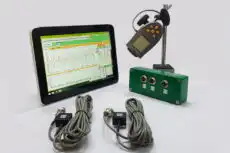
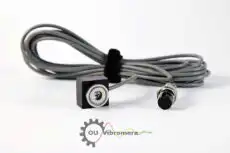
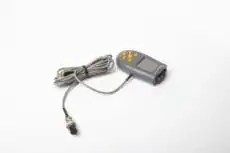
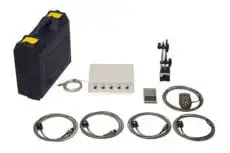
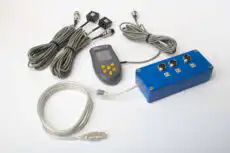
The frequencies hidden inside a vibration signal are extracted with the Fast Fourier Transform (FFT). An accelerometer captures the raw time waveform, and the FFT algorithm decomposes it into a frequency spectrum — a graph that displays every individual frequency making up the complex vibration, with the height of each peak showing how much energy sits there. The analyst then matches those peaks to the fault signatures above. In the field, a portable two-channel instrument such as the Balanset-1A performs this FFT on the spot, measuring spectra from roughly 5 Hz up to 1000 Hz so the running-speed peak and its harmonics can be read directly at the machine, with the once-per-revolution tachometer pulse identifying exactly which peak is 1×.
5. The Relationship Between Frequency, Velocity, and Acceleration
For a given level of vibrational energy, the amplitudes of displacement, velocity, and acceleration depend strongly on frequency, which is why each unit dominates a different band:
- Low frequencies: displacement is largest, so it is the natural unit for slow shaft motion.
- Mid frequencies: velocity is largest and most uniform, which is why vibration severity standards such as ISO 20816 (the modern successor to ISO 10816) judge overall machine health in mm/s velocity.
- High frequencies: acceleration is largest, making it the unit of choice for bearing and gear tones.
Choosing the wrong unit for a frequency band can bury a genuine fault in the noise floor; choosing the right one makes the same fault leap off the chart. Understood this way, frequency is the key that unlocks the diagnostic potential of vibration analysis — turning a raw, tangled signal into actionable maintenance information.

