

了解振動分析中的頻率
頻率 是衡量重複事件在給定單位時間內重複發生頻率的指標——在 振動分析中,它量化了物體振盪的速度。它是診斷機械問題根本原因最重要的單一參數。雖然 振幅 告訴你 嚴重度 振動的 來源;讀取振幅讀數,你就知道問題有多嚴重;讀取其頻率,你就知道問題是什麼。
1. 定義:什麼是振動頻率?
頻率描述了週期性運動的速率——振動部件在單位時間內完成的完整振盪週期數。以 1,800 rpm 轉動的轉子每秒完成三十轉,因此它產生的每轉一次的力量每秒重複三十次。隱藏在機器 時域波形 內的每個週期性成分都有其自身的頻率,而分離這些成分是所有診斷工作的基礎。
關鍵在於,頻率獨立於振幅。在完全相同的頻率下,振動可能劇烈也可能幾乎無法察覺;當故障擴大時,通常改變的是振幅,而頻率則固定於產生它的物理機制。這種穩定性正是使頻率成為如此可靠指紋的原因。
2. 頻率的診斷能力
的核心原則是 振動診斷 不同的機械和電氣部件在開始失效時,會在特定且可預測的頻率下產生振動。透過識別機器振動特徵中存在的頻率——以及每個頻率的強度——分析師可以精確定位導致問題的具體部件。這與醫生如何使用聽診器聆聽揭示不同病症的特定聲音非常類似。
Each potential fault carries a characteristic frequency signature:
- 不平衡: a problem with the whole rotating assembly, such as 不平衡, appears at the frequency of the shaft’s rotation — 1× 運轉轉速.
- 不對心: a problem in the coupling between two shafts, such as 不對心, typically shows up at twice running speed (2×), often with a raised 3×.
- 軸承缺陷: a flaw on a rolling-element bearing generates non-integer 軸承故障頻率 set by its raceway and ball geometry and the shaft speed.
- Gear problems: meshing teeth create energy at the 齒輪嚙合頻率 (GMF) — the number of teeth multiplied by the gear’s speed — frequently flanked by 邊頻帶.
Because these signatures rarely overlap, a single well-resolved spectrum can separate unbalance from misalignment from a failing bearing without ever opening the machine.
3. The Units of Frequency
Frequency is expressed in several units, and a working analyst needs to be fluent in all of them.
赫茲 (Hz)
The international (SI) unit. One hertz equals one cycle per second. This is the standard in scientific and most instrument contexts, and it is the unit used on an FFT frequency axis.
Cycles Per Minute (CPM)
Widely used in industrial maintenance because it relates directly to rotational speed, which is quoted in revolutions per minute (RPM). Since a minute holds 60 seconds, the conversion is simply CPM = Hz × 60. A vibration at 30 Hz therefore equals 1,800 CPM — and on a machine running at 1,800 rpm, that peak sits exactly at running speed, which is often easier to recognise in CPM than in Hz.
階次
Orders are multiples of the machine’s own running speed: running speed is the 1st order, twice running speed the 2nd order, and so on. The advantage is that orders stay constant even as the machine changes speed — unbalance lives at the 1st order whether the shaft turns at 900 or 3,600 rpm, while its frequency in Hz moves. This makes orders indispensable for variable-speed equipment and is the basis of 階次分析. A free 諧波頻率計算器 converts an RPM into its 1× through 10× frequencies in one step, and a 振動單位轉換器 handles the Hz–CPM bookkeeping.
4. How Frequency is Determined
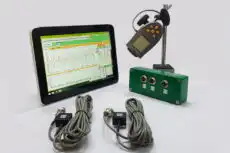
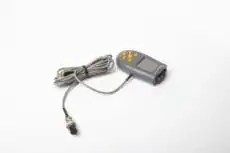
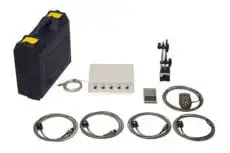
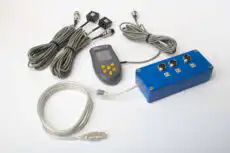
The frequencies hidden inside a vibration signal are extracted with the 快速傅立葉轉換 (FFT). An 加速規 captures the raw time waveform, and the FFT algorithm decomposes it into a 頻譜 — a graph that displays every individual frequency making up the complex vibration, with the height of each peak showing how much energy sits there. The analyst then matches those peaks to the fault signatures above. In the field, a portable two-channel instrument such as the Balanset-1A performs this FFT on the spot, measuring spectra from roughly 5 Hz up to 1000 Hz so the running-speed peak and its harmonics can be read directly at the machine, with the once-per-revolution tachometer pulse identifying exactly which peak is 1×.
5. The Relationship Between Frequency, Velocity, and Acceleration
For a given level of vibrational energy, the amplitudes of 位移, 速度,以及 加速度 depend strongly on frequency, which is why each unit dominates a different band:
- Low frequencies: displacement is largest, so it is the natural unit for slow shaft motion.
- Mid frequencies: velocity is largest and most uniform, which is why 振動嚴重度 standards such as ISO 20816 (the modern successor to ISO 10816) judge overall machine health in mm/s velocity.
- High frequencies: acceleration is largest, making it the unit of choice for bearing and gear tones.
Choosing the wrong unit for a frequency band can bury a genuine fault in the noise floor; choosing the right one makes the same fault leap off the chart. Understood this way, frequency is the key that unlocks the diagnostic potential of vibration analysis — turning a raw, tangled signal into actionable maintenance information.

