ISO 8579-1:2002 — Acceptance Code for Gear Units — Part 1: Test Code for Airborne Sound




ISO 8579-1:2002 (Acceptance code for gear units — Part 1: Test code for airborne sound) is a specialised standard that lays out a detailed, repeatable procedure for measuring and reporting the airborne noise radiated by an enclosed gear unit. It is an acceptance code: its purpose is to let a manufacturer and a customer verify that a new or repaired gearbox meets a contractually agreed acoustic performance level. This sets it apart from vibration analysis, which examines structural vibration to detect and diagnose faults. ISO 8579-1 is concerned instead with quantifying the total sound power level of the unit for environmental noise control and occupational-health purposes — a single, defensible “pass or fail” number rather than a diagnostic spectrum.
1. Scope and Measurement Principle
The standard’s scope is the determination of the airborne sound emission — emission sound pressure levels at specified positions and the sound power level — of enclosed gear units and gearmotors. Because it functions as an acceptance code, its procedures are written to verify compliance with a pre-agreed acoustic specification between supplier and purchaser. The governing principle is that the sound power level — an intrinsic property of the source, independent of where you stand — is calculated from a set of sound pressure level measurements taken at multiple, precisely defined points on an imaginary surface that envelops the gearbox. By sampling the pressure all around the unit, the method captures the total radiated sound energy rather than the pressure at any one arbitrary location.
2. Test Environment and Conditions
This part of the standard imposes strict requirements on where and how the test is run, so that the only sound measured is the gearbox itself. The test must take place in an acoustic environment that approximates a free field — no nearby reflecting surfaces to corrupt the measurement. An anechoic chamber is ideal, though a large open outdoor area can serve. Critically, the background noise from every other source — including the motor driving the test gearbox — must be measured separately and must be at least 6 dB lower than the gearbox noise, and preferably more than 10 dB lower. If the background is too loud it contaminates the result and invalidates the test. The gear unit must also run under a specified load and speed, since both dramatically influence the noise generated and the gear-mesh frequency tones that dominate it.
3. Instrumentation
The standard fixes the performance class of the equipment in the measurement chain. It mandates a Type 1 (Class 1) precision Sound Level Meter, microphone and filter set conforming to the relevant IEC standards, ensuring high accuracy and consistency. It also requires a Sound Calibrator of the same precision class, and specifies that the entire system — microphone, meter and cables — be calibrated with it both immediately before and immediately after the run of sound measurements. That bracketing calibration confirms the instrument’s sensitivity did not drift during the test, which is essential for a valid acceptance result.
4. Measurement Procedure
This is the prescriptive heart of the standard. It requires the definition of a hypothetical measurement surface that completely envelops the gearbox — typically a rectangular parallelepiped (a box shape) set at a fixed distance, usually 1 metre, from the reference surface of the unit. The standard then specifies the minimum number and exact location of microphone positions on that surface; for a parallelepiped this is commonly a set of nine points covering the four sides, the top and key positions between them. The sound pressure level is recorded at each point while the gearbox runs under the agreed steady-state load and speed. Sampling many points is what allows the sound field to be averaged correctly and accounts for the directionality of the radiated noise.
5. Calculation of Sound Power Level
This section supplies the mathematics that turns raw readings into a result. First, the sound pressure levels — being logarithmic dB values — measured at the various microphone positions are logarithmically averaged to give the mean sound pressure level over the whole measurement surface. That mean is then used to compute the sound power level (Lw), a calculation that brings in the area (S) of the hypothetical measurement surface. The final sound power level is a single figure in dB representing the total acoustic energy radiated by the gearbox. Because it is independent of measurement distance and environment, it is the definitive metric for the acceptance test.
6. Information to Be Recorded and Reported
To keep results unambiguous, comparable and fully traceable, the final section lists everything that must appear in the official test report. Beyond the calculated sound power level itself, this includes:
- Gear-unit description: model, serial number and other identifying details.
- Operating conditions: input speed, output torque, and lubricant type and temperature.
- Test environment: a description and sketch of the room and the microphone positions.
- Instrumentation: every instrument used, with serial numbers and calibration dates.
- Background noise: the results of the separate background-noise measurements.
This rigorous documentation underpins the test’s validity and lets it be reliably reproduced if a dispute arises.
7. Key Concepts Behind the Standard
- Sound power vs. sound pressure: the standard determines sound power, the total acoustic energy radiated by the source. This differs from sound pressure, which is what a microphone actually senses and which falls with distance from the unit. Sound power is the more consistent, transferable metric for an acceptance test.
- Acceptance test code, not a diagnostic tool: the standard is a standardised pass/fail procedure. A customer can write a maximum acceptable sound power level into a purchase contract, and ISO 8579-1 provides the agreed method to verify compliance.
- The vibro-acoustic link: although the standard measures airborne sound, the root cause of that sound is the structural vibration of the gearbox housing, itself driven by the meshing of the gear teeth. High noise levels therefore tend to correlate with high vibration at the gear-mesh frequency and its sidebands — and conditions such as gear defects, wear or misalignment that raise vibration usually raise radiated noise as well.
8. ISO 8579-1 in Practice: Noise, Vibration and Diagnostics
The acoustic acceptance figure from ISO 8579-1 tells a purchaser whether a gearbox is quiet enough to install, but it does not, on its own, reveal why a unit is noisy or how its condition changes in service. That is the domain of vibration measurement. Because airborne sound and structural vibration share the same origin in the tooth mesh, a unit that drifts louder over time is usually telling the same story its vibration spectrum tells — rising energy at the gear-mesh frequency, growing sidebands, or new impact content from a spalled tooth.
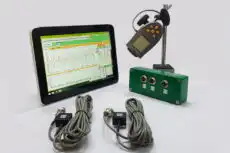
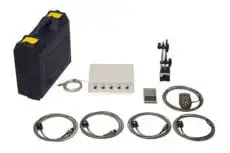
In the field, engineers complement the supplier’s ISO 8579-1 noise certificate with on-machine vibration checks. A portable two-channel analyser such as the Balanset-1A measures vibration directly on the gearbox bearing housings, capturing the spectrum where mesh-frequency tones and sidebands appear, so that a noisy gearbox can be diagnosed rather than merely graded. Where a numerical gear-vibration limit is needed, the ISO 20816-9 gear-drive vibration limits tool provides one, the Gear Mesh Frequency Calculator pinpoints the frequencies to look for, and the Noise Distance Attenuation Calculator helps relate a measured sound level to distance for occupational-noise planning.
9. The Official Standard
ISO 8579-1 is published and maintained by the International Organization for Standardization, and the full normative text — including the exact microphone coordinate sets, the averaging formulae and the report template — is available through the ISO Store. The summary here conveys the standard’s purpose, principle and procedure, but any formal acceptance test should be conducted against the complete published document to ensure full compliance.

