Vibration Amplitude: A Key Indicator of Machine Health






Vibration amplitude is the measure of the intensity or severity of vibration — it quantifies “how much” a machine is moving and is one of the most fundamental parameters in condition monitoring and machinery diagnostics. A change in amplitude over time is very often the first sign of a developing mechanical problem. The neat division of labour to remember is this: frequency helps diagnose the type of fault, while amplitude helps determine its severity. The two together are what turn a raw signal into a decision.
1. Why Measuring Amplitude Matters
Tracking vibration amplitude is the backbone of any predictive maintenance programme. An increase in amplitude correlates directly with an increase in the dynamic forces acting on a machine’s components — more amplitude means more force, more stress, and more accumulated fatigue. Monitoring those levels lets a reliability team:
- Establish a baseline: measuring amplitude on a known-healthy machine provides the baseline against which all future readings are judged.
- Trend machine health: plotting amplitude over time exposes gradual deterioration through trending long before a failure occurs.
- Set alarms: amplitude thresholds drive the alarm and warning levels that notify staff when a machine’s condition has worsened significantly.
- Assess severity: the magnitude of the amplitude is a direct indicator of how serious a problem is, which is exactly what lets a planner prioritise one repair over another.
2. Different Ways to Measure Amplitude
Vibration is a dynamic, time-varying signal, so its amplitude can be quantified in several distinct ways. None is “correct” in the abstract — the right descriptor depends on the machine and on the information you are chasing. The three standard measures are read off the same time waveform but answer different questions.
Peak (Pk) Amplitude
The peak value is the maximum amplitude the waveform reaches in one direction — positive or negative — from its zero or equilibrium position. Peak measurements shine for short-duration, high-impact events such as a broken gear tooth or a severe bearing defect, because they capture the single worst excursion. It indicates the maximum stress or force applied to a component during a vibration cycle, which is why it is favoured for impulsive faults.
Peak-to-Peak (Pk-Pk) Amplitude
The peak-to-peak value is the total distance the vibrating part travels from its maximum positive peak to its maximum negative peak — the full excursion of the motion. It is most commonly used for measuring displacement, where it is critical for assessing clearances. A classic example: peak-to-peak shaft displacement tells you whether a rotating shaft is moving enough to risk contact with a stationary bearing housing, which is exactly what a proximity probe watches on large turbomachinery.
RMS (Root Mean Square) Amplitude
The RMS value is the most common and most useful measure of overall vibration severity. It is calculated by taking the square root of the average of the squared values of the waveform over time. Its key advantage is that it relates directly to the energy content — and therefore the destructive power — of the vibration. Because RMS weighs the entire signal rather than a single instant, it is far more stable and representative of a machine’s true condition than a lone peak. Most international standards, including the vibration-severity series formerly numbered ISO 10816 and now superseded by ISO 20816, specify their limits in RMS velocity.
3. The Relationship Between Pk, Pk-Pk, and RMS
For a perfect, single-frequency sine wave these three values are tied together by simple constants:
Peak-to-Peak = 2 × Peak
RMS = Peak / √2 ≈ 0.707 × Peak
For real-world machinery, however, the signal is rarely a clean sine. It is a complex, non-sinusoidal mixture laden with harmonics and impacts, and the tidy 0.707 relationship no longer holds. The ratio of peak to RMS then becomes a diagnostic in its own right: the crest factor. A high crest factor — a tall peak riding on a modest RMS — points to impulsive faults such as early bearing damage, even when the overall RMS still looks acceptable.
4. Which Amplitude Unit to Use?
Amplitude can be expressed as displacement, velocity, or acceleration, and the best choice is governed by the frequency of interest. The reason is physical: differentiating from displacement to velocity to acceleration multiplies the signal by frequency each time, so each unit emphasises a different part of the spectrum.
- Displacement (μm, mils): best for low-frequency vibration (below ~10 Hz), such as structural movement or unbalance on very slow machines.
- Velocity (mm/s, in/s): the best general-purpose indicator across the mid-range (roughly 10 Hz to 1,000 Hz), where most common faults — unbalance and misalignment — live. This is why severity standards are written in velocity.
- Acceleration (g, m/s²): best for high-frequency vibration (above ~1,000 Hz), such as gear mesh and bearing faults.
Modern instruments handle the conversion seamlessly through integration and differentiation, so a single acceleration sensor can report any of the three; if you need to move a figure between units by hand, the Vibration Unit Converter does it instantly.
5. Amplitude in Practical Balancing
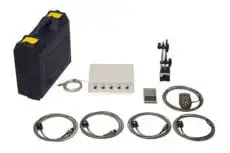
Amplitude is not only a health gauge — it is the quantity an engineer actively drives down when balancing a rotor. Unbalance produces a vibration at running speed (1×) whose amplitude is proportional to the size of the heavy spot, so reducing that 1× amplitude is the literal measure of a successful balancing job. In the field, a portable two-channel instrument such as the Balanset-1A reads the 1× amplitude and its phase before and after a trial weight, computes the influence coefficients, and confirms that the residual amplitude falls inside the chosen ISO 21940-11 balance grade. Watching the amplitude collapse from one run to the next — and then settle below tolerance — is balancing made visible.
6. Common Amplitude Pitfalls
A few traps catch the unwary and turn good sensors into misleading numbers:
- Mixing units or measures: comparing a peak reading on one day with an RMS reading on another is meaningless. Trend like-for-like.
- Ignoring the crest factor: a healthy-looking RMS can hide a sharp, growing peak from an incipient bearing fault. Watch both.
- Wrong unit for the frequency: reporting a high-frequency gear fault in displacement, or a slow structural motion in acceleration, buries the very signal you are hunting for.
- Resonance amplification: a large amplitude does not always mean a large fault — it may mean a modest force coinciding with a structural natural frequency, inflating the reading.

