Understanding Trial Weights in Rotor Balancing



A trial weight — sometimes called a test weight or calibration weight — is a known mass attached temporarily to a rotor at a precisely defined angular location during the balancing process. Its job is to deliberately introduce a known, controlled amount of unbalance so the analyst can watch how the rotor responds. That measured response is then used to calculate the exact correction weight needed to cancel the rotor’s original unbalance. The trial weight is the cornerstone of the influence coefficient method, the most widely used technique for field balancing of rotating machinery.
1. Why a Trial Weight Is Needed
In the field we cannot easily measure a rotor’s mass distribution, bearing stiffness, damping, or foundation flexibility. Rather than try to model all of that, the trial-weight method treats the whole machine as a “black box” and measures its dynamic behaviour directly. A single known input — the trial mass — produces a measurable output, and that input–output relationship is all the maths needs. The benefits of this empirical approach are considerable:
- Accurate system characterisation: the test captures every real-world factor that shapes the vibration response — bearing stiffness, foundation flexibility, coupling effects, and aerodynamic forces — without any of them having to be known in advance.
- Precise correction: by measuring the change in amplitude and phase caused by a known mass, the instrument computes the required correction with high accuracy.
- No prior knowledge required: the method needs no drawings, no specifications, and no theoretical rotor model.
- True operating conditions: the trial run is performed at the machine’s actual speed, temperature, and load, so the correction is valid for the way the rotor really runs.
2. Choosing the Right Trial Weight
Selecting the trial mass well is critical to a reliable result. It must be large enough to produce a clearly measurable change in vibration, yet small enough never to create unsafe conditions or trip protection systems. Too small a weight gives a response lost in the noise; too large a weight risks the machine.
General guidelines
- Rule of thumb: aim for a trial weight that shifts the vibration vector by roughly 25–50% of the initial reading — enough for a clear, confident measurement of the change in both amplitude and phase.
- Initial estimate: for an unfamiliar rotor, a starting mass of about 1–5% of the rotor’s weight, placed at the balancing radius, is a sensible first guess. Most modern balancing instruments include a trial-weight estimator based on the initial vibration level.
- Calculated approach: a common working formula is Mt = Mr × Ksupp × Kvib / (Rt × (N/100)²), where Mt is the trial mass, Mr the rotor mass, Ksupp a support-stiffness coefficient (typically 1–5), Kvib a vibration-level coefficient, Rt the installation radius, and N the speed in rpm. The relationship reflects a key physical truth: because centrifugal force grows with the square of speed, a fast rotor needs a far smaller trial weight than a slow one of the same mass.
- Safety first: never fit a trial weight large enough to push vibration past safe limits.
- Secure attachment: bolt, clamp, or magnetically fix the weight so it cannot fly off at speed. Putty or modelling clay is convenient for quick trials but must be pressed on firmly and, ideally, backed up mechanically.
To turn rotor mass, radius, and speed straight into a recommended mass, our Trial Weight Calculator automates the arithmetic and removes the guesswork from this first, decisive step.
3. How the Trial Weight Is Used: the Procedure
The trial-weight method follows a systematic sequence that sits at the heart of modern field balancing:
- Initial run: operate the machine at its normal speed and record the initial vibration vector — amplitude and phase together. This is the response to the rotor’s original unbalance, established during the test run.
- Attach the trial weight: stop the machine and fix the known mass at a recorded angular position — usually marked 0° or referenced to a keyphasor mark — on the chosen correction plane.
- Trial run: restart and run at the identical speed, then measure and record the new vibration vector. This reading is the vector sum of the original unbalance and the effect of the trial weight.
- Calculate the influence coefficient: the instrument performs a vector subtraction to isolate the response due to the trial weight alone, then forms the influence coefficient as the ratio of that vibration change to the trial mass.
- Calculate the correction weight: from the influence coefficient, the software computes the exact mass and angle of the permanent correction weight that will cancel the original unbalance.
- Install and verify: remove the trial weight, fit the calculated correction, and run a final check to confirm that the residual unbalance has dropped to an acceptable level.
4. The Trial Weight in Practical Field Balancing
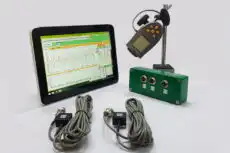
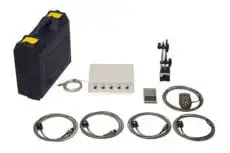
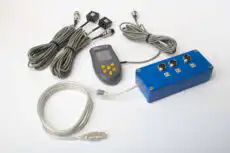
On a portable instrument the trial-weight run is the step that makes balancing on an assembled machine possible at all. The Balanset-1A guides this workflow directly: working in the machine’s own bearings at operating speed, it captures the 1× amplitude and phase on the initial run, again with the trial weight fitted, and computes the influence coefficient automatically. The software then returns the mass and angle of the correction weight and verifies the result on a final run — all without a balancing machine and without removing the rotor. For machines that need correction in two planes, the same logic extends to a sequence of trial runs, one weight per plane.
5. Practical Considerations and Best Practices
Reliable results depend on a handful of disciplines that experienced balancers follow without fail:
- Accurate angular positioning: record the trial weight’s angle precisely. Even a few degrees of error in the recorded position feeds straight through into a wrong correction calculation.
- Consistent radial placement: where possible, place the trial weight at the same radius the correction weight will occupy. This keeps the maths simple and improves accuracy.
- Repeatable conditions: the initial run and every trial run must share identical speed, temperature, and load. Inconsistent conditions corrupt the comparison the whole method depends on.
- Multiple planes: for two-plane or multi-plane balancing, expect several trial weights, applied to different correction planes on separate runs, each characterising one part of the rotor’s cross-coupled response.
The trial-weight method costs an extra machine run, but in exchange it delivers the accuracy and repeatability that professional work demands. It remains the industry standard for in-situ dynamic balancing, and a good understanding of how to choose and place a trial weight is one of the most valuable practical skills a balancing technician can develop.
Letting the Software Place the First Trial Weight
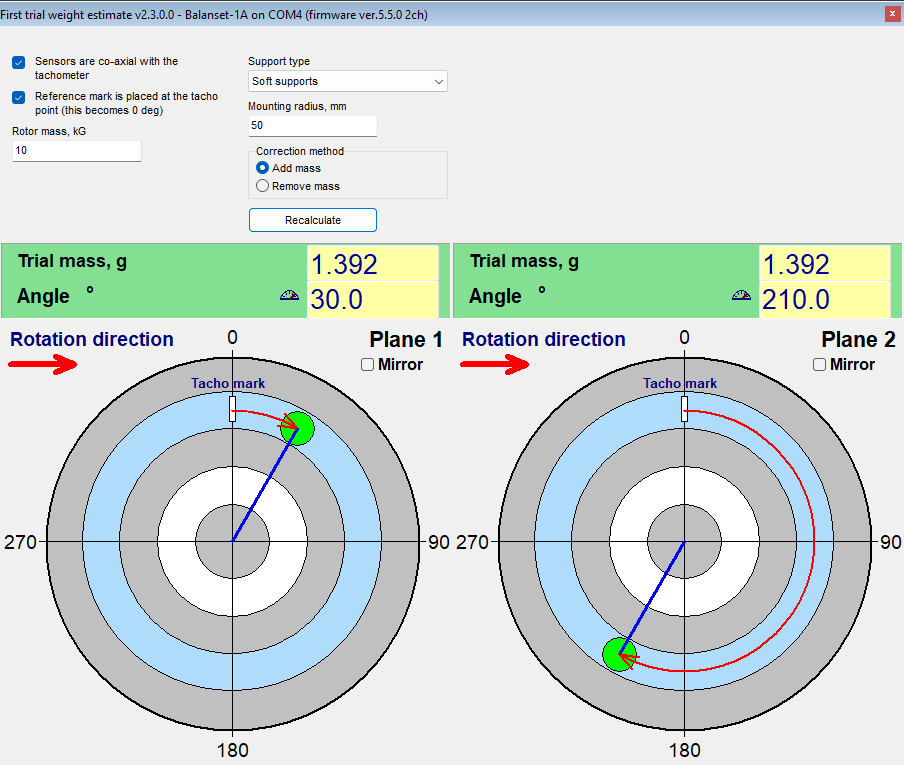
The Balanset software carries a small estimator for exactly the problem described above: where to put the very first trial weight so that it lands near the light spot and reduces vibration from the first run — valuable when weights are welded on and hard to reposition. It opens from the balancing form (“Menu” → “First trial weight estimate”) and works from Run 0 data, before any weight is installed.
Two conditions printed in the window itself must hold for the angle to mean anything: the sensors are mounted coaxially with the tachometer, and a reference mark is placed on the rotor where the tachometer triggers — that mark becomes 0°. You then enter the rotor mass, the support type (rigid or soft), the mounting radius, and whether mass will be added or removed — removal turns the recommendation by 180° — and press “Recalculate”.
For each correction plane the window returns an installation angle measured from the tacho mark and an approximate mass in grams, drawn on a polar diagram. The light spot is placed from the Run 0 phase corrected for the support’s phase lag (0° for rigid supports, 180° for soft), and the mass is sized by the centrifugal rule — the weight’s force about 7% of the rotor weight — or, on soft supports, from the vibration amplitude, whichever is smaller. It is deliberately an estimate: its job is to land on the correct half of the rotor, and the exact correction is then computed in the normal trial-run way.