अक्षीय फॅन दोष समजून घेणे



अक्षीय पंखे दोष are the faults specific to axial-flow fans, in which air moves parallel to the shaft axis through a propeller-like rotor. They include blade pitch-angle errors, tip-clearance degradation, blade थकवा and cracking, hub-attachment failures, rotating stall, and aerodynamic resonances. Axial fans differ from centrifugal fans in their flow path and force distribution, which exposes them to unique failure modes tied to blade twist, tip-leakage flow, and varying axial thrust. They sit within the wider family of फॅन दोष but demand their own diagnostic approach.
Axial fans are everywhere in HVAC systems, cooling towers, power-plant draft fans, and industrial ventilation. Their large diameter and relatively lightweight blades make them especially prone to vibration-induced fatigue and to aerodynamic instabilities — problems that show up clearly in a कंपन विश्लेषण survey when you know what signatures to look for.
1. ब्लेड पिच आणि कोनातील समस्या
चुकीची पिच सेटिंग
- Adjustable-pitch fans: the blade angle is adjustable to tune performance.
- चुकीचे समायोजन: blades set to the wrong angle for the operating conditions.
- परिणाम: poor performance, high vibration, and a tendency to stall.
- Non-uniform setting: blades sitting at different angles distribute mass and aerodynamic load unevenly, creating unbalance.
ब्लेड ट्विस्ट विकृती
- Blades permanently twisted by aerodynamic or centrifugal loads.
- Altered flow angles, which degrade performance.
- Asymmetric twist that creates unbalance.
- Thermal distortion driven by temperature gradients across the rotor.
2. टिप क्लीयरन्स समस्या
Why Tip Clearance Is Critical in Axial Fans
- Flow leaks over the blade tips, forming tip vortices.
- Efficiency is very sensitive to tip clearance.
- Each 1% increase in clearance loses roughly 1–2% efficiency.
- Clearance also affects vibration and acoustic performance.
अतिरिक्त क्लीयरन्स
- कारणे: झीज, housing distortion, blade deflection, and thermal growth.
- परिणाम: performance loss, stronger tip vortices, and increased vibration.
- Typical new clearance: 0.5–1.5% of blade span.
- Action needed: more than 3% of span indicates the fan needs replacement or rebuild.
टिप रब्स
- Blade tips contacting the housing.
- Caused by excessive vibration, थर्मल वाढ, किंवा misalignment.
- Generates noise, vibration, and blade damage — a localised form of रोटर घर्षण-स्पर्श.
- Leaves wear marks visible on both the blade tips and the housing.
3. ब्लेड संरचनात्मक दोष
थकव्यामुळे तडे
- स्थान: the blade root (where it attaches to the hub) and the leading edge.
- कारण: alternating aerodynamic loads, vibration, and ब्लेड रेजोन्स.
- शोध: dye penetrant, magnetic particle, or ultrasonic विनाशकारी परीक्षण म्हणून.
- गंभीरता: if undetected, a fatigue crack can progress to blade liberation — the throwing of a whole blade.
ब्लेड जोडणी अपयश
- Welds cracking at the blade-to-hub junction.
- Bolted attachments working loose.
- Root fillet cracks.
- Progressive failure if the condition is not caught early.
4. वायुगतिक अस्थिरता
फिरता स्टॉल
- Flow separation that forms on some blades and rotates around the annulus.
- Produces उप-समकालिक vibration at 0.2–0.5× rotor speed.
- Occurs at low flow or under high inlet resistance.
- Can be violent and damaging to the blades.
फ्लटर
- Self-excited blade vibration arising from aeroelastic coupling — a form of स्व-उत्तेजित कंपन.
- Blade motion changes the airflow, and the airflow in turn drives the blade motion.
- Occurs at the blade’s नैसर्गिक वारंवारता.
- Can cause rapid blade failure.
- Rare, but catastrophic when it happens.
5. Vibration Signatures
ब्लेड पासिंग वारंवारता
- गणना: BPF = number of blades × RPM / 60. You can work this out instantly with the ब्लेड पास फ्रिक्वेन्सी कॅलक्युलेटर.
- Axial fans: तो ब्लेड पाससिंग वारंवारता is often prominent — more so than in centrifugal fans.
- Elevated amplitude: points to tip-clearance issues, blade damage, or flow problems.
- हार्मोनिक्स: multiple BPF harmonics indicate blade or flow problems.
Unbalance
- Arises from blade buildup, erosion, or pitch-angle non-uniformity.
- Shows up as a 1× running-speed component.
- Correctable by क्षेत्र संतुलन with blade-mounted weights.
स्टॉल-संबंधित कंपन
- Sub-synchronous components in the 0.2–0.5× range.
- Random, fluctuating amplitude.
- An increase in broadband noise.
- Disappears once flow is increased — a useful confirming test.
6. Detection and Monitoring
कंपन विश्लेषण
- Standard bearing vibration monitoring.
- Trending of BPF amplitude over time.
- Watching for sub-synchronous components that signal stall.
- अक्षीय कंपन measurement to catch thrust variations.
कार्यक्षमता निरीक्षण
- Airflow measurement by the pressure-differential method.
- Power-consumption trending.
- Efficiency calculation.
- Comparison against design or baseline performance.
तपासणी
- Visual blade inspection for cracks, erosion, and गंज.
- Blade pitch-angle verification.
- Tip-clearance measurement.
- Hub and attachment-point inspection.
- NDT for crack detection in critical fans.
7. Field Balancing and Vibration Limits
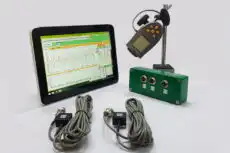
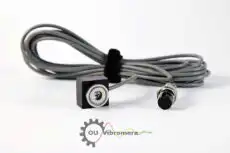
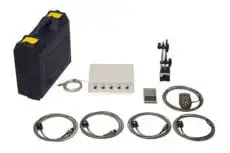
Because an axial fan runs in its own bearings, the practical way to deal with the dominant 1× unbalance is to balance it in place rather than remove the rotor. A portable two-channel analyser such as the Balanset-1A 1× मापते मोठेपणा आणि टप्पा कार्यरत वेगावर, याची गणना करते इन्फ्लुअन्स कोइफिशंट्स of the fan, and tells you the mass and angle of the दुरुस्ती वजन to add at the blades. It then verifies the result against the अवशिष्ट असंतुलन tolerance. For acceptance and balance-quality grades, large industrial fans are addressed specifically by ISO 14694, while overall vibration severity on the bearing housings is judged against the modern ISO 20816-3 (the standard that superseded ISO 10816-3).
8. Maintenance and Correction
ब्लेड देखभाल
- Clean buildup from the blades, then rebalance.
- Repair minor erosion and corrosion damage.
- Replace cracked or severely damaged blades.
- Verify that all blades sit at the same pitch angle.
- Check and tighten the blade-attachment bolts.
क्लीयरन्स पुनर्स्थापना
- Add shroud rings or tip seals where clearance is excessive.
- Rebuild the housing to reduce its diameter.
- Replace the fan if that is economically justified.
ऑपरेटिंग पॉइंट नियंत्रण
- Adjust system resistance so the fan operates near its design point.
- Use variable-speed control for optimal matching.
- Avoid operation in the stall region.
- Use inlet-vane or damper control for turndown.
Axial fan defects combine the standard problems of rotating machinery with aerodynamic phenomena unique to axial-flow machines. Understanding blade structural issues, the criticality of tip clearance, and instabilities such as rotating stall — paired with appropriate vibration monitoring and performance testing — keeps these essential air-moving machines running reliably in industrial service.

