Compreendendo o espectro cruzado




Espectro cruzado — also called the cross-power spectrum or cross-spectral density — is the frequency-domain representation of the relationship between two simultaneously measured vibração sinais. É calculado multiplicando o FFT of one signal by the complex conjugate of the FFT of the other. Where an espectro automático shows the frequency content of a single channel, the cross-spectrum reveals which frequencies are common to both signals and the fase relationship between them at every frequency.
This makes the cross-spectrum the mathematical foundation of advanced multi-channel analysis: função de transferência estimation, coerência analysis, and Operating Deflection Shape (ODS) measurements all rest on it. In practical terms it lets an engineer see how vibration propagates through a structure and identify cause-and-effect relationships between measurement locations — something a single-channel espectro simply cannot do.
1. Mathematical Definition
Computação
The defining relationship is compact:
Gxy(f) = X(f) × Y*(f)
- X(f) is the FFT of signal x(t).
- Y*(f) is the complex conjugate of the FFT of signal y(t).
- The result is complex-valued, carrying both magnitude and phase.
Componentes
- Magnitude — |Gxy(f)|: shows the strength of the frequency content the two signals share.
- Phase — ∠Gxy(f): shows the phase difference between the signals at each frequency.
- Parte real: the in-phase, or co-spectral, component.
- Parte imaginária: the quadrature, or 90°-out-of-phase, component.
2. Properties
Three properties set the cross-spectrum apart from the familiar auto-spectrum, and each one matters in interpretation.
It Is Complex-Valued
- Unlike the auto-spectrum, which is real only, the cross-spectrum is complex.
- It therefore carries both magnitude and phase.
- That phase information is the whole point — it is what reveals how the two signals relate in time.
It Is Not Symmetric
- In general Gxy(f) ≠ Gyx(f).
- Order matters — which signal you treat as the reference changes the result.
- Formally, Gyx(f) is the complex conjugate of Gxy(f), so the phase simply flips sign.
It Requires Averaging
- A single cross-spectrum is noisy and unreliable.
- Averaging many cross-spectra produces a stable estimate.
- Uncorrelated noise components average toward zero because their phase is random from block to block.
- Genuinely correlated components keep a consistent phase and reinforce — which is exactly why averaging cleans the estimate up.
3. Aplicativos
Transfer Function Calculation
This is the single most important application:
H(f) = Gxy(f) / Gxx(f)
- Here x is the input and y is the output.
- The result shows how the system responds to excitation.
- Its magnitude shows amplification or attenuation at each frequency.
- Its phase shows time delay and ressonância behaviour.
- It is the core measurement of análise modal and structural dynamics, closely related to the função de resposta em frequência.
Coherence Calculation
- Coherence is defined as |Gxy|² / (Gxx × Gyy).
- It measures the correlation between the two signals at each frequency.
- It ranges from 0 to 1: a value of 1 means perfect correlation, 0 means none at all.
- It validates measurement quality and flags where the result is being corrupted by noise — indispensable during a teste de colisão or modal survey.
Phase Relationship Determination
- The phase from the cross-spectrum reveals time delay or resonance directly.
- 0°: the signals are in phase, moving together.
- 180°: the signals are out of phase, moving in opposition.
- 90°: quadrature, indicating resonance or a pure time delay.
- This is the diagnostic basis for formas de modo and for tracing vibration transmission.
Common-Mode Rejection
- The cross-spectrum isolates the frequency components common to both channels.
- Uncorrelated noise cancels through averaging.
- The true, shared signal components emerge from the background.
- The practical payoff is a better signal-to-noise ratio.
4. Practical Measurement Scenarios
The abstract idea becomes concrete the moment two sensors go onto a real machine. Three everyday set-ups show the value.
Comparação de rolamentos
- Signal X: vibration at bearing 1. Signal Y: vibration at bearing 2.
- The cross-spectrum shows the frequencies that affect both bearings at once.
- That separates a shared, rotor-related issue from a problem local to one consequência.
Input–Output Analysis
- Signal X: force or vibration at the input — a coupling or the driver bearing.
- Signal Y: the response at the output — the driven-equipment bearing.
- The cross-spectrum reveals the transmission characteristics between them.
- The derived transfer function then quantifies exactly how vibration travels across a acoplamento.
Transmissão Estrutural
- Signal X: bearing-housing vibration. Signal Y: foundation or frame vibration.
- The cross-spectrum shows which frequencies actually reach the structure.
- That guides decisions on isolation or stiffening, and connects directly to rigidez da fundação e ressonância estrutural problemas.
5. Interpreting the Cross-Spectrum
High Magnitude at a Frequency
- Indicates strong correlation between the signals at that frequency.
- Points to a common source or strong coupling between the two locations.
- The component is genuinely present in both signals.
Low Magnitude at a Frequency
- Indicates little correlation — weak coupling, or no shared source.
- The component may exist in one signal but not the other.
- Or it may simply be uncorrelated noise from different sources.
Informações de fase
- 0°: the signals move together — a rigid connection, or operation below resonance.
- 180°: the signals move oppositely — above resonance, or across a line of symmetry.
- 90°: quadrature — at resonance, or arising from a specific geometry.
- Frequency-dependent phase: the way phase changes with frequency exposes the dynamic behaviour of the structure.
6. Advanced Applications
Multiple Input / Output Analysis
- Several reference signals are paired with several response signals.
- The result is a full matrix of cross-spectra.
- It identifies multiple, simultaneous transmission paths.
- This is how genuinely complex systems are characterised.
Formas de deflexão operacional
- Cross-spectra are taken between many measurement points around a machine.
- Their phase relationships define the deflection pattern.
- The motion of the whole structure can then be visualised and animated.
- Resonant modes stand out clearly in the result.
7. Cross-Spectrum in Field Balancing
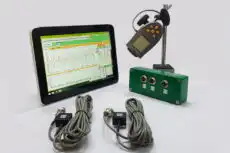
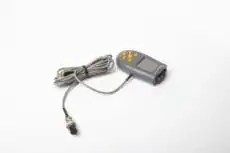
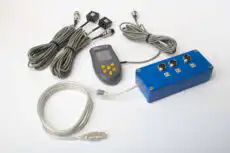
Although the cross-spectrum is most associated with modal and structural work, the same two-channel mathematics underpins everyday balanceamento de campo. Um instrumento portátil de dois canais, como o Conjunto de equilíbrio-1a records vibration at two bearing planes simultaneously and references both to the once-per-revolution tachometer pulse, so it can resolve the amplitude-and-phase of the 1× component at each plane and compute the cross-coupled coeficientes de influência that link a weight in one plane to the response in the other. That two-channel, phase-referenced relationship is conceptually a cross-spectrum focused on running speed — and it is exactly what makes correct two-plane balanceamento dinâmico possible on an assembled machine.
In short, the cross-spectrum extends frequency analysis from one channel to many, exposing the relationships between signals that enable transfer-function calculation, coherence validation, and an understanding of how vibration travels through a machine and its supports. More demanding than the auto-spectrum, it is nonetheless essential for modal testing, structural dynamics, and any sophisticated diagnostic that relies on multi-point measurement.

