ISO 7919-1: Evaluating Machine Vibration by Measurements on Rotating Shafts






ISO 7919-1 — “Mechanical vibration — Evaluation of machine vibration by measurements on rotating shafts — Part 1: General guidelines” — is the key international standard for measuring and judging vibration on the rotating shaft of a machine. It is the direct counterpart to ISO 10816 (now modernised as the ISO 20816 series), which deals with vibration measured on the non-rotating casing. Where the casing standard listens to the structure, ISO 7919 watches the shaft itself, using non-contact proximity probes to measure the rotor’s movement relative to its bearings. That distinction matters most on large, critical machinery with fluid-film bearings — turbines, compressors, and large pumps — where the rotor’s true dynamic behaviour is the difference between safe running and a wrecked bearing.
1. Scope and Measurement Principle
The standard sets out general procedures for measuring and evaluating vibration on rotating shafts. Its founding principle is that the quantity of interest is the vibratory motion of the shaft itself, normally measured relative to the stationary bearing housing. This is the critical departure from casing measurements covered by ISO 20816. Shaft vibration is the preferred measurement on machines whose rotor is massive compared with a relatively flexible casing and which run in fluid-film journal bearings. In those cases, large shaft motion can occur inside the bearing clearance without ever being transmitted to the outside of the housing — so a casing accelerometer would simply miss it. The goal is to assess the severity of this dynamic shaft motion and so protect the machine from bearing damage or rotor-stator contact.
2. Measurement Quantities
The standard specifies which parameters to measure and evaluate. The primary quantity for overall vibration severity is Sp-p, the peak-to-peak vibratory displacement of the shaft. This represents the total excursion of the shaft centreline as it moves within the bearing, and because it is expressed in micrometres it can be compared directly against the physical bearing clearance — a uniquely useful property for machinery protection.
The standard also values other quantities for diagnostics. It recommends that the measurement system be able to provide:
- The shaft orbit — the path traced by the shaft centreline, essential for diagnosing problems such as oil whirl or misalignment.
- The average shaft centreline position — a shift in which can flag a change in load or alignment.
- Filtered values — for some applications the vibration at 1× running speed is evaluated separately to isolate the unbalance response.
3. Instrumentation and Mounting
This part gives practical guidance on the hardware. It specifies a non-contacting probe system built from three components that are calibrated together and are not interchangeable:
- The probe (sensor) — the eddy-current sensing tip.
- An extension cable of a defined length.
- A driver (proximitor) that conditions the signal.
Probes are mounted in pairs at each bearing, set 90° apart in an X–Y configuration. This lets the system capture the full two-dimensional motion of the shaft centreline and reconstruct the orbit. The standard stresses that installation quality is critical: rigid mounting brackets, correct probe gapping, and a smooth “probe track” on the shaft that is free of mechanical or electrical runout which would otherwise corrupt the signal. Because mechanical and electrical runout add a once-per-revolution error that masquerades as vibration, slow-roll compensation at low speed is normally applied before the data is trusted.
4. Evaluation Criteria and Zones
The standard offers two complementary ways to judge severity. The first is an absolute criterion: the measured Sp-p is compared against predefined limits using a four-zone model.
- Zone A (Good): the vibration level expected of newly commissioned machinery.
- Zone B (Satisfactory): acceptable for unrestricted long-term operation.
- Zone C (Unsatisfactory): a potential problem; the machine should be investigated to find the cause.
- Zone D (Unacceptable): levels considered damaging, requiring immediate action.
The second is a change criterion: a significant increase in vibration from a known baseline can be an early warning of a developing fault even when the absolute level is still inside the “Satisfactory” zone. Part 1 supplies only this general framework — the specific numerical zone boundaries live in the machine-specific parts of the ISO 7919 series, because the allowable displacement of a large slow turbine differs greatly from that of a small high-speed compressor. As a rule, the boundaries are scaled against the maximum shaft speed and, ultimately, against the available bearing clearance.
5. Setting Alarms: Alert and Trip
The final section turns the evaluation criteria into a working machinery-protection system, recommending a two-tier alarm strategy:
- Alert (alarm) setpoint: placed just above the machine’s normal, stable operating baseline. Breaching it warns the operator that conditions have changed and that an investigation is warranted.
- Trip (shutdown) setpoint: an absolute limit set where continued running would likely cause severe damage. Breaching it should trigger an automatic shutdown to prevent catastrophic failure.
The standard advises basing these setpoints on both the absolute zone boundaries — a Trip should not be set above the Zone C/D boundary — and on significant change from baseline; an Alert might be triggered if vibration doubles, even while it remains in Zone B. This pairing of absolute and relative logic is exactly what a continuous protection system needs to catch both gross excursions and slow drift.
6. Key Concepts in Practice
- Shaft vs. casing vibration: for machines with massive, stiff rotors and flexible casings, the motion of the shaft is a far more direct and reliable indicator of dynamic state than whatever reaches the outside of the housing.
- Machinery protection first: although the data also feeds diagnostics, the primary role of the ISO 7919 framework is real-time protection against catastrophic failure.
- The value of relative motion: measuring the shaft against the bearing lets an analyst gauge directly how much of the bearing clearance is being used, and pin down issues such as oil whirl or excessive preload.
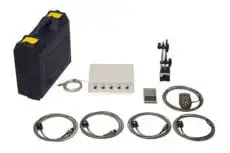
Where this standard governs permanently instrumented critical machines, portable instruments cover the complementary job of field diagnosis and on-site correction. A two-channel analyser such as the Balanset-1A measures the 1× amplitude and phase in the machine’s own bearings at operating speed, so an engineer can confirm that an unbalance flagged by a shaft-vibration trend really is unbalance — and then balance the rotor and verify the result without disturbing the installed proximity-probe system.
7. The Standard and Its Family
ISO 7919-1 is the umbrella “general guidelines” document; the numbered parts that follow it (covering specific machine classes such as steam turbines, gas turbines, and coupled industrial machines) supply the actual numerical limits. Read alongside the casing-based ISO 20816 series, it completes the two-sided picture of machine vibration — shaft motion on one side, structural response on the other — that any rigorous monitoring programme on critical machinery relies upon. The full, legally authoritative text is published by the International Organization for Standardization and must be purchased from the official ISO catalogue; this article summarises its structure and intent so the concepts can be applied without the document in hand.

