



了解現場動平衡(原位平衡)
現場動平衡,也稱為 原位平衡,是在轉子於其自身軸承和支撐結構中運轉時,於正常運轉速度或接近正常運轉速度下,校正 不平衡 的 轉子 while it runs in its own bearings and support structure, at or near its normal operating speed. Unlike shop balancing, where the rotor is removed and mounted on a dedicated 動平衡機, field balancing is performed on-site with the machine fully assembled. It is the practical, everyday form of 轉子動平衡校正 for maintenance and reliability teams, because it corrects the machine as it actually runs.
1. Definition: What is Field Balancing?
The process typically uses a portable 振動分析儀 to measure the 振幅 與 相位 of the 1× (運轉速度) vibration, attach a 試重 of known mass, re-measure the new vibration response, and then calculate the required 校正配重 and its angular placement. Because the rotor stays in its own bearings, the result reflects the machine’s true running state rather than an idealised condition on a balancing stand.
A phase reference is indispensable: the analyser must know 其中 the shaft is at each instant to convert a vibration peak into a heavy-spot angle. That reference comes from a 轉速計 triggering once per revolution, typically off a strip of 反光膠帶.
2. Why is Field Balancing Necessary?
雖然車間動平衡校正精度極高,但無法考慮影響機器在實際運行環境中平衡狀態的所有因素。當不平衡是由於整體組裝機器引起,或僅能透過考慮整體組裝機器來校正時,現場動平衡是必要的。常見原因包括:
- Assembly unbalance: the final unbalance of a machine is the sum of the unbalance of all its rotating components (impeller, shaft, 聯軸器, sheave, keys and fasteners). Field balancing corrects the unbalance of the whole assembly at once, including small shifts introduced when the machine was reassembled.
- Operational effects: unbalance can arise from conditions that only appear under normal running, such as 熱變形 of the rotor, 氣動力,或 液壓力. These cannot be replicated on a shop balancing machine.
- Material build-up or wear: for fans, blowers and centrifuges, uneven product build-up or uneven 磨損 causes unbalance to develop over time. Field balancing is the only practical way to correct this without a complete overhaul.
- Impracticality of removal: for very large machines — big industrial fans, turbine generators — removing the rotor for shop balancing is extremely expensive and time-consuming. Field balancing is a far more economical and faster solution, and is the basis of the in-situ criteria in ISO 21940-13.
3. The Field Balancing Process (Influence Coefficient Method)
現場動平衡最常用的方法是 影響係數法, which follows a logical, repeatable sequence:
- 初始運轉: the machine is run at its normal operating speed, and the initial 1× vibration amplitude and phase — the 初始不平衡 vector — are measured and recorded.
- Trial-weight placement: the machine is stopped and a trial weight of known mass is securely attached to the rotor at a known angular position.
- 試運轉: the machine is run again at the same speed. The new vibration amplitude and phase (the response vector) are measured and recorded.
- 計算: the change in the vibration vector caused by the trial weight yields an 影響係數, describing how much the vibration at the measurement point changes for a given unbalance at the correction location. The analyser combines this coefficient with the initial vector — using 向量加法 — to compute the exact mass and angle of the required correction.
- Correction-weight placement: the machine is stopped, the trial weight removed, and the calculated correction weight permanently attached at the specified angle.
- 驗證運轉: the machine is run a final time to confirm the vibration has dropped to an acceptable level, per standards such as ISO 20816-1, and that the 剩餘不平衡 sits within the chosen tolerance.
Simple rotors are handled with 單面動平衡; longer rotors that exhibit a couple component require 雙面(動態)動平衡. A 試重計算器 helps choose a safe, effective starting mass for the first trial run.
4. Field Balancing in Practice with a Portable Analyser
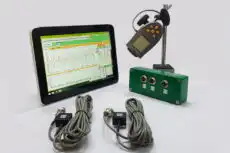
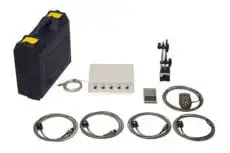
In the field, the whole loop above is run with a single hand-carried instrument rather than a balancing stand. A portable two-channel analyser such as the Balanset-1A measures 1× amplitude and phase on each bearing, computes the influence coefficients automatically, and guides single- and two-plane corrections — then verifies the residual unbalance against ISO 21940-11 balance-quality grades. Working in the machine’s own bearings at operating speed, it captures the genuine running state — assembly, thermal and aerodynamic effects included — that a shop machine simply cannot reproduce. The supplied optical laser tachometer provides the once-per-revolution phase reference from a small piece of reflective tape, so no shaft preparation beyond a tape strip is needed.
5. Key Considerations and Safeguards
Field balancing demands skill and careful planning. As outlined in standards such as ISO 21940-13等標準所述,安全至關重要。
- 安全性: 試重與校正配重必須牢固地安裝,以承受 離心力 在運轉速度下的離心力,且在機器運轉期間必須管控人員接近。
- 先決條件: 在進行動平衡校正前,必須排除其他導致高 1× 振動的原因—— 不對心, 共振,a 軸彎曲,或機械 鬆動 ——因為動平衡校正無法修復並非由不平衡引起的問題。
- 儀器設備: 此工作需要使用能夠測量振幅與相位的分析儀,以及相位參考感測器(轉速計)。可重複的測量取決於一致的感測器安裝方式,以及乾淨可靠的轉速計脈衝。
- 轉速穩定性: 機器必須在每次運轉期間保持穩定的轉速;轉速漂移會破壞整個計算所依賴的相位資料。

