Meet Vibromera.com — our new international website. Visit Vibromera.com →
Nonlinear Objects in Rotor Balancing: Causes, Symptoms, and Practical Approach

Nonlinear Objects in Rotor Balancing

Why balancing “does not work”, why influence coefficients change, and how to proceed in real field conditions

概述

In practice, rotor balancing is almost never reduced to simply calculating and installing a correction weight. Formally, the algorithm is well known and the instrument performs all calculations automatically, but the final result depends far more on the behavior of the object itself than on the balancing device. This is why, in real work, situations constantly arise where balancing “does not work”, influence coefficients change, vibration becomes unstable, and the result is not repeatable from one run to another.

線性與非線性振動、其特徵及動平衡校正方法

成功的動平衡校正需要理解物件對質量增加或移除的反應。在此背景下,線性與非線性物件的概念扮演著關鍵角色。了解物件是線性還是非線性,有助於選擇正確的動平衡校正策略,並幫助達到預期結果。

線性物件因其可預測性和穩定性而在該領域佔有特殊地位。它們允許使用簡單且可靠的診斷和動平衡校正方法,使其研究成為振動診斷中的重要一步。

Linear vs nonlinear objects

Most of these problems are rooted in a fundamental but often underestimated distinction between linear and nonlinear objects. A linear object, from the balancing point of view, is a system in which, at a constant rotational speed, the vibration amplitude is proportional to the amount of unbalance, and the vibration phase follows the angular position of the unbalanced mass in a strictly predictable way. Under these conditions, the influence coefficient is a constant value. All standard dynamic balancing algorithms, including those implemented in the Balanset-1A, are designed precisely for such objects.

For a linear object, the balancing process is predictable and stable. Installing a trial weight produces a proportional change in vibration amplitude and phase. Repeated starts give the same vibration vector, and the calculated correction weight remains valid. Such objects are well suited both for one-time balancing and for serial balancing using stored influence coefficients.

A nonlinear object behaves in a fundamentally different way. The very basis of the balancing calculation is violated. Vibration amplitude is no longer proportional to unbalance, the phase becomes unstable, and the influence coefficient changes depending on the trial weight mass, operating mode, or even time. In practice, this appears as chaotic behavior of the vibration vector: after installing a trial weight, the vibration change may be too small, excessive, or simply non-repeatable.

什麼是線性物件?

線性物件是一種振動與不平衡量大小成正比的系統。

A linear object, in the context of balancing, is an idealized model characterized by a direct proportional relationship between the magnitude of the imbalance (unbalanced mass) and the vibration amplitude. This means that if the imbalance is doubled, the vibration amplitude will also double, provided the rotor's rotational speed remains constant. Conversely, reducing the imbalance will proportionally decrease the vibrations.

與非線性系統不同,後者中物件的行為可能會因多種因素而變化,線性物件則能以最小的努力實現高精度。

此外,它們還作為動平衡校正人員培訓和實踐的基礎。理解線性物件的原理有助於培養技能,這些技能隨後可應用於更複雜的系統。

線性的圖形表示

Imagine a graph where the horizontal axis represents the magnitude of the unbalanced mass (imbalance), and the vertical axis represents the vibration amplitude. For a linear object, this graph will be a straight line passing through the origin (the point where both the imbalance magnitude and the vibration amplitude are zero). The slope of this line characterizes the object's sensitivity to imbalance: the steeper the slope, the greater the vibrations for the same imbalance.

圖 1:振動幅度(µm)與不平衡質量(g)之間的關係

圖 1:振動幅度(µm)與不平衡質量(g)之間的關係

圖 1 說明了線性動平衡校正物件的振動幅度(µm)與轉子不平衡質量(g)之間的關係。比例係數為 0.5 µm/g。只需將 300 除以 600 即可得到 0.5 µm/g。對於 800 g 的不平衡質量(UM=800 g),振動將為 800 g * 0.5 µm/g = 400 µm。請注意,這適用於轉速恆定的情況。在不同的轉速下,係數將不同。

此比例係數稱為影響係數(敏感度係數),其量綱為 µm/g,或在涉及不平衡量的情況下為 µm/(g*mm),其中 (g*mm) 是不平衡量的單位。知道影響係數(IC)後,也可以解決逆問題,即根據振動幅度確定不平衡質量(UM)。為此,將振動幅度除以 IC。

例如,如果測得的振動為 300 µm,且已知係數為 IC=0.5 µm/g,將 300 除以 0.5 即可得到 600 g(UM=600 g)。

影響係數(IC):線性物件的關鍵參數

A critical characteristic of a linear object is the influence coefficient (IC). It is numerically equal to the tangent of the slope angle of the line on the graph of vibration versus imbalance and indicates how much the vibration amplitude (in microns, µm) changes when a unit of mass (in grams, g) is added in a specific correction plane at a specific rotor speed. In other words, IC is a measure of the object's sensitivity to imbalance. Its unit of measurement is µm/g, or, when imbalance is expressed as the product of mass and radius, µm/(g*mm).

IC is essentially the "passport" characteristic of a linear object, enabling predictions of its behavior when mass is added or removed. Knowing the IC allows solving both the direct problem – determining vibration magnitude for a given imbalance – and the inverse problem – calculating imbalance magnitude from measured vibration.

直接問題:

Vibration Amplitude (µm) = IC (µm/g) * Unbalanced Mass (g)

逆問題:

Unbalanced Mass (g) = Vibration Amplitude (µm) / IC (µm/g)

線性物件中的振動相位

In addition to amplitude, vibration is also characterized by its phase, which indicates the rotor's position at the moment of maximum deviation from its equilibrium position. For a linear object, the vibration phase is also predictable. It is the sum of two angles:

  1. The angle that determines the position of the rotor's overall unbalanced mass. This angle indicates the direction in which the primary imbalance is concentrated.
  2. The argument of the influence coefficient. This is a constant angle that characterizes the object's dynamic properties and does not depend on the magnitude or angle of the unbalanced mass installation.

因此,通過知道 IC 的幅角並測量振動相位,可以確定不平衡質量安裝的角度。這不僅允許計算校正質量的大小,還允許其在轉子上精確放置以達到最佳平衡。

線性物件的動平衡校正

需要指出的是,對於線性物件,以這種方式確定的影響係數(IC)不取決於試重安裝的大小或角度,也不取決於初始振動。這是線性的一個關鍵特徵。如果當試重參數或初始振動改變時 IC 保持不變,則可以自信地斷言該物件在所考慮的不平衡量範圍內表現為線性。

線性物件動平衡校正的步驟

  1. 測量初始振動: 第一步是測量其初始狀態下的振動。確定指示不平衡方向的幅度和振動角度。
  2. 安裝試重: 在轉子上安裝已知重量的質量。這有助於了解物件對額外負載的反應,並允許計算振動參數。
  3. 重新測量振動: 安裝試重後,測量新的振動參數。通過將它們與初始值進行比較,可以確定質量如何影響系統。
  4. 計算校正質量: 根據測量資料,確定校正配重的質量和安裝角度。將此配重放置在轉子上以消除不平衡。
  5. 最終驗證: 安裝校正配重後,振動應顯著降低。如果殘餘振動仍超過可接受水平,則可以重複該程序。

注意: 線性物件是研究和實際應用動平衡校正方法的理想模型。它們的特性允許工程師和診斷人員專注於培養基本技能並理解與轉子系統工作的基本原理。儘管它們在實際應用中的應用有限,但對線性物件的研究仍然是推進振動診斷和動平衡校正的重要一步。

Placeholder shortcode:

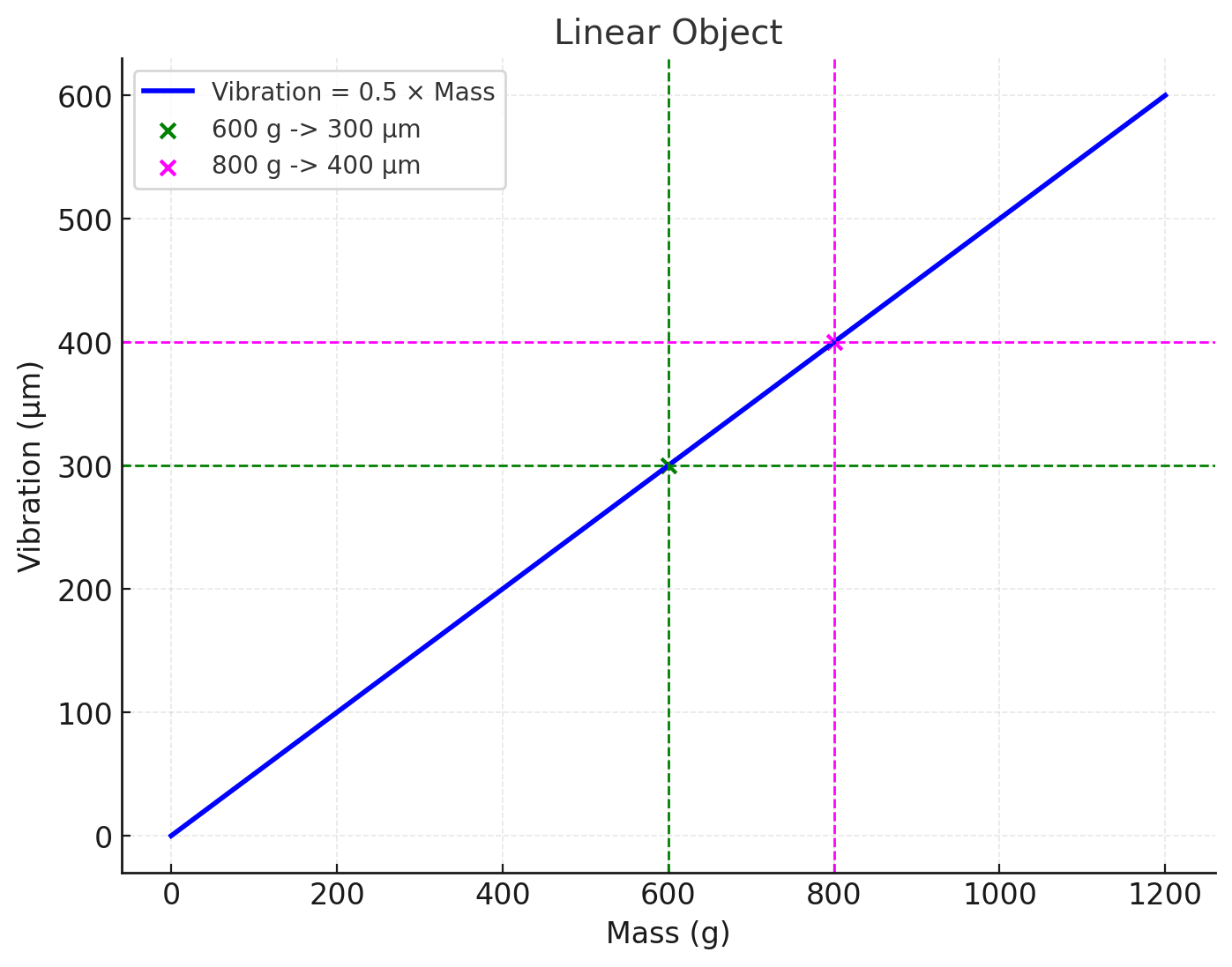
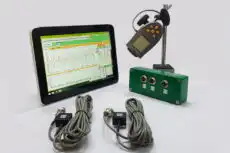
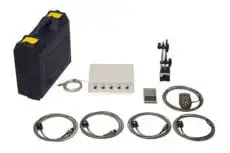
便攜式平衡機 & 振動分析儀 Balanset-1A

振動感測器

光學感測器(雷射轉速計)

Balanset-4

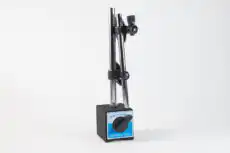
磁吸支架 Insize-60-kgf

反光膠帶

動平衡機「Balanset-1A」OEM

Serial balancing and stored coefficients

Serial balancing deserves special attention. It can significantly increase productivity, but only when applied to linear, vibration-stable objects. In such cases, influence coefficients obtained on the first rotor can be reused for subsequent identical rotors. However, as soon as support stiffness, rotational speed, or bearing condition changes, repeatability is lost and the serial approach stops working.

非線性物件:當理論與實踐背道而馳時

什麼是非線性物件?

非線性物件是一種振動幅度與不平衡量大小不成比例的系統。與線性物件不同,後者中振動與不平衡質量之間的關係由直線表示,而在非線性系統中,這種關係可能遵循複雜的軌跡。

在現實世界中,並非所有物件都表現為線性。非線性物件表現出非直接正比的不平衡與振動關係。這意味著影響係數不是恆定的,可能會根據多種因素而變化,例如:

  • 不平衡量大小: Increasing the imbalance can change the stiffness of the rotor's supports, leading to nonlinear changes in vibration.
  • 轉速: 在不同的轉速下可能會激發不同的共振現象,從而導致非線性行為。
  • 游隙和間隙的存在: 軸承及其他連接處的游隙與間隙,在特定條件下可能導致振動發生突變。
  • 溫度: 溫度變化會影響材料特性,進而影響該物件的振動特性。
  • 外部負荷: 作用於轉子上的外部負荷可能改變其動態特性,並導致非線性行為。

為何非線性物件具挑戰性?

非線性會為動平衡校正過程引入許多變數。成功處理非線性物件需要更多的測量與更複雜的分析。例如,適用於線性物件的標準方法,對非線性系統並不一定能產生準確的結果。這需要更深入地了解過程的物理原理,並使用專門的診斷方法。

非線性的徵兆

非線性物件可透過以下徵兆來識別:

  • 非比例振動變化: 隨著不平衡量的增加,振動可能比線性物件預期的增長更快或更慢。
  • 振動相位偏移: 振動相位可能隨著不平衡量或轉速的變化而不可預測地改變。
  • 諧波與次諧波的存在: 振動頻譜可能顯示出高次諧波(轉頻的倍數)與次諧波(轉頻的分數),這表明存在非線性效應。
  • 滯後現象: 振動幅值不僅取決於當前的不平衡量,還可能取決於其歷史變化。例如,當不平衡量增加後再減少回初始值時,振動幅值可能不會回到原始水平。

非線性會為動平衡校正過程引入許多變數。成功操作需要更多的測量與複雜的分析。例如,適用於線性物件的標準方法,對非線性系統並不一定能產生準確的結果。這需要更深入地了解過程物理原理,並使用專門的診斷方法。

非線性的圖形表示

在振動對不平衡量的圖表中,非線性表現為偏離直線。圖表可能具有彎折、曲率、滯後迴圈及其他特徵,表明不平衡量與振動之間存在複雜的關係。
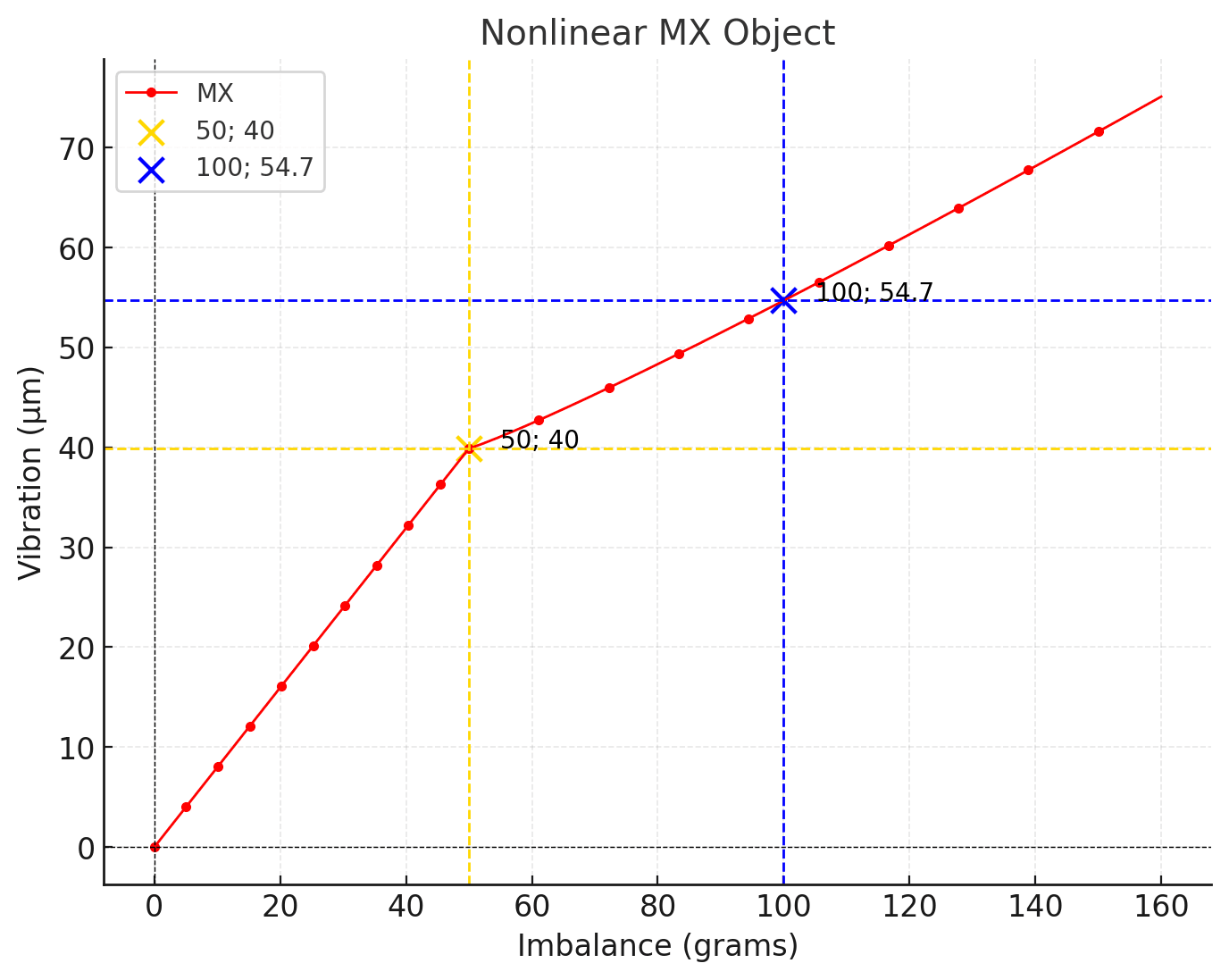
圖 2. 非線性物件

圖 2. 非線性物件

50g; 40μm (yellow), 100g; 54.7μm (blue).

此物件呈現兩個線段,即兩條直線。對於小於 50 公克的不平衡量,圖表反映線性物件的特性,保持公克為單位的不平衡量與微米為單位的振動幅值之間的比例關係。對於大於 50 公克的不平衡量,振動幅值的增長會減緩。

非線性物件的範例

在動平衡校正背景下,非線性物件的範例包括:

  • 帶有裂紋的轉子: 轉子上的裂紋可能導致剛性發生非線性變化,進而導致振動與不平衡量之間呈現非線性關係。
  • 帶有軸承游隙的轉子: 軸承游隙在特定條件下可能導致振動發生突變。
  • 帶有非線性彈性元件的轉子: Some elastic elements, such as rubber dampers, may exhibit nonlinear characteristics, affecting the rotor's dynamics.

非線性的類型

1. 軟硬非線性

在此類系統中,可觀察到兩個線段:軟段與硬段。在軟段中,行為類似線性,即振動幅值與不平衡質量成比例增加。然而,在達到某個閾值(斷點)後,系統會轉換為硬段模式,此時幅值增長會減緩。

2. 彈性非線性

系統內支撐或接觸點的剛性變化,使振動與不平衡量的關係變得複雜。例如,當跨越特定負荷閾值時,振動可能會突然增加或減少。

3. 摩擦誘發非線性

在具有顯著摩擦的系統中(例如軸承內),振動幅值可能難以預測。摩擦可能在某一轉速範圍內降低振動,而在另一範圍內放大振動。

Common causes of nonlinearity

The most common causes of nonlinearity are increased bearing clearances, bearing wear, dry friction, loosened supports, cracks in the structure, and operation near resonance frequencies. Often, the object exhibits so-called soft–hard nonlinearity. At small unbalance levels the system behaves almost linearly, but as vibration increases, stiffer elements of the supports or casing become involved. In such cases, balancing is possible only within a narrow operating range and does not provide stable long-term results.

Vibration instability

Another serious issue is vibration instability. Even a formally linear object may show changes in amplitude and phase over time. This is caused by thermal effects, changes in lubricant viscosity, thermal expansion, and unstable friction in the supports. As a result, measurements taken only minutes apart can produce different vibration vectors. Under these conditions, meaningful comparison of measurements becomes impossible, and the balancing calculation loses reliability.

Balancing near resonance

Balancing near resonance is especially problematic. When the rotational frequency coincides with, or is close to, a natural frequency of the system, even a small unbalance causes a sharp increase in vibration. The vibration phase becomes extremely sensitive to small speed variations. The object effectively enters a nonlinear regime, and balancing in this zone loses physical meaning. In such cases, the operating speed or the mechanical structure must be changed before balancing can be considered.

High vibration after “successful” balancing

In practice, it is common to encounter situations where, after a formally successful balancing procedure, the overall vibration level remains high. This does not indicate an error of the instrument or the operator. Balancing eliminates mass unbalance only. If vibration is caused by foundation defects, loosened fasteners, misalignment, or resonance, correction weights will not solve the problem. In these cases, analyzing the spatial distribution of vibration across the machine and its foundation helps to identify the true cause.

非線性物件的動平衡校正:一項需要非傳統解決方案之複雜任務

非線性物件的動平衡校正是一項具挑戰性的任務,需要專門的方法與途徑。為線性物件開發的標準試重法,可能產生錯誤的結果或完全無法適用。

非線性物件的動平衡校正方法

  • 逐步動平衡校正: This method involves gradually reducing imbalance by installing corrective weights at each stage. After each stage, vibration measurements are taken, and a new corrective weight is determined based on the object's current state. This approach accounts for changes in the influence coefficient during the balancing process.
  • 多轉速動平衡校正: 此方法解決了不同轉速下共振現象的影響。在接近共振的數個轉速下進行動平衡校正,使整個運轉轉速範圍內的振動降低更為均勻。
  • 使用數學模型: 對於複雜的非線性物件,可採用描述轉子動態並考慮非線性效應的數學模型。這些模型有助於預測物件在各種條件下的行為,並確定最佳的動平衡校正參數。

The experience and intuition of a specialist play a crucial role in balancing nonlinear objects. An experienced balancer can recognize signs of nonlinearity, select an appropriate method, and adapt it to the specific situation. Analyzing vibration spectra, observing vibration changes as the object's operating parameters vary, and considering the rotor's design features all assist in making the right decisions and achieving the desired results.

如何使用為線性物件設計的工具來校正非線性物件

這是個好問題。我個人校正此類物件的方法始於修復機件:更換軸承、焊接裂紋、鎖緊螺栓、檢查錨固或減震器,並確認轉子未與靜止結構元件發生摩擦。

接著,我會識別共振頻率,因為在接近共振的轉速下無法對轉子進行動平衡校正。為此,我使用衝擊法來確定共振頻率,或使用轉子惰轉降速圖。

Then, I determine the sensor's position on the mechanism: vertical, horizontal, or at an angle.

試運轉後,設備會指示校正負載的角度與重量。我會將校正負載的重量減半,但使用設備建議的角度來安裝轉子。如果校正後的殘餘振動仍超過可接受範圍,我會再次運轉轉子。當然,這需要更多時間,但有時結果令人鼓舞。

旋轉設備動平衡校正的藝術與科學

旋轉設備的動平衡校正是一個複雜的過程,結合了科學與藝術的元素。對於線性物件,動平衡校正涉及相對簡單的計算與標準方法。然而,處理非線性物件需要深入理解轉子動力學、分析振動信號的能力,以及選擇最有效動平衡校正策略的技巧。

經驗、直覺與持續的技能提升,是讓動平衡校正人員成為真正大師的關鍵。畢竟,動平衡校正的品質不僅決定了設備運轉的效率與可靠性,也確保了人員的安全。


Measurement repeatability

Measurement issues also play a major role. Incorrect installation of vibration sensors, changes in measurement points, or improper sensor orientation directly affect both amplitude and phase. For balancing, it is not enough to measure vibration; repeatability and stability of measurements are critical. This is why, in practical work, sensor mounting locations and orientations must be strictly controlled.

Practical approach for nonlinear objects

Balancing a nonlinear object always begins not with installing a trial weight, but with evaluating vibration behavior. If amplitude and phase clearly drift over time, change from one start to another, or react sharply to small speed variations, the first task is to achieve the most stable operating mode possible. Without this, any calculations will be random.

The first practical step is choosing the correct speed. Nonlinear objects are extremely sensitive to resonance, so balancing must be performed at a speed as far as possible from natural frequencies. This often means moving below or above the usual operating range. Even if vibration at this speed is higher, but stable, it is preferable to balancing in a resonant zone.

Next, it is important to minimize all sources of additional nonlinearity. Before balancing, all fasteners should be checked and tightened, clearances eliminated as much as possible, and supports and bearing units inspected for looseness. Balancing does not compensate for clearances or friction, but it may be possible if these factors are brought to a stable condition.

When working with a nonlinear object, small trial weights should not be used out of habit. Too small a trial weight often fails to move the system into a repeatable region, and the vibration change becomes comparable to instability noise. The trial weight must be large enough to cause a clear and reproducible change in the vibration vector, but not so large that it drives the object into a different operating regime.

Measurements should be performed quickly and under identical conditions. The less time passes between measurements, the higher the chance that the dynamic parameters of the system remain unchanged. It is advisable to perform several control runs without changing the configuration to confirm that the object behaves consistently.

It is very important to fix vibration sensor mounting points and their orientation. For nonlinear objects, even a small sensor displacement can cause noticeable changes in phase and amplitude, which may be mistakenly interpreted as the effect of the trial weight.

In calculations, attention should be paid not to exact numerical agreement, but to trends. If vibration consistently decreases with successive corrections, this indicates that balancing is moving in the right direction, even if influence coefficients do not formally converge.

It is not recommended to store and reuse influence coefficients for nonlinear objects. Even if one balancing cycle is successful, during the next start the object may enter a different regime and the previous coefficients will no longer be valid.

It should be remembered that balancing a nonlinear object is often a compromise. The goal is not to achieve the lowest possible vibration, but to bring the machine into a stable and repeatable condition with an acceptable vibration level. In many cases, this is a temporary solution until bearings are repaired, supports are restored, or the structure is modified.

The main practical principle is to stabilize the object first, then balance it, and only after that evaluate the result. If stabilization cannot be achieved, balancing should be considered an auxiliary measure rather than a final solution.

Reduced correction weight technique

In practice, when balancing nonlinear objects, another important technique often proves effective. If the instrument calculates a correction weight using a standard algorithm, installing the full calculated weight frequently makes the situation worse: vibration may increase, the phase may jump, and the object may shift into a different operating mode.

In such cases, installing a reduced correction weight works well — two or sometimes even three times smaller than the value calculated by the instrument. This helps avoid “throwing” the system out of the conditionally linear region into another nonlinear regime. In effect, the correction is applied gently, with a small step, without causing a sharp change in the dynamic parameters of the object.

After installing the reduced weight, a control run must be performed and the vibration trend evaluated. If the amplitude steadily decreases and the phase remains relatively stable, the correction can be repeated using the same approach, gradually approaching the minimum achievable vibration level. This step-by-step method is often more reliable than installing the full calculated correction weight at once.

This technique is especially effective for objects with clearances, dry friction, and soft–hard supports, where full calculated correction immediately drives the system out of the conditionally linear zone. Using reduced correction masses allows the object to remain in the most stable operating regime and makes it possible to achieve a practical result even where balancing is formally considered impossible.

It is important to understand that this is not an “instrument error”, but a consequence of the physics of nonlinear systems. The instrument correctly calculates for a linear model, while the engineer adapts the result in practice to the real behavior of the mechanical system.

Final principle

Ultimately, successful balancing is not merely about calculating a weight and an angle. It requires understanding the dynamic behavior of the object, its linearity, vibration stability, and distance from resonance conditions. The Balanset-1A provides all necessary tools for measurement, analysis, and calculation, but the final result is always determined by the mechanical condition of the system itself. This is what distinguishes a formal approach from real engineering practice in vibration diagnostics and rotor balancing.

Questions & answers

Why do vibration amplitude and phase change unpredictably after installing a trial weight, and why does the correction weight calculation give a poor result?

This is a sign of a nonlinear object. In a linear object, vibration amplitude is proportional to the amount of unbalance, and the phase changes by the same angle as the angular position of the weight. When these conditions are violated, the influence coefficient is no longer constant and the standard balancing algorithm starts to produce errors. Typical causes are bearing clearances, loosened supports, friction, and operation near resonance.

What is a linear object from the balancing point of view?

A linear object is a rotor system in which, at the same rotational speed, vibration amplitude is directly proportional to the magnitude of unbalance, and the vibration phase strictly follows the angular position of the unbalanced mass. For such objects, the influence coefficient is constant and does not depend on the mass of the trial weight.

What is considered a nonlinear object in balancing?

A nonlinear object is a system in which the proportionality between vibration and unbalance and/or the constancy of the phase relationship is violated. Vibration amplitude and phase begin to depend on the mass of the trial weight. Most often this is associated with bearing clearances, wear, dry friction, soft–hard supports, or the engagement of stiffer structural elements.

Is it possible to balance a nonlinear object using an instrument designed for linear systems?

Yes, but the result is unstable and depends on the operating mode. Balancing is possible only within a limited range where the object behaves conditionally linearly. Outside this range, influence coefficients change and result repeatability is lost.

What is the influence coefficient in simple terms?

The influence coefficient is a measure of vibration sensitivity to changes in unbalance. It shows how much the vibration vector will change when a known trial weight is installed in a given plane at a given speed.

Why does the influence coefficient change from one measurement to another?

The influence coefficient is unstable if the object is nonlinear, if vibration is unstable over time, or if resonance, thermal warm-up, loosened fasteners, or changing friction conditions are present. In such cases, repeated starts produce different amplitude and phase values.

When can stored influence coefficients be used?

Stored influence coefficients may be used only for identical rotors operating at the same speed, under the same installation conditions and support stiffness. The object must be linear and vibration-stable. Even a slight change in conditions makes the old coefficients unreliable.

Why does vibration change during warm-up even without a change in unbalance?

During warm-up, bearing clearances, support stiffness, lubricant viscosity, and friction level change. This alters the dynamic parameters of the system and, as a result, changes vibration amplitude and phase.

What is vibration instability and why does it interfere with balancing?

Vibration instability is a change in amplitude and/or phase over time at a constant rotational speed. Balancing relies on comparing vibration vectors, so when vibration is unstable, the comparison loses meaning and the calculation becomes unreliable.

What types of vibration instability exist?

There are inherent structural instability, slow “creeping” instability, variation from start to start, warm-up-related instability, and resonance-related instability when operating near natural frequencies.

Why is it impossible to balance a rotor in the resonance zone?

In the resonance zone, even a small unbalance causes a sharp increase in vibration, and the phase becomes extremely sensitive to small changes. Under these conditions, the object becomes nonlinear and the balancing results lose physical meaning.

How can one tell that the balancing speed is close to a resonant speed?

Typical signs are a sharp increase in vibration with small speed changes, unstable phase, broad humps in the spectrum, and high sensitivity of vibration to minor RPM variations. A vibration maximum is often observed during run-up or coast-down.

Why does high vibration not always mean large unbalance?

High vibration can be caused by resonance, loosened structures, foundation defects, or bearing problems. In such cases, balancing will not eliminate the cause of vibration.

What is the difference between vibration displacement, vibration velocity, and vibration acceleration?

Vibration displacement characterizes the motion amplitude, vibration velocity characterizes the speed of this motion, and vibration acceleration characterizes the acceleration. These quantities are related, but each is better suited to detecting certain types of defects and frequency ranges.

Why are vibration limits usually specified in terms of vibration velocity?

Vibration velocity reflects the energy level of vibration over a wide frequency range and is convenient for assessing the overall condition of machines according to ISO standards.

Is it possible to directly convert vibration displacement to vibration velocity and vice versa?

Correct conversion is possible only for single-frequency harmonic vibration. For complex vibration spectra, such conversions provide only approximate results.

Why does vibration remain high after balancing?

Possible reasons include resonance, foundation defects, loosened fasteners, bearing wear, misalignment, or object nonlinearity. Balancing removes unbalance only, not other defects.

How can one tell that the problem is not in the rotor but in the foundation?

If mechanical defects are not detected and vibration does not decrease after balancing, it is necessary to analyze the vibration distribution over the machine and the foundation. Typical signs are high vibration of the casing and base, and phase shifts between measurement points.

Why is correct installation of vibration sensors important?

Incorrect sensor installation distorts amplitude and phase, reduces measurement repeatability, and can lead to incorrect diagnostic conclusions and erroneous balancing results.

Why do different measurement points show different vibration levels?

Vibration is distributed unevenly throughout the structure. Stiffness, masses, and mode shapes differ, so amplitude and phase can vary significantly from point to point.

Is it possible to balance a rotor with worn bearings?

As a rule, no. Wear and increased clearances make the object nonlinear. Balancing becomes unstable and does not provide a long-term result. Exceptions are possible only with design clearances and stable conditions.

Why does the balancing result differ after each start?

Starting creates high dynamic loads. If the structure is loosened, the relative positions of elements change after each start, leading to changes in vibration parameters.

When is serial balancing using influence coefficients acceptable?

Serial balancing is possible for identical rotors installed under identical conditions, with vibration stability and absence of resonance. In this case, influence coefficients from the first rotor can be applied to subsequent ones.

Why does the result suddenly stop being repeatable during serial balancing?

This is usually due to changes in support stiffness, assembly differences, changes in rotational speed, or transition of the object into a nonlinear operating regime.

What is the main criterion for successful balancing?

Reduction of vibration to a stable level while maintaining repeatability of amplitude and phase from start to start, and the absence of signs of resonance or nonlinearity.


0 Comments

Leave a Reply

Avatar placeholder
WhatsApp
Balanset-1A · €1975Ask engineer