转子平衡中的非线性物体
为什么平衡“不起作用”?为什么影响系数会变化?以及如何在实际现场条件下进行操作?
概述
实际上,转子平衡几乎从来都不是简单地计算并安装修正配重那么简单。理论上,算法是众所周知的,仪器也能自动完成所有计算,但最终结果更多地取决于物体本身的特性,而非平衡装置本身。正因如此,在实际工作中,经常会出现平衡“失效”、影响系数发生变化、振动变得不稳定以及结果无法重复等情况。
线性与非线性振动:特点及平衡方法
成功的平衡需要了解物体对质量增加或减少的反应。在这种情况下,线性和非线性物体的概念起着关键作用。了解物体是线性的还是非线性的,可以选择正确的平衡策略并有助于实现所需的结果。
线性物体因其可预测性和稳定性而在该领域占有特殊地位。它们允许使用简单可靠的诊断和平衡方法,使它们的研究成为振动诊断的重要一步。
线性对象与非线性对象
这些问题大多根源于线性对象与非线性对象之间一个基本但常被低估的区别。从平衡的角度看,线性对象是这样一种系统:在恒定转速下,振动振幅与 不平衡,且振动相位严格按照可预测的方式,跟随不平衡质量的角度位置变化。在这种条件下,影响系数是一个恒定值。包括Balanset-1A所采用的算法在内,所有标准动平衡算法,正是针对这类对象而设计的。
对于线性物体,平衡过程是可预测且稳定的。安装一个 试验重量 所增加的量成正比地引起振动振幅和相位的变化。重复启动会得到相同的振动向量,计算出的校正重块也始终有效。这类对象既适合一次性平衡,也非常适合利用已保存的影响系数进行批量平衡。
非线性物体的行为方式截然不同。平衡计算的基本原理被打破。振幅不再与不平衡量成正比,相位变得不稳定,影响系数也会随试块质量、运行模式甚至时间而变化。在实际应用中,这表现为振动矢量的混沌行为:安装试块后,振动变化可能过小、过大,或者根本无法重复。
什么是线性物体?
线性物体是一种振动与不平衡程度成正比的系统。
在平衡的语境下,线性物体是一种理想化的模型,其特征在于不平衡量(不平衡质量)的大小与振动幅度之间存在直接的比例关系。这意味着,如果转子的转速保持不变,不平衡量增加一倍,振动幅度也会增加一倍。反之,减少不平衡量会成比例地降低振动幅度。
与非线性系统不同,非线性系统中对象的行为可能根据多种因素而变化,而线性对象则可以用最小的努力实现较高的精度。
此外,它们也是平衡者的训练和练习的基础。了解线性物体的原理有助于培养以后可以应用于更复杂系统的技能。
线性的图形表示
想象一个图表,横轴代表不平衡质量的大小(不平衡量),纵轴代表振动幅度。对于线性物体,该图表将是一条穿过原点的直线(原点为不平衡量和振动幅度均为零的点)。这条直线的斜率表征了物体对不平衡的敏感度:斜率越陡,相同不平衡量下的振动幅度越大。
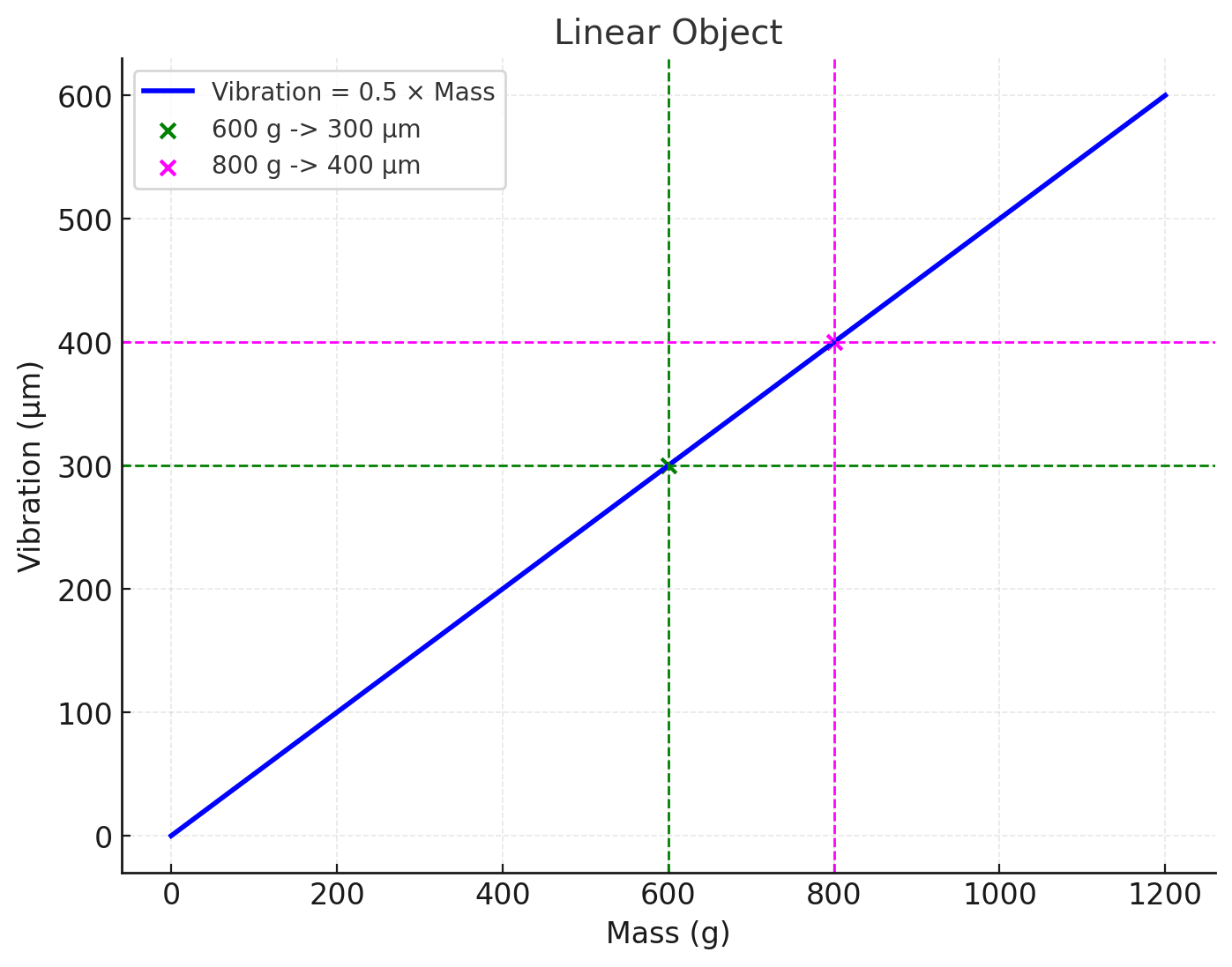
图表1:在校正半径和转速均保持恒定的条件下,振动幅值(µm)与不平衡质量(g)之间的关系
图 1 说明了线性平衡物体的振动幅度 (µm) 与转子的不平衡质量 (g) 之间的关系。比例系数为 0.5 µm/g。只需将 300 除以 600 即可得出 0.5 µm/g。对于 800 g 的不平衡质量 (UM=800 g),振动将为 800 g * 0.5 µm/g = 400 µm。请注意,这适用于恒定的转子速度。在不同的转速下,系数会有所不同。
该比例系数称为影响系数(灵敏度系数),其单位为 µm/g,在涉及不平衡的情况下,单位为 µm/(g*mm),其中 (g*mm) 是不平衡的单位。了解影响系数 (IC) 后,还可以解决逆问题,即根据振动幅度确定不平衡质量 (UM)。为此,将振动幅度除以 IC。
例如,如果测得的振动为 300 µm,已知系数为 IC=0.5 µm/g,则将 300 除以 0.5 可得到 600 g(UM=600 g)。
关于单位的说明: 这些示例中使用的位移值(µm)仅为示意,选用是为了便于计算。Balanset-1A 测量并显示振动速度(mm/s RMS);无论采用哪种单位,线性原理和影响系数法的适用方式都相同。
影响系数(IC):线性物体的关键参数
线性物体的一个关键特性是 影响系数 (IC)。它在数值上等于振动—不平衡关系图中直线斜率角的正切值,表示在特定转子转速下,某一校正平面内每增加一个单位质量(克,g)时振动振幅(微米,µm)的变化量。换句话说,IC衡量的是对象对不平衡的敏感程度。其单位为µm/g,或者当不平衡量以质量与半径的乘积表示时,单位为µm/(g·mm)。
初始条件(IC)本质上是线性物体的"通行证"特征,它能够预测物体在质量增加或减少时的行为。了解初始条件可以解决正问题(确定给定不平衡量下的振动幅度)和逆问题(根据测得的振动计算不平衡量)。
正问题:
反问题:
IC 在实践中如何获得:
式中V0 是初始运行(Run 0)中测得的振动向量,V1 是加装试验质量 m 后测得的向量trial 安装后(Run 1),K为影响系数,m校对 是校正质量。以上各量均为结合了幅值和相位的复数(矢量)——这正是本文后面要讨论影响系数幅角的原因。
本文通篇以克为单位的质量作为不平衡量的代用指标:只要校正半径保持不变,它就等同于以g·mm表示的不平衡量。若半径发生变化,则应改用g·mm单位表示不平衡量,并使用单位为µm/(g·mm)的影响系数。
线性物体的振动相位
除了振幅之外,振动的另一个特征是相位,它表示转子偏离平衡位置最大时刻的位置。对于线性物体,振动相位也是可以预测的。它是两个角度之和:
- 该角度决定了转子整体不平衡质量的位置。该角度指示了主要不平衡集中的方向。
- 影响系数的参数。这是一个表征物体动态特性的常数角度,与不平衡质量装置的大小或角度无关。
因此,通过了解 IC 参数并测量振动相位,可以确定不平衡质量装置的角度。这不仅可以计算校正质量大小,还可以精确地将其放置在转子上以实现最佳平衡。
线性物体的平衡
需要注意的是,对于线性物体,通过试重运行得到的影响系数为 K = (V1 − V0) / mtrial 既不取决于试重安装的大小或角度,也不取决于初始振动。这是线性的一个关键特征。如果在改变试重参数或初始振动时,IC保持不变,就可以确信该对象在所考察的不平衡范围内表现为线性。
平衡线性物体的步骤
- 测量初始振动: 第一步是测量初始状态下的振动,确定指示不平衡方向的振幅和振动角度。
- 安装试重质量: 在转子上安装一个已知重量的物体。这有助于了解物体对额外负载的反应,并计算出振动参数。
- 重新测量振动: 安装试验质量后,测量新的振动参数。通过将其与初始值进行比较,可以确定质量对系统的影响。
- 计算校正质量: 根据测量数据确定校正重量的质量和安装角度。该重量被放置在转子上以消除不平衡。
- 最终验证: 安装校正重量后,振动应明显减少。 如果残余振动仍然超过可接受水平,则可以重复该过程。
请注意: 线性对象,是研究以及实际应用各种平衡方法的理想模型。它所具有的这些特性,使得工程师和诊断人员,能够把精力集中在培养基本技能,以及理解处理转子系统的基本原理这两件事情上面。虽然说,完全线性的对象,终归只是一种理想化的假设,但是大多数机械设备,只要处于良好的机械状态,在现场平衡当中所遇到的不平衡范围之内,其表现就已经足够线性了——而这,正是影响系数法之所以能够行之有效的根本原因所在。因此,线性模型并不只是一种学术上的练习,而是一种通常情况下的工作假设;相比之下,非线性才是那种需要被特别识别出来的例外情况。

串行平衡和存储系数
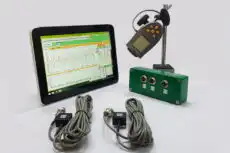
批量平衡值得特别关注。它可以显著提高生产效率,但仅适用于线性、振动稳定的对象。在这种情况下,第一个转子上获得的影响系数可重复用于后续相同的转子。Balanset-1A 软件直接支持这一点:先前平衡会话的系数存储在存档中,可通过 Apply coefficients 功能(F8 Reports,平衡存档)重新应用到相同的转子上。然而,一旦支承刚度、转速或轴承状态发生变化,重复性就会丧失,批量方法也就不再适用。
非线性物体:理论与实践出现分歧之时
什么是非线性对象?
非线性物体是一种振动幅度与不平衡量不成比例的系统。与线性物体不同,线性物体的振动与不平衡质量之间的关系用直线表示,而在非线性系统中,这种关系可以遵循复杂的轨迹。
在现实中,并非所有物体都表现为线性。非线性物体的不平衡量与振动之间并非直接成正比关系,这意味着影响系数并非恒定,可能因以下因素而变化:
- 不平衡程度: 增加不平衡量会改变转子支撑的刚度,从而导致振动的非线性变化。
- 存在间隙和缝隙: 在某些条件下,轴承和其他连接中的间隙和缝隙会导致振动的突然变化。
温度变化和外部负载的波动同样会改变物体的动态特性,但方式不同:它们使系统变为非定常,而非非线性(见下文振动不稳定性一节)。
为什么非线性物体具有挑战性?
非线性会将许多变量引入平衡过程。成功处理非线性对象需要进行更多测量和更复杂的分析。例如,适用于线性对象的标准方法并不总是能为非线性系统产生准确的结果。这需要更深入地了解该过程的物理原理并使用专门的诊断方法。
非线性迹象
非线性对象可以通过以下标志来识别:
- 非比例振动变化: 随着不平衡量的增加,振动的增长速度可能比线性物体预期的更快或更慢。
- 振动的相移: 振动相位可能会随着不平衡或转速的变化而发生不可预测的变化。
- 谐波和次谐波的存在: 振动频谱中可能出现更高次谐波(转频的整数倍)和次谐波(转频的分数倍),表明存在非线性效应。在 Balanset-1A 软件中,可在 F7 - Charts 界面的 F5-Spectrum (Hz) 选项卡上查看这些成分。
- 滞后: 振动幅度可能不仅取决于当前的不平衡值,还取决于其历史值。例如,当不平衡增加然后又降低回其初始值时,振动幅度可能不会回到其原始水平。
如何测试物体的线性
- 重复性检查: 执行Run 0,停机后重新启动,在不做任何改动的情况下重复Run 0。若振幅差异在约10%以内、相位差异在约10–15°以内,说明该物体足够稳定,可以进行平衡。
- 移除检查: 试运行结束后,取下试重并重复Run 0。如果振动矢量未能恢复到原始值,说明该物体存在滞后效应或松动。
- 双倍质量检查: 在同一位置用重量加倍的试重重复试重运行。对于线性物体,向量变化 (V1 − V0)的大小必须变为两倍,且方向保持不变。出现任何其他结果,都意味着影响系数与试重质量有关——该物体是非线性的。
- 180° 检查: 同一试重移动180°后,向量变化也必须旋转180°。
非线性的图形表示
在振动与不平衡关系图上,非线性表现为偏离直线。该图可能具有弯曲、曲率、磁滞回线和其他特征,表明不平衡与振动之间存在复杂的关系。
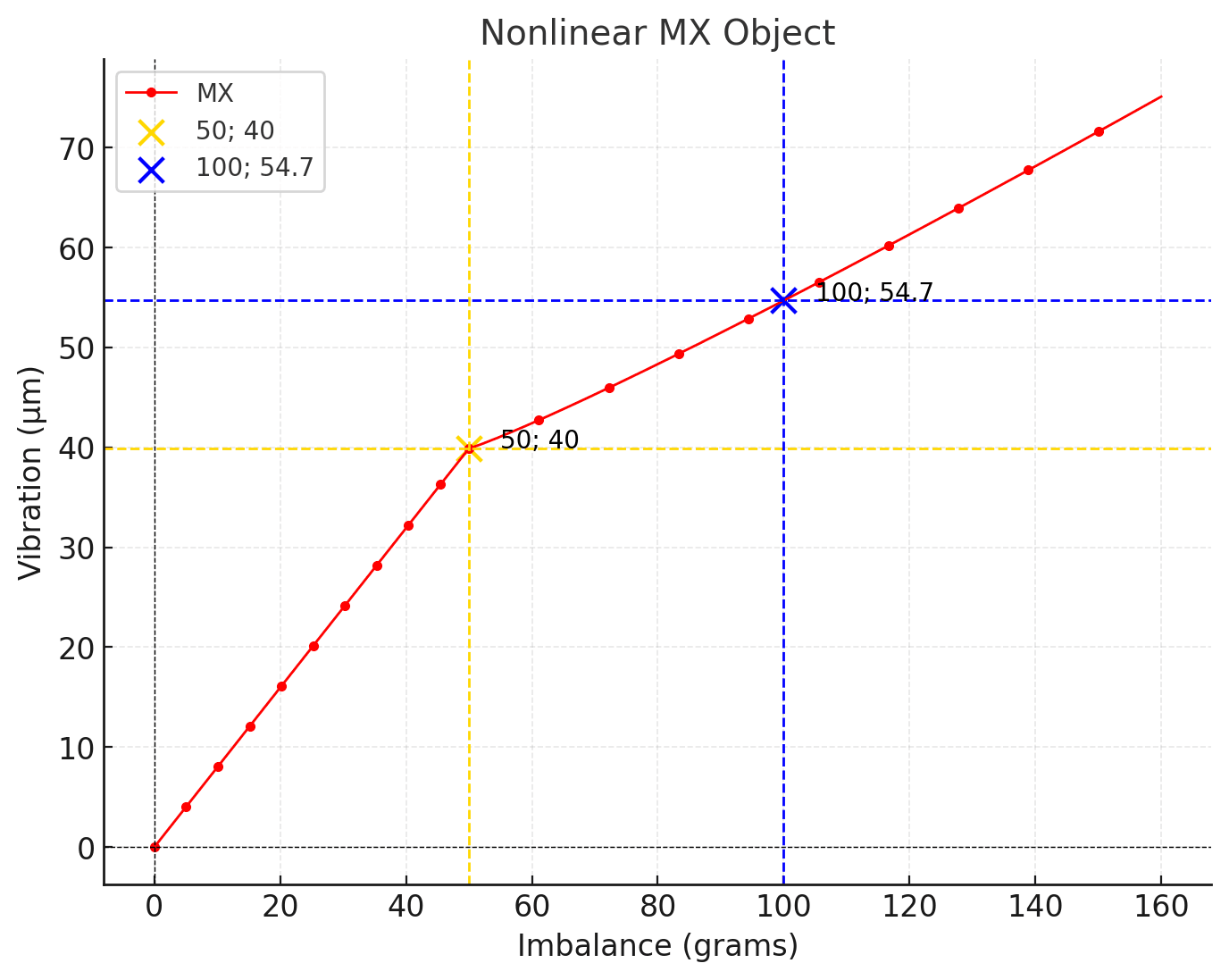
图2. 非线性物体(校正半径恒定、转速恒定)
50 g;40 µm(黄色),100 g;54.7 µm(蓝色)。
此物体呈现两个段,两条直线。对于小于 50 克的不平衡,该图反映了线性物体的属性,保持了克数不平衡与微米数振幅之间的比例。对于大于 50 克的不平衡,振幅的增长会减慢。
非线性对象的例子
平衡背景下的非线性对象的示例包括:
- 有裂纹的转子: 转子中的裂纹可能导致刚度的非线性变化,从而导致振动和不平衡之间的非线性关系。
- 转子与轴承间隙: 在某些条件下,轴承间隙可能会导致振动突然变化。
- 具有非线性弹性元件的转子: 某些弹性元件,例如橡胶阻尼器,可能会表现出非线性特性,从而影响转子的动力学特性。
非线性类型
1. 软硬非线性
在此类系统中,可以观察到两个部分:软部分和硬部分。在软部分,行为类似于线性,其中振动幅度与不平衡质量成比例增加。然而,在某个阈值(断点)之后,系统过渡到硬模式,其中振幅增长减慢。
2. 弹性非线性
系统内支撑或接触刚度的变化使振动不平衡关系变得复杂。例如,当超过特定负载阈值时,振动可能会突然增加或减少。
3. 摩擦引起的非线性
在摩擦力较大的系统中(例如轴承),振动幅度可能无法预测。摩擦力可以在某一速度范围内减少振动,而在另一个速度范围内则会增加振动。
非线性现象的常见原因
非线性最常见的原因包括轴承间隙增大、轴承磨损、干摩擦、支撑松动以及结构裂纹。在接近 谐振 是一个独立的问题:它并不会使对象变成非线性,但它会破坏测量的可重复性,因此,对于影响系数法而言,其危害同样是致命的。这种对象,往往表现出所谓的“软—硬”非线性特性。在不平衡程度较小的时候,系统的表现几乎是线性的;但是随着振动的增大,支承或者机壳当中刚度更高的元件,就会开始参与进来。在这种情况下,平衡只能在一个较窄的运行范围内才能实现,而且无法提供长期稳定的效果。
振动不稳定性
另一个严重的问题,是振动的不稳定性。即便是一个在形式上属于线性的对象,其振幅和相位,也有可能随着时间的推移而发生变化。造成这种情况的原因,包括热效应、润滑剂粘度的变化、热膨胀、支承部位摩擦力的不稳定,以及作用在机器上的外部负载的波动。其结果就是,即便前后只相隔几分钟所进行的测量,也有可能得出不同的振动矢量。在这种条件下,对各次测量结果进行有意义的比较,就变得不再可能,平衡计算的可靠性,也就随之丧失了。
请注意区别:一个 非线性 物体在不同的试重质量下会得到不同的影响系数;一个 非定常 (不稳定)对象对于同一个试重,在不同时间测得的影响系数会不一样。两者都会破坏计算,但补救方法不同——非线性问题要靠机械手段解决,不稳定问题则要靠稳定运行工况并加快测量速度来解决。
平衡近共振
在接近共振区域进行平衡尤其成问题。当旋转频率接近 固有频率 的这个系统,哪怕是很小的一点不平衡,也会导致振动急剧增加,而且振幅和相位这两者,都会对微小的转速变化变得极为敏感。这里要请注意,共振本身其实并不等同于非线性——线性系统当中同样存在共振现象,而且即便是在共振状态下,振动的大小仍然与不平衡量成正比。真正丧失掉的,是测量结果的可重复性——在临界转速附近,哪怕转速只有±1%这样微小的波动,对测得矢量所造成的影响,也要远远大于试重本身所带来的影响,因此,在这个区域内测得的影响系数,在实际应用当中是不可用的。(此外,较大的共振响应,还有可能把支承结构推入到真正的非线性区间当中去——但那只是一种结果,而并非非线性本身的定义。)在这种情况下,必须先把平衡转速移离固有频率,或者改变机械结构本身,然后才能够尝试进行平衡。
“成功”平衡后出现高振动
在实际操作中,经常会遇到这样的情况:即使经过了形式上的平衡调整,整体振动水平仍然很高。这并不意味着仪器或操作人员出现了错误。平衡调整只能消除质量不平衡。如果振动是由地基缺陷、紧固件松动、不对中或共振引起的,那么使用校正配重块并不能解决问题。在这种情况下,分析机器及其地基的振动空间分布有助于确定真正的原因。
非线性物体的平衡:一项需要非常规解决方案的复杂任务
平衡非线性物体是一项具有挑战性的任务,需要专门的方法和手段。为线性物体开发的标准试重法可能会产生错误的结果或完全不适用。
非线性对象的平衡方法
- 逐步平衡: 该方法通过在各个阶段安装修正配重来逐步减少不平衡量。每个阶段结束后,进行振动测量,并根据物体的当前状态确定新的修正配重。这种方法考虑了平衡过程中影响系数的变化。
- 多种转速下的平衡: 影响系数与转速有关,因此需要在很宽转速范围内运转的转子,可能需要在多个转速下测量系数。这属于柔性转子的模态(多转速)平衡范畴,需要线性、可重复的对象、多个校正平面,并且通常需要使用平衡机。它不是处理非线性对象的变通办法,也不意味着在共振点附近进行平衡——测量转速仍必须选在远离临界转速的位置。在 Balanset-1A 的影响系数流程中,所有运行(Run 0 / Run 1 / Run 2 / Run T)都必须在相同的转速下进行。
- 使用数学模型: 对于复杂的非线性对象,可以采用描述转子动力学并考虑非线性效应的数学模型。这些模型有助于预测对象在各种条件下的行为并确定最佳平衡参数。
在平衡非线性物体时,专家的经验和直觉起着至关重要的作用。经验丰富的平衡师能够识别非线性迹象,选择合适的方法,并根据具体情况进行调整。分析振动频谱、观察物体运行参数变化时的振动变化,以及考虑转子的设计特点,都有助于做出正确的决策并达到预期的效果。
如何使用专为线性物体设计的工具平衡非线性物体
这是个好问题。我个人平衡此类物体的方法是从修复机械装置开始:更换轴承、焊接裂纹、拧紧螺栓、检查锚栓或隔振器,并确认转子不会与固定结构元件摩擦。
接下来,我会确定共振频率,因为在接近共振的转速下无法对转子进行平衡。为此,我使用敲击法来确定共振(即Balanset-1A软件中的Bump Test功能),或者使用转子惰转曲线(RunDown功能)。
然后,我确定传感器在机械装置上的位置:垂直、水平或倾斜。
试运行后,该设备会显示校正负载的角度和重量。我将校正负载重量减半,但使用该设备建议的角度放置转子。如果校正后的残余振动仍然超过可接受水平,我会再次运行转子。当然,这需要更多时间,但结果有时令人鼓舞。
旋转设备平衡的艺术与科学
旋转设备的平衡是一个复杂的过程,结合了科学和艺术的元素。对于线性物体,平衡涉及相对简单的计算和标准方法。然而,处理非线性物体需要深入了解转子动力学、分析振动信号的能力以及选择最有效平衡策略的技能。
经验、直觉和持续的技能提升是让平衡工成为真正大师的关键。毕竟,平衡的质量不仅决定了设备运行的效率和可靠性,还确保了人员的安全。
测量重复性
测量问题也起着至关重要的作用。振动传感器的安装不当、测量点的改变或传感器方向错误都会直接影响振幅和相位。对于动平衡而言,仅仅测量振动是不够的;测量的重复性和稳定性至关重要。因此,在实际工作中,必须严格控制传感器的安装位置和方向。
非线性对象的实用方法
对非线性物体进行平衡时,并非首先安装试重,而是首先评估其振动特性。如果振幅和相位随时间明显漂移、在不同启动之间发生变化,或对微小的速度变化反应剧烈,则首要任务是使其达到尽可能稳定的运行状态。否则,任何计算都将是随机的。
第一个实际步骤是选择合适的转速。非线性物体对共振极其敏感,因此平衡操作必须在尽可能远离固有频率的转速下进行。这通常意味着转速要低于或高于通常的工作范围。即使这种转速下的振动幅度更大,但只要振动稳定,也比在共振区进行平衡要好。
接下来,必须尽可能减少所有额外的非线性来源。在进行动平衡之前,应检查并拧紧所有紧固件,尽可能消除间隙,并检查支架和轴承单元是否松动。动平衡并不能补偿间隙或摩擦,但如果这些因素达到稳定状态,则有可能实现补偿。
在处理非线性物体时,不应出于习惯而使用过小的试砝码。过小的试砝码往往无法使系统进入可重复的区域,振动变化甚至会与不稳定噪声相当。试砝码必须足够大,才能引起振动矢量清晰且可重复的变化,但又不能过大,以免使物体进入不同的工作状态。
测量应在相同条件下快速进行。测量间隔时间越短,系统动态参数保持不变的可能性就越高。建议在不改变配置的情况下进行多次控制运行,以确认被测对象行为的一致性。
固定振动传感器的安装点及其方向至关重要。对于非线性物体,即使传感器发生微小位移也会导致相位和振幅发生明显变化,这可能会被误认为是试重的影响。
在计算中,应关注趋势而非精确的数值一致性。如果振动随着连续修正而持续降低,则表明平衡正朝着正确的方向发展,即使影响系数并未完全收敛。
不建议存储和重复使用非线性对象的影响系数。即使一次平衡循环成功,在下次启动时,对象也可能进入不同的状态,导致之前的系数不再有效。
需要注意的是,平衡非线性物体通常是一种折衷方案。其目标并非实现最低振动,而是使机器处于稳定且可重复的状态,同时保持可接受的振动水平。在许多情况下,这只是一个临时解决方案,直到轴承修复、支撑恢复或结构改造完成。
主要实践原则是先稳定物体,再进行平衡,最后评估结果。如果无法实现稳定,则平衡应被视为辅助措施而非最终解决方案。
减少矫正重量技术
在实际应用中,平衡非线性物体时,另一种重要的技巧往往非常有效。如果仪器使用标准算法计算修正重量,那么安装完整的计算重量通常会使情况变得更糟:振动可能增大,相位可能跳变,物体可能切换到不同的工作模式。
在这种情况下,采用较小的校正权重效果很好——其值通常比仪器计算值小两倍甚至三倍。这有助于避免系统从条件线性区域“跳出”非线性区域。实际上,校正是以一种小步长的方式缓慢进行的,不会导致物体动态参数的剧烈变化。
安装减重配重后,必须进行控制运行并评估振动趋势。如果振幅持续下降且相位保持相对稳定,则可以采用相同的方法重复校正,逐步接近可达到的最小振动水平。这种分步方法通常比一次性安装全部计算出的校正配重更可靠。
对于存在间隙、干摩擦以及软硬支撑的物体,这种技术尤为有效,因为完全计算的修正会立即使系统脱离条件线性区。使用减小的修正质量可以使物体保持在最稳定的运行状态,即使在理论上认为无法进行平衡的情况下,也能获得实际可行的结果。
需要注意的是,这并非“仪器误差”,而是非线性系统物理特性所致。仪器能够正确计算线性模型下的结果,而工程师在实际应用中需要根据机械系统的实际运行情况对结果进行调整。
最终原则
归根结底,成功的动平衡并非仅仅计算重量和角度。它需要理解物体的动态特性、线性度、振动稳定性以及与共振条件的距离。Balanset-1A 提供了所有必要的测量、分析和计算工具,但最终结果始终取决于系统本身的机械状态。这正是形式化方法与振动诊断和转子平衡中实际工程实践之间的区别所在。
问答
这是判断一个对象属于非线性对象的一个标志。在一个线性对象当中,振动振幅是与不平衡量的大小成正比的,而相位变化的角度,也与配重的角度位置保持一致。一旦这些条件被打破,那么影响系数就不再是一个恒定的数值,标准的平衡算法,也就开始产生误差了。造成这种情况的典型原因,包括轴承间隙过大、支承松动、摩擦,以及在接近共振的状态下运转——需要说明的是,这本身并不属于非线性,但它会放大振动,并破坏读数的可重复性(可以用Bump Test功能来加以检验)。
线性物体是指在相同转速下,振动幅度与不平衡量成正比,且振动相位严格跟随不平衡质量角位置的转子系统。对于此类物体,影响系数为常数,与试验砝码的质量无关。
非线性物体是指振动与不平衡之间的比例关系和/或相位关系不再恒定的系统。振动幅值和相位开始取决于试块的质量。这种情况通常与轴承间隙、磨损、干摩擦、软硬支撑或刚性结构元件的啮合有关。
是的,但结果不稳定,并且取决于操作模式。平衡只能在物体表现为条件线性行为的有限范围内进行。超出此范围,影响系数会发生变化,结果的可重复性也会丧失。
影响系数衡量的是振动对不平衡变化的敏感度。它表示在给定速度下,当在给定平面上安装已知试重时,振动矢量会发生多大的变化。
如果物体是非线性的,振动随时间不稳定,或者存在共振、热升温、紧固件松动或摩擦条件变化等情况,则影响系数不稳定。在这种情况下,重复启动会产生不同的振幅和相位值。
存储的影响系数仅适用于在相同转速、相同安装条件和相同支撑刚度下运行的相同转子。被测物体必须具有线性和振动稳定性。即使条件发生微小变化,也会导致旧系数失效。
预热过程中,轴承间隙、支撑刚度、润滑剂粘度和摩擦程度都会发生变化。这会改变系统的动态参数,从而导致振动幅值和相位发生变化。
振动不稳定性是指在恒定转速下,振幅和/或相位随时间发生变化。平衡依赖于比较振动矢量,因此当振动不稳定时,这种比较失去意义,计算结果也变得不可靠。
在接近固有频率运行时,存在固有的结构不稳定性、缓慢的“蠕动”不稳定性、启动时的变化、与预热相关的不稳定性以及与共振相关的不稳定性。
在共振这个区域内,哪怕是很小的一点不平衡,也会导致振动急剧增加,而振幅和相位这两者,都会对微小的转速变化变得极为敏感。共振本身,其实并不等同于非线性——线性系统当中,同样也存在共振现象,而且即便是在共振状态下,振动的大小仍然与不平衡量成正比。真正丧失掉的,是测量结果的可重复性:在临界转速附近,转速上正常出现的那种波动,对测得矢量所造成的影响,要远远大于试重本身所带来的影响,因此,在这个区域内测得的影响系数,在实际应用当中是不可用的。在真正尝试进行平衡之前,必须先把平衡转速,移离固有频率才行。
典型的迹象包括:转速稍有变化,振动便急剧增加;相位不稳定;频谱当中出现宽大的凸起;以及振动对微小的转速波动表现出高度的敏感性。振动的最大值,往往会在升速或者降速的过程当中被观测到。其中最为可靠的判断指标,是相位:当转速经过共振区域的时候,相位滞后会在峰值附近变化大约90°,而在峰值之上,则会反转大约180°。在缓慢升速或者降速的过程当中,密切关注相位读数——如果观察到180°的相位摆动,同时伴随着振幅达到最大值,那么这个位置,就是临界转速所在之处。
剧烈振动可能是由共振、结构松动、地基缺陷或轴承问题引起的。在这种情况下,平衡并不能消除振动的根本原因。
振动位移表征运动的振幅,振动速度表征运动的快慢,振动加速度表征加速度。这些量相互关联,但各自更适用于检测特定类型的缺陷和频率范围。
振动速度反映了振动在宽频率范围内的能量水平,便于依据ISO标准(例如 ISO 10816-1.
只有单频谐波振动才能进行正确的转换。对于复杂的振动频谱,此类转换只能提供近似结果。
可能的原因包括共振、地基缺陷、紧固件松动、轴承磨损、不对中或物体非线性。平衡只能消除不平衡,无法解决其他缺陷。
如果未检测到机械缺陷且平衡后振动未降低,则需要分析机器和基础的振动分布。典型迹象是机壳和底座振动较大,以及测量点之间存在相位差。
传感器安装不当会扭曲幅值和相位,降低测量重复性,并可能导致错误的诊断结论和错误的平衡结果。
振动在结构中的分布并不均匀。由于刚度、质量和振型各不相同,振幅和相位在不同位置之间可能存在显著差异。
通常情况下,不行。磨损和间隙增大会导致物体非线性运动,平衡变得不稳定,无法提供长期效果。只有在设计间隙和稳定条件下,才有可能例外。
启动时会产生高动态载荷。如果结构处于松动状态,每次启动后各构件的相对位置都会发生变化,从而导致振动参数发生变化。
对于在相同条件下安装的相同转子,可以进行串联平衡,前提是振动稳定且无共振。在这种情况下,第一个转子的影响系数可以应用于后续转子。
这通常是由于支撑刚度的变化、装配差异、旋转速度的变化,或者物体进入非线性运行状态所致。
将振动降低到稳定水平,同时保持振幅和相位从开始到结束的可重复性,并且没有共振或非线性迹象。

Nikolai Shelkovenko
Nikolai Shelkovenko是一名振动分析工程师,也是Vibromera的创始人兼首席执行官。 15年多来,他一直在现场——而非在试验台上——为旋转设备进行平衡:粉碎机、工业风机、破碎机、离心机、轴和主轴。正是这些实际工作催生了Balanset系列仪器——它们被设计为一种专业人员可以随身携带到机器旁、在现场独立使用的工具,而非实验室设备。 Vibromera成立于2017年,自2023年起总部设于葡萄牙波尔图。Balanset系列产品的研发、组装与支持均在此完成。旗舰产品是Balanset-1A,一款用于单平面及双平面平衡和振动诊断的便携式分析仪。 Nikolai亲自参与客户支持工作,处理各种棘手的平衡案例,并参与软件开发。他以任何语言为全球客户提供服务。


0 评论