Understanding Trim Balancing






A trim balance is a final, fine-tuning balancing correction performed on a rotor to reduce its residual unbalance to the lowest practical level. It is usually a single-run correction made after a major balancing job is already complete, or as a follow-up to a shop balance once the rotor is installed in its own bearings under normal operating conditions. The word “trim” captures the intent precisely: it is a small, precise adjustment to an already-good balance, not the correction of a large initial unbalance.
1. Definition: A Final Fine-Tuning Step
A trim balance starts from a rotor that is already running reasonably smoothly and pushes its 1× vibration down to the minimum the machine and its mounting will allow. Because the starting unbalance is small, only a light correction weight is added, and the change in vibration is correspondingly subtle. This distinguishes trim balancing from a from-scratch correction, where a heavy initial unbalance dominates the response. In practice the line between the two blurs — the last run of almost any good balancing job is, in effect, a trim.
2. When is a Trim Balance Performed?
Trim balancing is a common and important step in several scenarios.
As the final step of a field balance
In a standard multi-run field balancing procedure built on the influence coefficient method, the closing run is often called the trim run. After the main correction weight has been calculated from the trial weight runs and installed, a final check run is taken. If the vibration still sits slightly above the desired tolerance, a small trim correction is computed and applied — frequently by vector addition to the existing weight — to bring the rotor into final specification.
Correcting for assembly and system effects
A rotor may be balanced to perfection in a balancing machine, yet the act of assembling it into its housing can introduce small changes that shift the balance state. These effects include:
- Coupling mounting: the fit and centring of the coupling hub on the shaft can alter the balance, and any eccentricity in the mounting adds its own unbalance.
- Thermal effects: as the rotor reaches operating temperature, slight distortion can cause a thermal bow, shifting the mass centreline.
- Aerodynamic and hydraulic effects: aerodynamic forces on a fan or hydraulic forces on an impeller influence the dynamic response once the machine is running in its process.
In these cases a trim balance is performed in situ to compensate for the real-world system effects and achieve the smoothest possible operation — something a shop balance alone cannot guarantee.
After component replacement or minor repairs
If a small part on a previously balanced rotor is replaced — a single fan blade, a bolt, or a freshly applied wear coating — a full re-balance is rarely warranted. A trim balance quickly corrects the modest unbalance the new component introduces and returns the machine to specification with minimal downtime.
3. The Trim Balance Procedure
A trim balance is usually far faster than a full balancing job, especially when the rotor’s response is already characterised.
- Measure current vibration: record the present 1× running-speed vibration vector — its amplitude and phase. This is the residual unbalance that needs trimming.
- Reuse known influence coefficients: if influence coefficients were established during an earlier balance on the same machine, they can usually be reused. This is a major time-saver because it removes the need for a fresh trial-weight run.
- Calculate the trim weight: the instrument combines the current vibration vector with the stored coefficient to compute, immediately, the small trim weight and angular position needed to cancel the residual vibration.
- Install and verify: the trim weight is fitted and a final run confirms the rotor now sits within the specified balancing tolerance.
If influence coefficients are not available, a new trial-weight run must be performed first to establish a coefficient before the trim correction can be determined.
4. Trim Balancing in the Field with a Portable Analyser
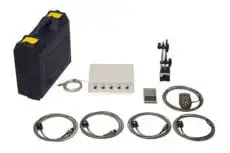
Trim balancing is where a portable two-channel instrument earns its keep, because the work happens on the assembled machine at operating speed rather than on a balancing machine. The Balanset-1A measures the 1× amplitude and phase, stores the influence coefficients from the initial balance, and on a return visit applies them to calculate the trim weight directly — often without any new trial run. Its optical tachometer supplies the phase reference, and a verification run confirms the residual unbalance against the chosen tolerance. Working in the machine’s own bearings, it captures the true installed balance state, including the assembly and thermal effects a shop balance never sees. The trial weight calculator helps size a safe starting weight on the rare occasion a fresh coefficient is required.
5. The Goal: Achieving Precision
The objective of a trim balance is the highest practical precision — bringing 1× vibration down to the lowest achievable level, comfortably inside the limits set by standards such as ISO 1940-1, now folded into the modern ISO 21940-11 series of balance quality grades. To confirm the result against a target grade, you can convert a G-grade and service speed to permissible gram-millimetres with the Residual Unbalance Calculator. This final step is crucial for maximising machinery reliability, extending bearing life, and ensuring quiet, efficient operation.

